
ECI Internal Rift Exposed: Why 14 Objections by Election Commissioners Have Put the Poll Panel Under Scrutiny
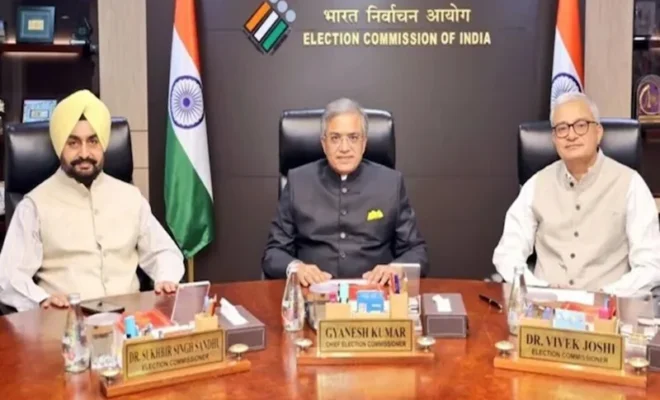
The Election Commission of India is coming under fire again following an investigation conducted by The Indian Express which found that the commissioners of elections Sukhbir Singh Sandhu and Vivek Joshi raised objections to the decisions and orders relating to electoral roll management a minimum of 14 times over 10 months.
These objections were noted as being raised during the rollout of the Special Intensive Revision (SIR) of the electoral rolls which have now become one of the most controversial matters regarding the Election Commission. According to the reports, the objections raised include those regarding voter registration, deletion and restoration of names and form 6 as well as control over the technological support for electoral rolls.
It should be noted that there is also an opposing view. The Election Commission has denied that there is any rift or break within the institution because of the objections as individual observations and objections are a part of institutional deliberations and all the decisions were unanimous.
What Triggered the Controversy?
The dispute is caused by the conclusions made by The Indian Express, which looked into internal communication regarding the three-member Election Commission that consisted of Gyanesh Kumar as the Chief Election Commissioner along with Sukhbir Singh Sandhu and Vivek Joshi as the other two Election Commissioners.
It appears from the investigation that Sandhu and Joshi complained several times about decisions that had been taken without their knowledge and consent. The complaints were supposedly related to the most critical functions of the election commission, which included the addition, exclusion and re-inclusion of voters in electoral rolls.
Therefore, the report has raised a much broader institutional issue: how disputes are settled in an institution, where final decisions have to be made collectively?
Why Form 6 Became an Important Flashpoint
Another one of the areas of disagreement was that of Form 6 which is the statutory application form for those people who seek inclusion in the electoral roll.
It appears that the investigation has revealed the addition of a fresh declaration pertaining to the old SIR electoral rolls. Sandhu and Joshi were said to have expressed concern regarding the change earlier without any amendment to the electoral rules.
The disagreement is important because any change in the registration procedure of voters will have some impact on the ease of voter registration.
The problem therefore does not remain confined to an administrative disagreement but goes beyond to the issue of how the electoral roll procedures need to be framed.
Why the Electoral Database Is at the Centre of the Debate
Another important problem pointed out by the report is the technology that is involved in the management of the electoral roll.
According to the report, the two commissioners mentioned that they were worried about the allocation of duties concerning the IT systems which support the voter database. Apparently, there was a shift in responsibility for some parts of the system and the two commissioners were not aware of the decisions being made.
Afterwards, the two commissioners approached the Cabinet Secretary regarding their worries about the technology and work allocation concerning the electoral roll, according to the report.
This has taken the whole problem to another level because electoral databases include information which is important for the election process.
What is the ECI Saying?
However, there have been indications that the Commission has reacted to such an interpretation of the existence of objections.
According to EC sources, any decision made by the Commission in relation to the SIR, and other issues, received the unanimous approval of all the three commissioners. Objections, observations and technical suggestions were part of the process of decision making.
This is an important point, since an observation made by a commissioner during the process of discussion does not imply that the decision arrived at was rejected by that particular commissioner.
Accordingly, the EC position is that the existence of observations within the institution does not necessarily indicate division of the Commission when it makes decisions.
Why the SIR Exercise Makes This More Sensitive
This controversy arises in the context of the Special Intensive Revision of electoral rolls, which started in Bihar in June 2025 and has since been extended to other parts of the country.
As reported by The Indian Express, the process of deletion has included the deletion of more than 13 crore names from draft electoral rolls of 30 states and Union Territories in India. It is the sheer scale of the process that has put pressure on the Election Commission.
The important point is that being deleted from the draft list of electoral rolls does not automatically imply disenfranchisement.
However, the reason why the electoral-roll revision process has assumed political significance is that this revision itself determines the composition of the electoral rolls.
Why This Has Become a Political Controversy
The objections mentioned above have been met with strong responses from the opposition, who have expressed their doubts about the functioning and credibility of the Election Commission. The opposition leaders have interpreted the incident as a case of too much power concentrated in the office of the CEC.
However, the ruling party sees things differently; they argue that disagreements among the commissioners are normal within the system and cannot be seen as its collapse.
For its part, the ECI has stated that all of the decisions have been made unanimously.
Hence, the main question is not whether the objections had been raised or not; the documentation proves that it was indeed the case, but rather what these objections say about the functioning of the Commission.
Does the CEC Have a Veto?
The controversy has also renewed attention on how decision-making works inside the three-member Election Commission.
The Commission is not structured as a system where the Chief Election Commissioner simply exercises a unilateral veto over the other commissioners. The legal framework provides for the Commission to transact business collectively, with unanimity preferred where possible and decisions taken according to the applicable rules when unanimity is not achieved.
That is why the reported correspondence is attracting attention. If commissioners formally raise objections but subsequently approve the final decisions, the disagreement can remain part of deliberation. If they do not approve a particular decision, questions about the authority and process through which it was implemented become much more significant.
Why This Matters to Voters
From the perspective of the average citizen, what is critical is not who is concerned, but the integrity of the process of preparing the electoral roll.
An electoral list decides if a citizen eligible to vote will be able to participate in an election. At the same time, electoral rolls have to be updated on a regular basis to eliminate duplicate, expired or otherwise ineligible names.
The task of any election commission is, therefore, to find the right balance between accuracy and preventing the unjust exclusion of eligible voters.
It is the objections reported recently which have revived this discussion.
What Happens Next?
The debate will most probably continue to revolve around the actual documents, the decision-making procedure and how ECI justified the way these objections were managed.
The presence of 14 objections makes clear that there was some internal concern. However, the explanation of the ECI offers a totally different view on the concerns, arguing that these were just regular discussions and that all decisions were taken unanimously.
The importance of this incident thus will also depend to a certain extent on how these objections were related to the final decisions made by the Commission.
Conclusion
The reported 14 objections raised by Election Commissioners Sukhbir Singh Sandhu and Vivek Joshi have provided an unusually clear insight into the working of India’s electoral regulator.
The objections included matters ranging from voter enrollment, deletion and restoration of names, Form 6, use of technology and database management in relation to electoral roll.
However, it is important to note that the Election Commission has refused to see these developments as a sign of an institutional crisis, saying that different observations form a part of deliberations and their ultimate decision was unanimous.
This leaves us with the question not just about whether differences did exist, but how these differences were managed.
Key Updates Shaping India’s Politics & Technology
What Changed in Electoral Roll Software?
Check out the concerns raised over proposed electoral roll software changes.
Can ISM 2.0 Transform India’s Chips?
Explore how ISM 2.0 could shape India’s semiconductor ambitions.
Can EVMs Really Be Hacked Wirelessly?
Find out what the ECI says about EVM security and connectivity.
Can India Synchronise Elections Nationwide?
Uncover the proposal and questions surrounding simultaneous elections.
What Was AAP’s UP Election Plan?
Browse the earlier announcement about AAP contesting Uttar Pradesh elections.