The Firecracker Dilemma: Balancing Religious Customs and Urban Public Health
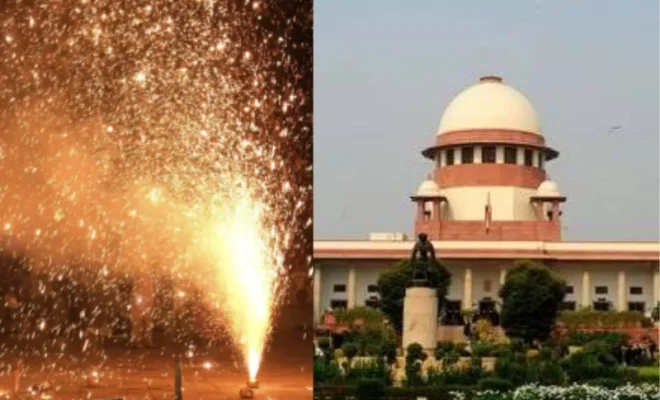
Every year, festivals make India’s cities come alive with light, parties, traditional desserts and fireworks. Fireworks are an important part of most celebrations for children and adults alike. But at the same time, these very festivities pose a serious challenge of how to preserve religious traditions and culture without poisoning millions of people with toxic air pollution and noise pollution.
Usually the conflict is viewed through the narrow lens of freedom of religion vs environmental constraints, but there is much bigger problem at hand. Festivities are something special, but the right to celebrate shouldn’t be a right to make someone else suffocate.
India must adopt a new strategy that takes into account both cultural traditions and health consequences of the matter.
The Public Health Cost of a Few Hours of Celebration
The components of firework are particulate matter (PM2.5 & PM10), Sulphur dioxide, Nitrogen dioxide, and heavy metals such as barium. Such components can further worsen the already existing poor air quality due to pollution from vehicle emissions, industrial pollution, construction sites, and various other sources.
Particulate Matter is among the public health hazards mentioned by the World Health Organization because these components tend to penetrate deep into the lungs and bloodstream.
The latest study published in Scientific Reports in 2026 on 14 cities in the Indo-Gangetic Basin showed that particulate matter levels have been more than three to ten times higher than national and WHO guidelines for 24 hours. It was found that during the festival, 80% of the cities have entered the health risk zone.
The consequences are not distributed equally. Children, older adults, pregnant women and people living with asthma, COPD or cardiovascular conditions face greater exposure-related risks.
Religious Freedom and the Right to Breathe Clean Air
Constitutional implications for firecrackers have equal importance. Article 25 guarantees freedom of religion and practice, subject to considerations of public order, morality, health, and other constitutional provisions. Article 21 gives a right to life that has been judicially expanded to include the right to a healthy environment.
While giving observations on the matter of firecrackers on November 2, 2026, Supreme Court recognized the religious, social, and emotional importance of Diwali and its environmental impact from unrestricted use of fireworks.
Court also observed that usage of firecrackers gained popularity after the discovery of gunpowder, but Diwali celebrations traditionally included lighting of lamps. Observations of court reflect an important point: preserving the cultural significance of a festival does not necessarily mean maintaining all the modern ways of celebrating it.
Religion can change yet still retain its significance.
Are Green Crackers a Practical Middle Ground?
Green crackers have been often introduced as an intermediate option between total ban on firecrackers and their free usage.
Developed with help from the CSIR-NEERI (National Environmental Engineering Research Institute of the Council of Scientific and Industrial Research), these firecrackers make use of certain modified chemical compositions that are intended to cut down emissions.
As per CSIR-NEERI, green crackers are capable of reducing particulate emissions by 30 percent or even higher than that, as compared to other conventional ones, given testing and standards requirements. Nonetheless, reduced emissions do not mean no pollution whatsoever. They can emit noise and cause pollution too.
The real challenge here lies in ensuring compliance. Conventional ones can also be sold in the name of green crackers.
Why Blanket Bans Alone May Not Work
India’s ban on firecrackers demonstrates that announcing the ban and enforcing it properly are two distinct processes.
The Supreme Court was recently concerned regarding whether the complete ban announced in 2024 in Delhi-NCR had been successful in bringing improvement in air quality.
It noted that no adequate amount of evidence had been collected by the authorities that would show the success of the ban.
However, it does not indicate that firecrackers are safe or there is no need to place any restrictions on them. It indicates the need for proper monitoring and assessment of policies in practice.
A More Responsible Way to Celebrate
India should opt for a complete plan against festive pollution rather than depend solely on emergency measures.
First of all, the government must improve its certification and traceability system so that customers can differentiate between green and conventional crackers. Secondly, law enforcement officials need to check manufacturing units, godowns and markets at any time of the year.
Thirdly, residents’ welfare groups and educational institutions can organize collective festivities, lighting in traditional manner and other alternatives. In those places where crackers are allowed, it is important to establish time frames and location for their use.
Finally, air quality measurement should be done before and after festivals. Hospitals can document all cases of emergency connected with pollution in the city.
Preserving Traditions Without Compromising Public Health
The discussion on firecrackers should not escalate into a debate on religion versus environment. Both the issues of cultural rights and public health must receive attention in equal measure.
Diwali can still remain a festival of lights, wealth, and unity without generating too much pollution and commotion. The aim must not be to undermine traditions, but rather to engage in celebrations that make people feel secure.
In the end, the celebration must be recalled for being happy and not for creating a public health crisis. Preserving our environment need not run against our religious beliefs, but complement our communities celebrating them.
India’s Energy, AI, Sports & Tourism Highlights
Why Does India Need Stronger Power Grid Resilience During Cyclones?
Explore the OPED’s take on gaps in India’s cyclone strategy and why protecting power infrastructure matters beyond evacuation efforts.
What Can India’s Three Indigenous AI Models Do?
Discover the new AI models launched under the IndiaAI Mission, including their multilingual processing and computer vision capabilities.
How Does India Plan to Reach 500 GW by 2035?
Explore PM Modi’s non-fossil energy capacity target and the key announcements from the Energy Summit.
What Makes Glenn Maxwell’s Cricket Career Memorable?
Look back at his international career, standout performances, major achievements, and statistics following his retirement announcement.
Why Are Winter Bookings Rising in Himachal and Uttarakhand?
Find out what is driving the reported rise in winter tourism bookings as travellers prepare for the snow season.