
Trump’s Praise for India’s Electoral System: Why Clean Voter Rolls Matter
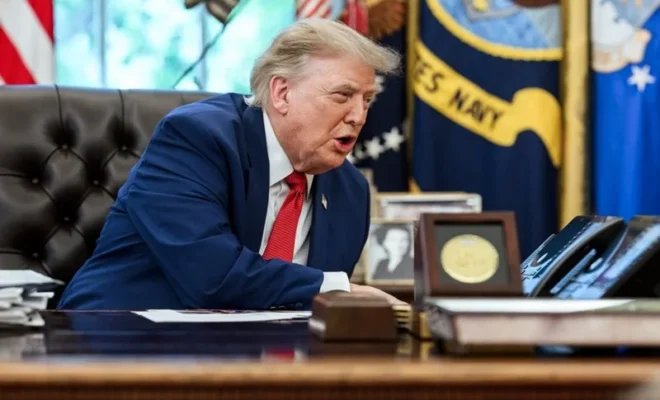
While pointing out India’s voter ID system while advocating for voter identification laws in the United States, US President Donald Trump did not merely shed light on India’s voter ID system; rather, he raised another pertinent issue. That issue is what makes an election credible?
In particular, President Trump spoke about photo identification and mentioned India’s huge number of elections. These comments came after the meeting of Chief Election Commissioner Gyanesh Kumar with US officials recently. President Trump made it clear that the USA should make identification requirements more stringent by considering the Indian example.
This is where the relevance of this comparison does not lie in voter ID, but in the message that is being conveyed here. That message is: An election does not start at the polling station, rather it starts from the voter register.
Voting can only be legitimate if the voter is qualified to vote, the voter’s list is correct, the voters are legitimate, and disqualifications have been detected through a transparent process. This is because clean voter rolls are not just an administrative matter; they form a part of the very basis of democracy.
India’s Electoral Scale Makes Accuracy Essential
The electoral process in India takes place on a scale that only a few other democracies can claim to achieve. Trump was talking about 646 million voters in India’s last general election and highlighting the voter-identification process in the country.
Handling a list of voters like this is indeed a massive undertaking. The people move around in cities, citizens turn eighteen years old and become eligible voters, some voters die, names get changed, addresses get changed, and there could be duplication in the process of registration.
This makes electoral rolls dynamic pieces of paper. These have to be maintained constantly.
An up-to-date list of voters serves two very important purposes; one, deleting irrelevant names from the list and two, preventing citizens who should be registered as voters from being left out by mistake.
The second aspect is as important as the first one.
Why Clean Voter Rolls Matter More Than Political Arguments
However, the debate on integrity in elections usually takes place using the vocabulary of machines, voter IDs, polling stations, and processes. But the most fundamental aspect of all this is much simpler than any of these: who is eligible to vote?
A non-eligible person staying in the electoral register would affect the integrity of the database. An eligible citizen getting deleted from the list would do so directly, as the citizen in question loses the chance to vote in an election altogether.
That is why an electoral roll revision is a very fine art and cannot be considered merely a deletion process.
This has become one of the hot topics following the recent Special Intensive Revision (SIR) of India. The Election Commission has been making systematic revisions of electoral rolls throughout various states, with the aim of finding errors and updating databases. This process has been facilitated by the voter services portal of the Election Commission through which citizens can take part in the process.
Supreme Court also recognized the power of the Election Commission to conduct SIRs as it advances the cause of free and fair elections.
Verification Is the Other Half of Electoral Integrity
The true test of any exercise for revising the electoral roll does not lie in merely deleting so many names from the database. It is whether each deletion is justified and whether every voter whose name is rightfully present in the electoral roll has the chance to prove his/her case against an erroneous deletion.
This is very significant.
For instance, in a recent news report, it was mentioned that 20.66 lakh names have been deleted from the draft electoral roll in the State of Punjab in the SIR exercise. The whole purpose of this exercise is to eliminate duplication, non-eligibility or obsolescence, but any mass deletion exercise gives rise to the apprehension that there may be deletions of names of genuine voters as well.
This apprehension has been felt elsewhere too. High numbers of voters who fall in particular verification categories in the State of Karnataka have led to the apprehension that some genuine voters might be left out, especially in cases where migration is common and change of address is frequent.
Such apprehensions do not affect the basic requirement of cleaning of the electoral roll at all.
The Delhi Experience Shows Why the Process Matters
The SIR being conducted in Delhi is yet another illustration of the need for the proper execution of electoral revision. The Election Commission has made changes in the schedule, putting back the draft electoral roll to August 31 and the final electoral roll to November 4.
The process may take longer, but accuracy will always trump speed.
The citizens have to get enough time to verify their names, react to notices, provide their documents, and point out any discrepancies. Political parties and civil society organizations should also have the capacity to monitor the whole process.
The legitimacy of the electoral roll is based on not just its content but on the fairness of the process of its formation.
India’s Strength Is Also Its Accountability Mechanism
The importance of Trump’s statement is that it involves the Indian electoral machinery in a global discussion on the integrity of elections. The Ministry of External Affairs has reacted by stating that the credibility and efficacy of India’s election machinery is already recognized all around the world.
But credibility of the democratic process should not rely on foreign praises only.
Indian electoral institutions need to be assessed according to independent, open, accurate, accessible and accountable standards.
Which is to say that it needs to take into account the positive aspects as well as the problematic issues of the process.
India has been developing a huge electoral machine to manage the voting of hundreds of millions of people. It also needs continuous modernization and supervision.
Mature democracy should be able to do both.
Voter ID Alone Cannot Guarantee a Clean Election
Voter identification should be distinguished from electoral roll integrity.
Voter identification may help prove that the individual showing up at the polling station corresponds to a registered voter. However, identification at the polling booth will not address all problems in the source database.
If the name of a registered voter happens to be absent from the electoral roll, then the possession of an identity card will not guarantee the right to vote.
Thus, the voter roll is just as crucial as the voter ID.
The US discourse initiated by Trump revolves around identification and citizenship verification. Yet, the Indian example shows that the administrative aspect of maintaining the accuracy of rolls is equally relevant.
The Real Lesson for Democracies
The greatest takeaway that India can provide is not that one specific country’s election system should simply be replicated somewhere else.
Election systems are formed within different contexts of constitutions, administrations and politics.
What holds true for India does not necessarily hold true for the United States or other democracies.
The greater lesson is one that all democracies must learn.
There must be reliable voter registration lists within democracies.
This entails reliable databases, identification, verification process, corrections and oversight.
This lesson also entails avoiding the tendency to regard all errors in administration and any attempt at correcting such errors as evidence of conspiracy and voter suppression respectively.
Both extremes undermine democratic confidence.
Clean Rolls Must Protect Inclusion as Well as Integrity
There is an inherent balance that lies at the very core of electoral roll revision.
It is the balance between blocking those who are not supposed to vote, while not unnecessarily obstructing those who are eligible from voting.
This is especially relevant in cases involving migrants, tenants, elderly voters, first-time voters, or individuals who have had changes in their documentation or address details.
An individual who has relocated needs to be able to register himself or herself. A newly eligible individual should find it easy to get registered. The name of a deceased individual needs to be struck off the roll. Duplicates need to be discovered. Most importantly, a valid voter whose name is unjustifiably struck off needs to have a way back into the system.
That is what a truly cleansed electoral roll is all about.
The Bigger Democratic Principle
It is rather interesting timing for Trump’s compliments to India because India is itself in the process of having a discussion on the accuracy of its electoral roll.
The irony is helpful.
Whereas the United States is trying to decide whether it needs to make its voter ID laws more stringent, India has been facing the equally important question of maintaining accuracy in its vast electoral roll without denying voting rights to any eligible citizen.
Neither of the two discussions must be seen as partisanship.
Both of them indicate one thing: the importance of knowing those who have the right to vote and making sure that their right is not denied.
Conclusion
The relevance of Trump’s remark about the Indian electoral system lies in the fact that it makes Indian electoral administration the focus of international attention. However, the true success of Indian electoral administration cannot simply be determined by how many voters the system handles or how many identity cards it distributes.
Its legitimacy will eventually depend on whether the citizens find themselves able to trust the whole process – right from registration and identification through to voting and tallying of the votes cast.
Clean voter rolls, accordingly, do not consist simply in the deletion of names.
It consists of ensuring the legitimacy of each name on the rolls.
The key aim must be straightforward – no fake voter, no duplication, but also no missing voter.
This is the standard by which electoral administration can be transformed into a bulwark of democracy.
Discover the latest stories shaping science, technology, business, and India.
Could Satellites Unlock The Early Universe?
Dive into how a miniature spacecraft could reveal secrets of the early cosmos.
Why Is Meta Facing India’s Scrutiny?
Find out what the summons could mean for social media regulation and internet freedom.
Can ₹1 BSNL SIMs Change Telecom?
Check out BSNL’s Freedom 2.0 offer featuring unlimited calling and 24-day validity.
Which New EVs Are Coming Soon?
Browse upcoming 2026 electric cars, their expected ranges, prices, and launch timelines.
How Will Tata Power Advance Renewables?
Uncover how Tata Power and IIT Bombay are advancing renewable energy research and digital innovation.