One Nation, One Election: Can India Synchronise Polls Without Diluting Democracy?
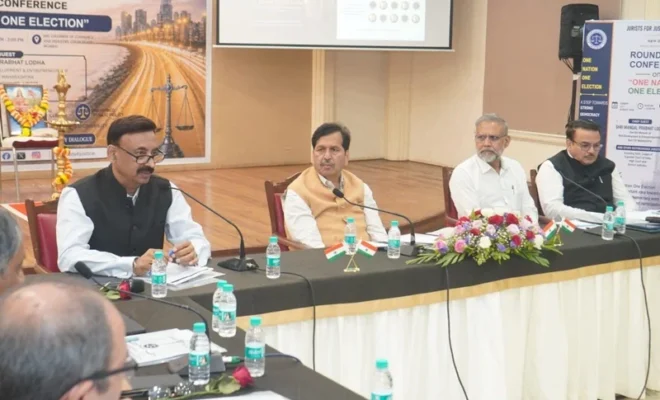
Discussion of “One Nation, One Election” in India is no longer a matter of academic interest concerning calendar of elections. It is now firmly entrenched in the realms of constitution-making, federalism and the practice of parliamentary democracy.
Proponents of ONOE talk of an India with less electioneering and more governance. They argue that holding repeated elections entails tremendous cost in terms of money and administrative efforts, puts into effect the Model Code of Conduct and forces the governments and political parties to focus on election campaigns rather than governance. Opponents of ONOE contend that elections are not a mere inconvenience but the means for holding the government accountable to its citizens. They warn that synchronizing elections may lead to the prioritization of national narratives over those of states and create an unfair advantage for national political parties.
This is the real issue here. The feasibility of ONOE should not be assessed only in terms of technical possibility of holding simultaneous elections in India. This should be done by evaluating whether simultaneous elections in India will not destroy the constitutional equilibrium between the Union, the states and the citizen.
The Idea Is Not New to India
In fact, India has seen simultaneous elections being held before. Lok Sabha elections and state assembly elections have taken place simultaneously for the first decades after independence starting from the first general elections of 1951-52 and lasting generally until the disruption of the electoral cycle in the late 1960s.
The idea now is to revive the concept of a synchronized electoral cycle but India’s political and constitutional structure is much more complex than ever before. There are 28 states, several Union Territories, strong regional parties and governments that could fall before completing their full term.
The problem thus is not simply to choose a common polling day. The problem is to design a constitutional device that would accommodate uncertainties in politics without making one elected legislature dependent on the life of the other.
Proposal of the Kovind Committee
High Level Committee under the chairmanship of the former President of India, Ram Nath Kovind submitted its report in March 2024 after consulting widely on the subject.
In other words, the proposal calls for simultaneous elections to Lok Sabha and state assemblies to be the first step, followed by synchronised local government (municipality and panchayat) elections to take place within 100 days of national and state elections.
It also addresses one of the biggest challenges: what happens in case a government falls before the end of its natural term?
The committee proposes constitutional safeguards that will allow preserving the bigger cycle of synchronised elections in case of premature dissolution of any government and not resetting the whole national cycle every time an election takes place in the middle of government’s natural term.
This is when the debate acquires much more important dimension.
The Most Important Argument in Support: Good Governance Without Permanent Elections
Proponents of ONOE make a powerful practical case in favour of the idea.
India finds itself in a permanent election situation. Different states conduct elections at different points of time, which results in political parties conducting elections one after another.
The Joint Parliamentary Committee, now considering the constitutional amendment, pointed out the negative impact of constant elections on governance, education, economy, public spending and industrial activities. When the JPC considered the matter in 2026, it specifically cited examples of elections being held during peak tourism seasons in Goa, and their negative effect on industry due to mass labour migrations.
The expense of frequent deployment of security personnel, polling staff, vehicles and other administrative infrastructure cannot be ignored either.
The point here is not that elections are bad. The point is that the process of democracy should not be perpetually in campaign mode.
Elections can be synchronized and governments could actually spend longer periods of uninterrupted time implementing policies. Bureaucracies would be disturbed less often by election duties, parties would spend less often money on campaign preparations, and voters would know exactly when to vote.
It is a serious point that cannot be simply waved off due to political controversy around ONOE.
But Democracy Is Not an Administrative Inconvenience
Counterargument is equally essential.
In a parliamentary democracy, governments are supposed to be responsible to legislatures. An ousted government does not have any justification to assert itself of five-year fixed-term irrespective of the political situation.
It brings out the basic problem of ONOE – what happens in case political reality doesn’t follow electoral timelines?
In case the state government is ousted mid-way through the five years, the electorate cannot be asked to just wait for the next general election cycle. Similarly, in case the Assembly is dissolved and another election takes place, the newly formed government may get reduced or increased term just to achieve synchronization.
The issue at stake here is whether the convenience of electoral politics is taking precedence over the right of electorate to elect a government which can serve a real constitutional term.
The above-mentioned question isn’t a mere conjecture since it forms the very basis of the present parliamentary consultations. The discussions on the issues like mid-term elections, premature dissolution and continuation of the remaining tenure of the legislature are also taking place along with federalism and Basic Structure Doctrine.
The Federalism Question
Undoubtedly, one of the strongest objections raised on constitutional grounds involves the federal character of India.
The simultaneity of the elections ensures the existence of a common political time when the national and state elections occur at the same time. There is a fear that the national campaign, national leadership and national issues may overshadow everything else.
When a person comes to cast his/her vote, he/she will vote for the Lok Sabha candidate and MLA at the same time, however, these two elections are concerned with the respective government, responsibilities and often the different political issues.
The problem is not about whether voters are unable to differentiate between the two types of elections. Indian voters have proven many times that they are able to tell the difference between national and state elections.
The problem is in whether the simultaneous campaigning will complicate the process of differentiation.
A single election held throughout the country will provide huge opportunities for parties with better organizational skills and higher campaign capacity. Regional parties will feel themselves overshadowed by national issues and narratives.
Thus, this problem cannot be limited by the issue of preserving the formal power of states within the Constitution. The existence of the political space for regional issues and representation is also an important part of federalism.
As stated in the article from the Indian Express, the synchronization of state legislative terms to the Parliament’s term is questionable because the federalism is regarded to be an essential part of the basic structure of the Constitution.
The Presidentialisation Risk
Apart from the issue of democracy that merits investigation, there is another problem regarding the indirect presidentialisation of a parliamentary election.
It was a conscious decision of India to adopt a parliamentary system where the government is dependent on legislative confidence. Neither the Prime Minister nor the Chief Ministers are elected directly in a presidential form of government.
However, when there is simultaneous election for national and state positions, the election campaigns may get dominated by national figures, while the people may evaluate governments at various levels of authority under one political prism.
Though, it does not mean that ONOE will automatically change India into a presidential form of government; but the possibility of nationalizing every election deserves attention.
Thus, the strategy of conducting simultaneous polls should take into account the preservation of visibility of state-level political choices.
Will Simultaneous Elections Cut the Costs?
The economic argument sounds convincing, but it needs more proof than only slogans.
There will definitely be some savings due to fewer election processes in terms of administrative preparations, security measures and campaign activities.
But the simultaneous polls will need huge organizational efforts as well since it is important to have enough voting machines, VVPAT devices, people and security forces, as well as appropriate infrastructure for the conduct of the process all around the country.
Therefore, the question about the financial benefits of the process should be formulated as net savings over the election cycle, rather than assumption that synchronization is an economical factor by itself.
There is another cost which is difficult to calculate, but it exists – the cost of losing electoral accountability.
The Strongest Case for ONOE Is Reform, Not Convenience
The strongest argument for simultaneous elections is not that elections are irritating and expensive.
It is that democratic systems should be made to ensure stable governance while retaining adequate accountability.
If ONOE can enable longer periods of governance without denying people the ability to remove governments that have lost legitimacy, ONOE should be seriously considered.
However, if the synchronization process involves the artificial manipulation of the tenure of the governments to lengthen or shorten the tenure, control of the consequences of legislative instability and making state politics subservient to national election cycles, then the constitutional cost of such a system is difficult to justify.
It may thus be that ONOE should be considered through developing a model that will have democratic safeguards.
What Safeguards Would Make ONOE More Viable?
Any viable ONOE model must clearly provide for what happens when a government falls.
It must also secure the constitutional power of the state legislatures and guarantee that the state election remains separate from the Lok Sabha election as well as make the electoral schedule devoid of any possibility of prolonging the tenure of the government.
The Election Commission will have to enhance its logistics capacity, and the Parliament will have to set up clear guidelines on the premature dissolution of the elected government, the caretaker government and replacement government tenure.
Most importantly, there should be political legitimacy.
Thus, the consultations held by the current Joint Parliamentary Committee across the country are critical.
The issues brought out in the 2026 consultations are indeed those that should be sorted out first.
The Democratic Test
However, it is important to move away from two oversimplified extremes – that ONOE will automatically turn India into a better-run democracy, or it will inevitably kill the federal system.
Neither of these views provides a satisfactory solution.
First of all, simultaneous elections might reduce some administrative costs and allow more time for the government to work without worrying about upcoming elections.
On the other hand, there is a number of important challenges which the proposed reform raises regarding federalism, accountability of the parliament, regional representation and relations between national and state mandates.
The question, thus, should not be whether “Can India have one election?”
India is definitely capable of holding huge-scale elections.
What the country actually faces is whether “Can India have synchronized elections without synchronizing its democracy?”
This difference is crucial.
India’s democracy is based on the ability of voters to make different decisions in various layers of government – one may choose a particular party to lead his state, and another one to lead the nation. This possibility is not a flaw of Indian federalism; it is one of its advantages.
Conclusion: Synchronize the Electoral Calendar, Not the Choice
“One Nation, One Election” can work in India, but only as a constitutional reform, not as an administrational trick.
The task is to eliminate unnecessary electoral disruptions without reducing the efficiency of democratic process and frequency of elections. India needs stable government, but stability cannot mean immunity from political responsibility. India needs efficient elections, but it cannot be the overriding principle of the constitution.
In this respect, the current parliamentary review of ONOE can serve as an opportunity to refine this proposal, not as the end of discussion. The committee’s consultations on premature dissolutions, federalism, elections management and constitutional limitations of the reform demonstrate its significance.
With such safeguards the reform might become an important electoral reform.
Without these precautions, the effort to synchronize electoral calendar might unintentionally damage the democratic flexibility which was a driving force of Indian federalism for decades.
The goal of ONOE is not to hold one election for the whole nation. The goal is to hold one electoral system which would take care of many nations’ voices.
Explore the latest developments shaping India’s electoral future and regional security.
How Would One Nation One Election Work?
Check out how the proposal could reshape elections and State Government powers.
Could One Nation One Election Transform India?
Uncover how simultaneous elections could transform India’s electoral landscape.
Who Will Lead The Election Committee?
Find out who could head the committee overseeing One Nation, One Election.
When Will Simultaneous Elections Begin India?
Track down India’s plans to initiate simultaneous elections nationwide.
Why Is Taiwan Expanding Its Defense Budget?
See how Taiwan’s record defense budget responds to rising cross-Strait tensions.