
India-OPEC Energy Summit: Hardeep Puri Pushes for Fair Pricing and Supply Stability
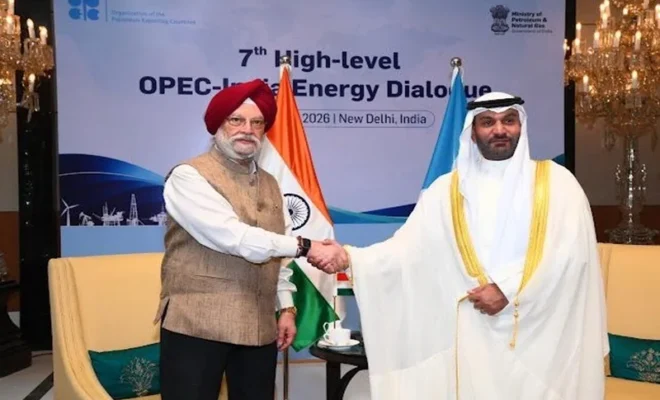
India and the Organization of the Petroleum Exporting Countries (OPEC) have renewed their focus on energy security, oil-market stability and reliable supplies as global energy markets face heightened geopolitical uncertainty.
The seventh High-Level Meeting of the OPEC-India Energy Dialogue was held in New Delhi on September 22, 2026, and was co-chaired by Union Petroleum and Natural Gas Minister Hardeep Singh Puri and OPEC Secretary General Haitham Al Ghais. The discussions covered short-, medium- and long-term oil-market outlooks, energy security and the need for adequate and timely investment across the oil industry.
For India, the discussion is particularly important because the country remains one of the world’s major energy consumers while relying heavily on imported crude oil. Puri emphasized that India and OPEC have a mutually beneficial relationship and called for closer cooperation to create a balanced, stable and predictable global energy market.
What Did Hardeep Puri Say?
Hardeep Puri noted that constant discussion among oil-producing and consuming countries is crucial amid the current challenges facing energy markets.
“As one of the fastest-growing large economies, India will be one of the driving forces behind the global energy demand in coming decades,” Hardeep Puri stated during the meeting. “It is clear that ongoing discussions between oil producers and consumers will be necessary for further investment, energy security, and supply reliability.”
Such a statement corresponds to India’s status as an oil-consuming country. In order to secure the supplies from the producing countries at reasonable prices without any significant inflation or transportation pressure on consumers, it is necessary to guarantee decent income for the producers.
Why Fair and Predictable Oil Pricing Matters for India
Oil prices affect India’s economy in a direct manner as crude is an important ingredient for the functioning of transportation, manufacturing, aviation, petrochemicals, and many more industries.
If international crude prices rise drastically, then the repercussions may go beyond just petrol and diesel. Increased costs of energy may lead to increased costs of transportation and production of goods.
It is for this reason that India has always stressed upon the balance of interests between the producer and consumer. Earlier, an official statement by the Indian government about its energy policy has made a mention about the need of the hour being oil prices at such reasonable levels so that producers benefit and there are no prices that force consumers into looking out for other sources of fuel.
During the last OPEC-India dialogue, Puri emphasized on the general principle of maintaining a balanced and predictable energy market.
Why Supply Stability Has Become a Bigger Concern
Timing is important in the context of the meeting as well. Currently, global oil markets are experiencing considerable uncertainty due to the geopolitical situation in West Asia and problems with energy trade routes.
In recent reporting, the effect of the conflict on oil supply and shipment through the Strait of Hormuz has been emphasized. In addition, Brent crude prices are trading above $100 per barrel amid concerns about oil supply. Thus, as one of the top importers of oil in the world, India needs access to crude from different sources for energy security reasons.
Data analysis revealed that the crude oil supply composition for India is changing recently. Russian oil was India’s top source of oil in August 2026, although Russia’s oil imports declined by 16.5% to approximately 2.1 million barrels per day, and Indian oil refineries are purchasing more oil from other sources.
India Wants a Stronger Producer-Consumer Dialogue
The latest round of discussions has also confirmed India’s inclination towards keeping up with a direct dialogue with the oil-exporting nations.
According to Puri, the dialogue between India and OPEC and its member nations is important for India since through the dialogue process, there has been better cooperation and understanding about energy-related issues.
India is also becoming more significant for OPEC. As per the OPEC Secretary General Haitham Al Ghais, it is important for the organization to dialogue with India since the nation will be gaining significance in the global energy map. The OPEC-India Energy Dialogue began in New Delhi in 2015 and has completed 11 years now.
This is because India requires energy that is both reliable and affordable, while producers require continued access to one of the world’s rapidly growing major oil markets.
Investment Is Another Major Focus
However, the debate was not restricted to the present oil prices alone. In addition to this, both the parties talked about the need for proper and prompt investments across the oil sector.
This is vital since constant investment is needed in the oil sector to ensure the availability of reliable sources of energy.
When there is insufficient investment to meet the future demand, supply shortages can arise in the future despite the current market conditions being fine.
Consequently, Puri related the issue of investments to the theme of energy security and reliable energy supply, explaining how continuous cooperation between oil producers and consumers would facilitate this infrastructure.
Message of OPEC to India
Like in the case of the message about cooperation above, the message of OPEC to India also concentrated on the issue of cooperation.
Al Ghais applauded India for its realistic, pragmatic and balanced energy policy.
Further, he said that many of the concerns of India about energy are shared by OPEC too.
One such concern is the aspect of diplomacy and international cooperation to deal with global issues, especially through dialogue.
What This Means for Indian Consumers
The talks between OPEC and India does not necessarily imply that prices of petrol and diesel are bound to go down after this talk. The global price of crude is dependent upon various factors such as global supply, demand, geopolitics, foreign exchange rates, logistics and production choices.
However, this talk is very significant as India needs to maintain a good relationship with energy-producing countries in order to ensure the energy security of the country.
With India anticipated to be one of the major sources of energy demand in the world, the continuous communication between producers and consumers may prove significant to counter future shocks to the energy supply.
The seventh round ended with both sides agreeing on the significance of energy cooperation. It was decided that India and OPEC will have the eighth High-Level Meeting of the OPEC-India Energy Dialogue in Vienna, Austria at a mutually convenient time.
Conclusion
The India-OPEC Energy Dialogue in recent times takes place in a scenario where there is an immense challenge for energy security due to geopolitics, supply and change in demand.
The key point in the message conveyed by Hardeep Singh Puri is continued dialogue between producers and consumers, investments and energy security and availability. India wants to promote economic growth and make sure that energy remains available and affordable for the consumers.
It becomes clear why India’s association with oil producing countries is of great significance even as it diversifies its sources of energy.
BRICS, Diplomacy & India’s Global Agenda
Why Is India Rejecting BRICS Currency?
Check out India’s position on a common BRICS currency amid tariff concerns.
What Happened At The BRICS Summit?
Find key developments from the 18th BRICS Summit in New Delhi.
Why Are Russia-Iran Talks Important?
Uncover the key issues surrounding Russia, Iran, oil prices, and supply chains.
What Is India’s Central Asia Strategy?
Browse key developments involving India, Uzbekistan, uranium, and the SCO agenda.
What Is Sitharaman Discussing In America?
Explore the G20 finance meeting and investor-focused agenda surrounding her US visit.