
ECI Internal Row: Election Commissioners Object to Electoral Roll Software Changes Ahead of Polls
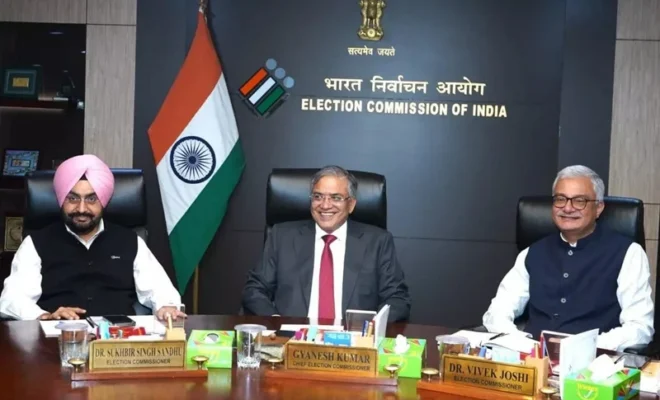
A new internal conflict within the Election Commission of India highlights the issue with India’s electoral rolls management system. An inquiry published by The Indian Express on September 23, 2026, states that the Election Commissioners Sukhbir Singh Sandhu and Vivek Joshi have filed at least 14 objections in the last ten months against certain decisions related to voter registration, deletions, appeals and access to the electoral-roll database.
The issue is especially controversial since it is reported that the reason for the objections lies in the technology and procedures employed to manage the voters’ register. The two commissioners made objections against amendments to Form 6, access to electoral-roll software for statutory officers, and a slow centralization process of the voters’ database.
Yet, the Election Commission insists that there is no crisis within the institution, and that all the decisions, including Special Intensive Revision, were approved by all three commissioners.
What Is the ECI Electoral Roll Software Dispute?
At the heart of this controversy lies the digital infrastructure utilized for keeping track of India’s electoral rolls. Electoral Registration Officers (EROs), or the statutory officials whose duty it is to compile and update the voter lists for their constituency, are of crucial importance.
According to the investigation conducted by The Indian Express, the two Election Commissioners were in doubt as to whether the EROs had enough access to the electoral-roll database, given that the ECI more and more relied on centralized digital infrastructures such as ERONet and its successor ECINet.
In May, Joshi raised his concerns regarding what he defined as the “gradual centralization” of the database in question and advocated the conduct of the audit in order to make sure that any modifications can be done only by authorized statutory officials. Sandhu expressed his worries along the same lines, saying, among other things, that there were reports of state level election officials lacking full access to ERONet.
It is important, because the management of electoral rolls is performed within a decentralized administration structure.
Why Did the Commissioners Object to Form 6 Changes?
Form 6 is the application through which eligible citizens apply for their registration as voters. In accordance with the findings of the study, a new question has been added to the form in July inquiring if the applicant or his/her parents or grandparents have registered themselves in the Electoral Roll as a result of the Special Intensive Revision exercise.
This addition was said to have caused controversy within the Commission. As per the report, Vivek Joshi had cautioned in May that the form cannot be changed in such a way without an amendment to the related rules, and later Sandhu referred to the alteration as being ‘unauthorized and illegal.’
The importance of the conflict is due to the fact that Form 6 is related to the voter registration process.
What Does Centralisation of the Voter Database Mean?
The key question posed by Sandhu and Joshi was not about whether the use of software was to be made or not. The use of digital mechanisms has long been a significant aspect of elections management.
What the problem posed by Sandhu and Joshi was, as per the reports, the question about who actually had the capacity to alter the electoral roll data.
According to convention, the electoral roll in respect of a constituency was supposed to be maintained by the statutory authorities. The two commissioners questioned whether centralised management through the ECI’s IT network would affect the capacity of the state/constituency level officers to do their job as defined by election laws.
Joshi suggested an audit of the system to check whether there was any person other than the statutory authorities which had the capability to alter the electoral roll data.
What Happened in Goa?
One of the most tangible examples presented through the investigation is the case of Goa.
In the course of the electoral-roll revision, it was reported that Electoral Registration Officers looked into cases where the software flagged “logical discrepancies” of the voters under consideration. These logical discrepancies may be defined as mismatches between data entered in the current electoral record and the old one, including mismatching names, ages and relationships.
It was stated in the report that EROs of Goa identified 97 individuals who were allowed to stay in the electoral roll after taking into account the documents provided by the voters. However, there was no way for the officers to mark their decision until the final electoral roll was created.
This example is important as it represents the wider problem put forward by the commissioners: whether the software is intended to aid decisions made by statutory officials or, on the contrary, the limits of the software make such decisions impossible to implement.
What Is the West Bengal Connection?
West Bengal has now become another critical part of this controversy owing to the extent of the Special Intensive Revision that was held there.
According to the report filed by the Election Commission, 27.16 lakh voters were struck off in the process, while more than 22 lakh of these voters have since appealed for their reinstatement. It stated to the Supreme Court that 38.31 lakh appeals had been filed in total, including the ones filed to remove others from voting lists.
The Indian Express investigation suggests that Sandhu raised concerns regarding the process of filing appeals in the case of retaining voters. He is said to have enquired as to who had authorized these appeals and who had lodged them, and that he or Joshi or the Chief Electoral Officer of West Bengal had not been made aware of it.
Why Is This Important Ahead of Future Polls?
The debate arises at a time when electoral roll correction has become one of the most watched topics in election administration in India.
Voting lists are what decides the participation in elections, and the integrity of the electoral databases becomes a vital part of the electoral process.
It is not proven by this controversy that any manipulation of the elections occurred or any intentional modification of the voters’ data. This is another question that needs evidence to be proved.
What can be concluded from the present controversy is that two out of three Election Commissioners raised several formal complaints regarding some procedures in the electoral roll.
What Does the Law Say About Decisions Inside the ECI?
The Election Commission is a constitutional authority created through Article 324 of the Constitution. The institution comprises the Chief Election Commissioner and other members of the Commission.
The 2023 law on the appointment and terms of service of the Commissioners states that, as far as practicable, all business of the Commission shall be transacted unanimously. Where Commissioners hold different views, the law provides for majority opinion to prevail.
The objectionable conduct thus creates a structural issue about how decision-making in election administration takes place where Commissioners hold opposing views.
What Has the Election Commission Said?
The Election Commission of India has rejected the reading of the reported differences as constituting a breakdown in its institution.
According to the reported accounts of the crisis in the institution, the ECI maintains that the decisions regarding procedures like the Special Intensive Revision were made with the agreement of all three commissioners.
This is significant, given that the allegations reported by The Indian Express relate to issues regarding internal disagreements and objections, while the ECI rejects the overall narrative of the institution being faced with such a situation.
Therefore, the reported accounts provide us with two elements, which should be separated.
How Has India’s Election System Evolved?
Could CJI Exit Change Poll Appointments?
Check out what the proposed change could mean for election officer selections.
Why Did Supreme Court Question Goel’s Appointment?
Find out why the Supreme Court examined Arun Goel’s appointment process.
What Could Replace Colonial-Era Laws?
Uncover the laws proposed for replacement during Parliament’s winter session.
Can One Nation Synchronise All Elections?
Explore how simultaneous elections could affect India’s electoral system.
Will AAP Contest Uttar Pradesh Elections?
Look into AAP’s plans for the Uttar Pradesh Assembly elections.
What Happens Next?
The emphasis at first is sure to stay on how electoral roll software is managed, what access there is to the databases of voters and how the decisions of Electoral Registration Officers are logged in the central system.
The scandal also brings up wider concerns about transparency and accountability in the ever-growing digital nature of election administration. With more processes of voter registration and roll management happening online, access and control rules will become more relevant.
The key for voters is clear-cut: eligible citizens need an effective way of registering themselves, checking their data, amending it and appealing decisions affecting their voting rights.
Conclusion
However, the dispute between the ECI members is more about the management of voter database in India rather than an update of a software. Allegations made by The Indian Express are quite serious, but they should be differentiated from those stating that the results of elections have been affected. From the information provided, it can be concluded that Sukhbir Singh Sandhu and Vivek Joshi, members of the Election Commission, complained on the administrative issues regarding electoral roll while the ECI denied any institutional crisis.
Given the increasing digitization of the elections, the question of decentralized authority, software control and institutional oversight will continue to exist.