PM’s Principal Secretary Warns: Why Fragmented Alliances and Tech Dependence Could Test India’s Growth Story
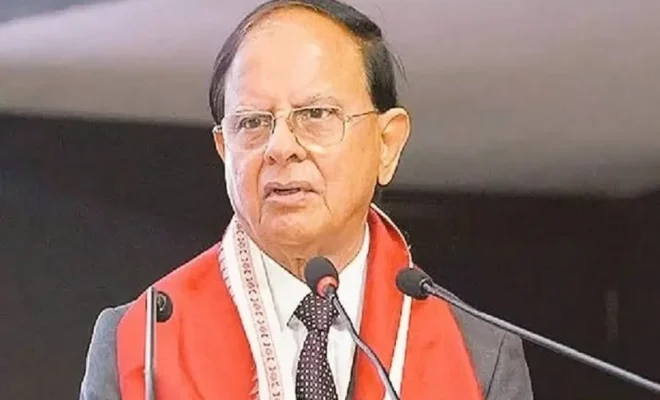
India needs to prepare for a world where global alliances are becoming less predictable, supply chains are increasingly vulnerable and technology is becoming a strategic tool, Prime Minister Narendra Modi’s Principal Secretary Pramod Kumar Mishra said at the 13th SBI Banking and Economics Conclave in Mumbai on September 23, 2026.
Mishra identified fragmented global alliances, import dependence, pressure on external accounts and the rapid development of artificial intelligence as four major risks facing India. His remarks come at a time when global trade is being reshaped by geopolitical tensions, higher trade barriers and efforts by countries to secure critical supply chains.
The larger message was that India cannot assume that favourable global conditions will continue indefinitely. The country needs to strengthen its domestic capabilities while remaining deeply connected to global markets.
Mumbai, Maharashtra: On the '13th Banking and Economics Conclave 2026', SBI Chairman CS Setty says, "… Over the past 13 years, the SBI Banking and Economics Conclave has grown into a valued forum where policymakers, regulators, business leaders, economists and other… pic.twitter.com/d7deZFowde
— IANS (@ians_india) September 23, 2026
Why Fragmented Global Alliances Are a Concern
According to Mishra, there is an increasing level of fragmentation in the international economic environment. This is attributed to the increasing reliance on the concept of strategic supply chain management and the revival of tariffs and non-tariffs in international trade.
This warning is important since India’s economy growth is becoming increasingly dependent on international trade, investment, and manufacturing networks. In case countries start reworking their supply chain management based on geopolitics rather than economic efficiency, the accessibility of markets, technology, and financing will be determined by geopolitical relations.
India must not rely on favorable trade environments since it should have sufficient capacity within itself to maintain its resilience in case there is a shift in the international environment.
India’s Import Dependence Is Another Major Risk
Secondly, the matter of India’s import dependence has been raised in the statement made by the Prime Minister’s Principal Secretary.
According to Mishra, India has a considerable merchandise trade deficit, and the need for manufacturing products that could compete was stressed.
As per reports in Business Standard, India’s merchandise trade deficit increased to $147.09 billion in the four months from April-August FY2026-27 as against $123.88 billion in the corresponding four months last year.
It should be noted that the problem goes beyond simply substituting Indian manufacturing for imported products. The point is manufacturing goods that would be competitive internationally from the standpoint of cost, quality, and technology.
From Make in India to Design, Innovate and Lead
Moreover, Mishra emphasized that manufacturing should not be the ultimate aim of India’s economic aspirations.
According to his statements, India requires taking an additional step towards greater value addition within the country, better components ecosystems, design capabilities, intellectual property and Indian brands competing in the global market. The overall process is described as progressing from “Make in India” to “design in India, innovate in India and finally lead from India”.
It signifies a shift in the focus from the increase of production capacity to the formation of stronger capabilities in the national economy.
India needs to develop its components ecosystem, rather than just increasing manufacturing capacity in order to capture more economic value created in the course of production.
Technology Dependence Is Becoming a Strategic Issue
Another key issue raised by Mishra was that of artificial intelligence. The fast progress made in AI has impacted the geography and organization of manufacturing, while posing new dilemmas in terms of technological dependency.
For India, there is a huge potential since it has a huge workforce that deals with technology, a growing digital infrastructure, as well as a vast domestic market. At the same time, for India to become one of the technological superpowers, it should be more than just importing other countries’ technologies or providing some services around those technologies.
Instead, what India should do is create its own capability when it comes to essential technologies and make sure that Indian companies will be able to generate intellectual property and platforms competing on the global stage.
In light of what Mishra said, we thus see how AI is embedded into much larger conversations about economic resilience. Technology is not only an efficient instrument anymore since access to certain technologies can affect manufacturing, trading, investments, and even national economy.
Why Supply Chains Are Becoming a Strategic Weapon
One of the sternest cautions issued by Mishra was on the new dynamics of global supply chains, which according to him is turning into a tool of strategy and where capital is turned on and off depending on the dynamics of geopolitics.
This implies that resilience and strategic security are now becoming increasingly more factors in addition to cost that determine the location of production.
The fact that supply chain disruptions can open up vulnerabilities is one side of the story, while the other is that the search for alternative locations for production will offer new opportunities to India.
According to Mishra, there is a possibility for India to play a significant role in production and innovation amid the restructuring of global supply chains.
What India Needs to Build
The reaction of Mishra focuses on the development of productive capabilities domestically while remaining open to global investments and business.
The improvement of manufacturing capabilities, human capital, foreign direct investments and economic competitiveness should be achieved simultaneously. There is also an important aspect related to the improvement of financial system in order to facilitate development of companies capable to produce next generation of goods and technologies in India.
The aim thus is not isolation from global economy but the development of capabilities in global economy.
It would enable the country to become involved in international supply chains in a stronger position instead of relying too much on imported components, technologies or capital.
Why This Warning Is Important for India’s 2047 Vision
Mishra’s warning can be connected to development ambitions of India as well. He suggested that GDP size cannot be the only indicator of India’s 2047 vision.
A bigger picture is about becoming more productive, innovative, technologically advanced, economically sophisticated and globally competitive.
Resilience becomes a very important element in the strategy of growth. Even a larger economy remains vulnerable in case of the dependence of critical technologies, components, energy or capital on external conditions.
Conclusion
The caution by Principal Secretary to PM, P K Mishra, comes at an important time for the Indian economy. While globalization is here to stay, the nature of its participation by countries is changing.
A multiplicity of alliances, vulnerability of supply chains, increase in trade restrictions, import dependence, and quick evolution of artificial intelligence is making the economic world order complex.
In such a scenario, for India, the path to move forward involves the development of indigenous capabilities without being closed to the international world.
Is India Ready for Its Next Growth Wave?
Can Upstox Win Back New Investors?
Check out the challenges shaping Upstox’s next growth phase.
Can India Turn Patents Into Innovation?
Uncover why patent filings alone may not drive innovation.
Could ISM 2.0 Transform India’s Chips?
Find out how ISM 2.0 could shape India’s semiconductor ambitions.
Can Quick Commerce Rewrite India’s Rules?
Explore how rapid delivery growth is raising new social questions.
Will India’s Growth Reach Everyone?
Look into whether economic growth could translate into broader gains.