
PM Modi in Central Asia: Inside the India-Uzbekistan Uranium Deal and SCO Summit Agenda
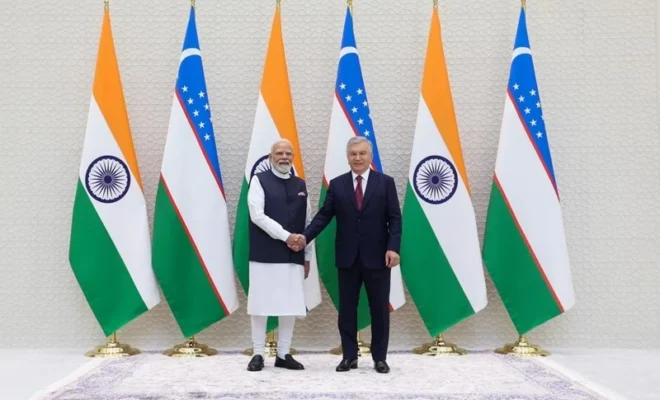
Prime Minister Narendra Modi’s ongoing Central Asia visit has emerged as an important diplomatic push for India, combining a major upgrade in India-Uzbekistan relations with a significant nuclear-energy agreement and India’s participation in the 26th Shanghai Cooperation Organisation (SCO) Summit in Bishkek.
Modi’s four-day visit to Uzbekistan and Kyrgyzstan, from August 29 to September 1, comes at a time when energy security, critical minerals, regional connectivity and geopolitical stability have become increasingly important for India. The Uzbekistan leg has already produced a major outcome: India and Uzbekistan have announced a long-term arrangement for uranium supplies, while elevating their bilateral relationship to a Comprehensive Strategic Partnership.
India-Uzbekistan Ties Get a Strategic Upgrade
The most notable political achievement following Modi’s visit to Tashkent was India and Uzbekistan’s decision to promote their relations to the level of a Comprehensive Strategic Partnership.
This step not only implies that traditional diplomatic links between India and Uzbekistan will be maintained but that other areas of cooperation will be strengthened such as trade, investment, energy, critical minerals, healthcare, defense, technology, agriculture, and cultural cooperation. The countries have also set themselves a goal of reaching $5 billion worth of bilateral trade by 2030, thus showing that they are ready to develop their economic ties even further.
For India, it is especially important to cooperate with Uzbekistan due to the geographical proximity of this country to the center of Central Asia, and thus it will provide one more channel through which the country can expand its influence in the region which becomes more competitive by the day.
What Is the India-Uzbekistan Uranium Deal?
One of the major outcomes of Modi’s trip to Uzbekistan was the long-term deal regarding uranium supplies agreed upon between the two nations.
During the meetings with the President of Uzbekistan Shavkat Mirziyoyev in the Kuksaroy Presidential Palace in Tashkent, India and Uzbekistan signed the long-term agreement regarding the supplies of uranium to India. The significance of the agreement lies in the fact that uranium is used to produce nuclear energy, and India aims at expanding the number of nuclear power plants that they have.
From India’s perspective, the agreement is not only about gaining one more source of natural resources but about strengthening the entire fuel supply chain needed to operate the growing number of nuclear facilities in India in order to increase production of low carbon emissions electricity.
India has very serious plans regarding the expansion of nuclear energy capacities, which makes uranium supplies essential for India. The recent reports reveal how much India will have to invest into reaching its goals in this sphere.
Why Uranium Matters for India’s Energy Security
The demand for energy is growing due to the development of the country’s industries, urbanization and economic growth. The share of solar and wind energy in the country’s electricity production is increasing rapidly. However, these energy sources depend on weather conditions and the time of day.
Another benefit offered by the use of nuclear power plants is the constant generation of electricity while providing minimum operational emissions of carbon dioxide.
Thus, cooperation with the country which provides the uranium needed can increase India’s energy resilience. In this sense, Uzbekistan as a country producing uranium becomes one of the sources of uranium for the building of India’s diversified nuclear-power energy system.
Therefore, the agreement becomes a part of the economic cooperation between the countries regarding the geological resources, mining and critical minerals.
Critical Minerals Become the Next Strategic Frontier
Uranium is not the only type of resource considered within the discussions of the two countries’ leaders.
India and Uzbekistan have also agreed to enhance cooperation in geological resources and mining, including critical minerals as well. Such types of resources become more and more important in the production of electric vehicles, batteries, electronics, renewable energy systems, defence technologies and manufacturing technologies.
India’s relationships with resource rich Central Asian countries can help to diversify India’s geographical sources of resources. Thus, it becomes important for India’s strategy not only in terms of energy but also in terms of other spheres, especially manufacturing.
From Tashkent to Bishkek: Why the SCO Summit Matters
After finishing his visit in Uzbekistan, Prime Minister of India, Narendra Modi will travel to Bishkek, Kyrgyzstan, where the 26th SCO Summit will be held on August 31-September 1.
Such an organization as SCO unites India, China, Russia, Iran and Central Asian states and it has become one of the major multilateral platforms for discussing security and economic matters of the region.
India became a full-fledged member of SCO in 2017. Thus, participating in the summit Modi can simultaneously discuss the issues with several countries that are important for India’s strategy.
What Will Be on the SCO Agenda?
It is anticipated that regional security will be discussed prominently, especially the issues of counterterrorism, extremism and transnational security threats.
The themes of connectivity and trade are equally significant. For India, it has been an important strategy for many years to improve connectivity and economic links with Central Asia, but the geography poses a big challenge because of the separation of India from the region through Pakistan.
Energy security will continue to be an important theme, especially in the context of instability in West Asia and problems related to energy supplies and shipping routes.
There are some other issues which are also important to discuss in this context when the relationship among the major Eurasian powers is getting complicated.
The Modi-Putin and Modi-Xi Factor
This particular SCO summit is special for India because of the possibilities of having bilateral talks on the margins of the summit.
It is predicted that Modi will meet with Russian President Putin. The discussion will include energy security, trade, defense cooperation and geopolitical developments.
Another important aspect is the likelihood of having an interaction between Modi and the Chinese President Xi Jinping. Since India-China relation seems to be moving cautiously towards engagement after years of tension, any interaction between both the leaders will be quite significant for the border issue, trade and regional stability.
The presence of Russian, Chinese, Iranian, Indian and Central Asian leaders in one platform gives India a chance to pursue its multi-alignment policy.
Why Central Asia Is Important for India
Central Asia has become a region of importance for India on account of its location, natural resources and strategic significance as the bridge between Europe, Russia, China, Afghanistan and South Asia.
India has been making efforts to establish its engagement with this region through diplomacy, trade, connectivity, education, health and security cooperation.
In this way, Modi’s visit to the region is not only about signing of the deals but is an attempt to consolidate India’s influence in a region which has already got strategic influence of Russia and China.
Uzbekistan partnership, uranium deal and membership of the SCO all help in the same direction.
What the Visit Means for India
Immediate results are significant: a long-term uranium supply agreement, a Comprehensive Strategic Partnership with Uzbekistan, $5 billion bilateral trade target till 2030, and discussions about critical minerals and other strategic sectors.
Bigger significance lies in the context of these moves.
In one move, India pursues energy security, resource diversification, economic relations, and geopolitical influence. And Central Asia offers a great platform for all of these.
Conclusion
PM Modi’s visit to Central Asia has become a strategically important diplomatic mission for India.
A uranium agreement between India and Uzbekistan strengthens the fuel supply base for India’s nuclear aspirations, whereas the elevation of the India-Uzbekistan relations to a Comprehensive Strategic Partnership creates an opportunity for further cooperation in trade, technology, critical minerals, and security.
The SCO summit in Bishkek takes the discussion to another level, creating a platform for discussions of India with Russia, China, Iran, and Central Asian countries during the times of geopolitical uncertainty.
All the above developments demonstrate that India’s Central Asia strategy is becoming about energy, resources, connectivity, and strategic influence altogether.
Uranium agreement might be a headline of the visit to Tashkent, but the bigger story is India’s growing Central Asia strategy – securing resources and strengthening the diplomatic positions in the Eurasian region.
Explore the Latest Stories Shaping India’s Global Outlook
How Is India Rethinking Central Asia Trade?
Check out the Middle Corridor’s growing role in India’s trade strategy.
Why Are India-Armenia Ties Growing Stronger?
Uncover the trade, corridors, and strategic links reshaping Eurasian relations.
What Is Behind Japan Trade Talks?
Find out how Basmati rice export mandates could shape negotiations with Japan.
How Are Glacier Floods Threatening India?
Track down how cross-border disasters could impact Indian hydropower infrastructure.
Can BRICS Reshape Global Finance?
Reveal Jaishankar’s call for reforms in the global financial architecture.