
New Delhi BRICS Summit Preview: India Opposes Common Currency Proposals Amid US Tariff Warnings
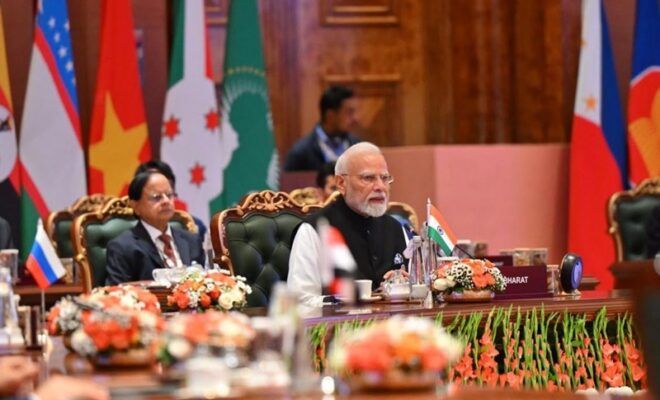
The 18th BRICS Summit in New Delhi has put India at the centre of a major debate over the future of global trade, currencies and the US dollar. Held on September 12–13, 2026, under India’s chairship, the summit brought together the expanded BRICS grouping at a time of heightened trade tensions and US tariff pressure. India’s position on one of the most closely watched proposals was clear: there is currently no proposal for a common BRICS currency. Instead, New Delhi backed greater use of national currencies for bilateral trade and better-connected cross-border payment systems.
The distinction is important. A common currency would require BRICS members to create a shared monetary framework, while local-currency settlements allow countries to continue using their own currencies when trading with one another. India’s approach therefore seeks to reduce transaction costs and excessive dependence on the dollar without committing to a single BRICS-wide currency.
What Happened at the New Delhi BRICS Summit?
The 18th BRICS Summit was held in India at Bharat Mandapam, New Delhi, as part of its chairship of 2026. Its official theme was “Building for Resilience, Innovation, Cooperation and Sustainability.” India became the chair of BRICS from January 1, 2026, marking its fourth chairmanship of BRICS.
The group has now 11 member countries comprising Brazil, China, Egypt, Ethiopia, India, Indonesia, Iran, Russia, Saudi Arabia, South Africa and the UAE. The total population of these countries accounts for nearly half of the world’s population while their economic output forms about 40 percent of the GDP of the world.
Therefore, the summit had more significance than any ordinary diplomatic event. The summit offered an opportunity to have discussions on issues related to trade, finance, technology, artificial intelligence, energy and global governance, along with the status of developing nations in international organizations.
Did India Reject a Common BRICS Currency?
The Indian stance, however, was more precise than simply a “rejection” of the concept. New Delhi made it very clear that there was no proposal on the table for a common BRICS currency.
According to Sudhakar Dalela, Secretary for Economic Relations in the Ministry of External Affairs, there is “no proposal in the BRICS for a BRICS currency, as of now.” While talks to settle bilateral trade through local currencies have continued.
This is important since discussions of “de-dollarisation” have often been viewed as an effort by the BRICS group to develop an alternative currency to the dollar. The Indian way of approaching the problem is much more conservative in nature. Instead of creating an alternative currency, India seeks ways in which to engage in direct currency transactions using individual national currencies.
Why India Prefers Local-Currency Trade
The logic behind local-currency settlements is relatively straightforward. When two countries trade directly using their own currencies, they can potentially reduce the need for repeated conversion through the US dollar.
For example, an Indian company importing from another BRICS country could potentially settle the transaction in rupees and the partner country’s currency, depending on the payment arrangements agreed between the two countries.
This can reduce certain transaction and conversion costs while giving participating countries greater flexibility in managing international payments.
The New Delhi Declaration therefore emphasized improving cross-border payment systems and promoting local-currency settlements rather than announcing a unified BRICS currency. The declaration also supported greater use of local currencies in trade and investment while recognizing that national circumstances and priorities differ.
What Does This Have to Do With the US Dollar?
It is tightly related to the ongoing conversation about decreasing reliance on the US dollar for international trade.
The use of the US dollar is widespread in global finance and involves such elements as trade invoicing, banking, reserves, and international payments. It will be very difficult to get rid of the US dollar and will face some economic and political difficulties.
India seems to have a policy that aims at diversifying and not severing relations with the current dollarized world order.
It is especially important that India has economic and strategic connections with the US, but it is also one of the founding members of BRICS. Thus, New Delhi is interested in remaining flexible and not creating another system to replace the current one.
How Did US Tariff Warnings Change the Conversation?
The BRICS summit came at a time when US tariff threats were on the rise. The New Delhi Declaration showed great concern over unilateral tariffs and non-tariff policies, claiming that such policies can be distorting international trade and run against WTO norms.
This issue is particularly important for India since both Washington and New Delhi are handling a complex relationship in terms of trade.
Additionally, the United States has threatened imposing more tariffs related to countries importing Russian oil. India, being one of the biggest importers of oil, said that such actions could influence bilateral relations.
India’s stance at the BRICS summit thus becomes more sensitive. While the country wants to protect its economic and political interests, it also wants to avoid any escalation with Washington.
BRICS Did Not Announce a Dollar Replacement
While a number of theories had emerged before the meeting, the New Delhi Declaration made no attempt at creating a common BRICS currency or outlining a program for replacing the US dollar.
BRICS countries opted for more tangible ways of financial cooperation, such as enhanced payments connectivity and the usage of local currencies, as well as development of existing financial structures. The BRICS Payment Task Force still works on interconnectivity of payment systems of BRICS countries.
This approach is much more incremental and allows BRICS countries to construct alternative payments systems gradually, instead of creating an entirely new financial structure right away.
Why India Is Taking a Cautious Approach
Creating a common currency will not just be as simple as giving a name to that common currency or issuing new currencies. The BRICS countries differ from one another in terms of their levels of inflation, monetary policies, economic structure, exchange rate system, and priorities.
The Indian country also has its own strong domestic economy and has its own monetary policy. Having a common currency means that there will be hard choices on who will dictate monetary policy, exchange rate system, and how to deal with economic shock for economies that have diverse characteristics.
By having local currency settlements, some of these hard choices are avoided since the individual countries will have their own currencies and monetary policies.
What the New Delhi Declaration Actually Prioritised
The economic discussion in the summit went beyond the currency. The New Delhi Declaration recommended reforms in the global trade regime, increased representation of emerging economies in international organizations, and more cooperation in sectors like artificial intelligence, technology, and sustainable development.
There were other initiatives proposed by India during the chairmanship of BRICS, which included digital public infrastructure, industrial capabilities, agriculture, health, and finance.
This shows that New Delhi had a much wider strategy for BRICS than merely challenging the dollar.
Is BRICS Becoming Anti-US?
While there was criticism regarding unilateral tariffs and economic coercion at the summit, it does not necessarily imply that BRICS has turned into an anti-US bloc.
India has always maintained links with Western countries as well as BRICS nations. The recent analysis of the New Delhi summit indicates that India tried to stop BRICS from becoming an explicitly anti-US bloc despite the fact that the group had been resisting unilateral economic coercion.
This is essential for India’s foreign policy. India is able to advocate a more balanced financial world order while remaining engaged economically and strategically with Washington.
What Happens Next?
The primary emphasis will most probably be on making local currency payments and international payment systems more workable.
If BRICS nations are able to make payment systems work in tandem with each other, increase local currency funding, and minimize costs involved in transactions, then they may move towards minimizing their dollar-based transactions in certain sectors without even having a common currency.
The real issue in the long run is how much success can be achieved in these mechanisms amid divergent economies among member nations.
As of now, the stand taken by India is that of greater financial diversification but not any common currency for BRICS.
Conclusion
This was evident at the 2026 New Delhi BRICS Summit, where the discussion about the future of world finance seems to be going beyond the debate over whether BRICS should develop its own currency.
India is taking a pragmatic stand on the issue. While advocating for more extensive use of local currencies, payment connectivity, and reform of global financial institutions, New Delhi rejects the idea of developing an exclusive BRICS currency.
All of this takes special significance in light of US tariffs and de-dollarization debates. India does not seem to be trying to abruptly remove the dollar from the global financial architecture but rather is advocating for its gradual diversification without compromising India’s sovereignty.
The big headline on BRICS currency is the one that India refused to make: India does not support the development of a common BRICS currency. Instead, it opted for other solutions like local currency trading and payment connectivity, which allows BRICS to become financially flexible without replacing the US dollar right away.
Global Affairs & Trade: What’s Changing for India?
How Is India-Vietnam Defence Cooperation Evolving?
Explore the latest defence production agreement between India and Vietnam.
Could Spending Rules Shape Indian Choices?
Check out how domestic spending mandates could influence consumer choices.
Why Did US Sanction Indian Companies?
Find out about the latest US sanctions linked to Iran trade.
How Could Iran Sanctions Affect India?
Uncover what new US measures could mean for India’s energy security.
Will Sanctions Disrupt Russia-India Trade?
See why bilateral trade may face limited impact amid sanctions.