
Central Asia Trade and the Middle Corridor: India’s Strategic Recalibration Explained
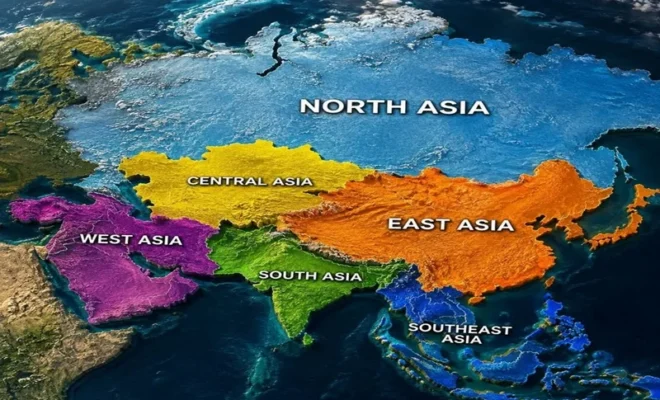
It appears that India’s interaction with Central Asia is moving towards a stage that is of great strategic importance, considering the global shift in trade routes, political alliances and logistical chains. For India, Central Asia is no longer merely a neighboring area full of mineral wealth; instead, the region is perceived as an important link between India and Eurasia, Europe and markets elsewhere.
The most crucial aspect of the strategic reassessment of India’s foreign policy priorities with regard to the region is the Middle Corridor, a multimodal transport link between Central Asia, the Caspian Sea, the South Caucasus, Türkiye and Europe. The emergence of such an alternative route is seen as a way to bypass some of the usual trade routes that have been subjected to geopolitical friction.
However, geographical factors make this a challenging task for India, since there is no land connection between India and Central Asia.
Why Central Asia Matters to India
Central Asia consists of five independent states which are Kazakhistan, Kirghizia, Tajikistan, Turkmenistan and Uzbekistan. This region falls at the juncture between Europe and Asia. The significance of Central Asia for India is related to energy, minerals, connectivity, defense, pharamaceuticals, agriculture and technology.
Kazakhstan, for instance, is a major supplier of uranium and other resources. Uzbekistan can be useful in the fields of pharamaceuticals, textile, agriculture and manufacturing. There is also natural gas resource in Turkmenistan.
India has had diplomatic relations with the Central Asian countries since their independence, however, due to distance, the scope of bilateral trade was restricted.
This is why connectivity plays a crucial role in the policy of New Delhi.
What Is the Middle Corridor?
Middle Corridor is an alternate trade route between the Eurasian countries and its other name is Trans-Caspian International Transport Route.
While freight transportation will be conducted through the Russian country alone, the goods can now pass from China and Central Asia to the Caspian sea, be transported through ships to Azerbaijan and then proceed to Georgia and finally Türkiye and reach Europe.
It involves railway, road and maritime transportation modes and thus it differs from the traditional maritime transport route.
The significance of the route has grown over the time due to diversification efforts and excessive reliance on any particular trade route.
For India, it can become a good chance to take part in the developing logistics system of the Eurasian countries.
India’s Connectivity Problem
The major impediment facing India in Central Asia is geography.
In addition to being blocked from access to Central Asia through Pakistan’s territory, India’s other possible alternative routes are hindered due to the volatility of Afghanistan.
This means that maritime and multimodal connectivity is extremely important in this case.
As such, India has focused its strategic attention on the International North-South Transport Corridor, which provides transportation from India to Iran, Caspian Region and Russia using sea, rail and roads.
It should be noted that Middle Corridor is not an alternative for International North-South Transport Corridor but rather complementary for India’s strategy of establishing multiple routes to Eurasia.
This becomes particularly crucial in an era when international trade routes may be interrupted by political tensions, sanctions and infrastructural issues.
The Chabahar Port Connection
India’s engagement in the Iranian Chabahar Port is important to mention in this context.
Having a port like Chabahar is important for India as it provides it with a maritime access to Afghanistan and Central Asia bypassing Pakistan. This allows Indian goods to reach the markets of the whole region and provides the Central Asian countries with another way to access Indian Ocean.
Therefore, the Chabahar port is not just about cargo shipping.
For India, this port is both a business project, a connectivity project and a strategic project.
However, the success of this project is based on infrastructural development, rail and road transportation links and overall geopolitical situation in Iran.
Why the Middle Corridor Changes the Equation
The Middle Corridor adds another element to India’s Eurasian considerations.
The countries of Central Asia themselves are keen to lower their reliance on conventional northward routes. Azerbaijan, Georgia and Turkey too are looking at becoming important players in terms of being transit gateways between Asia and Europe.
A wider network opens up in which India may link its western ports to the markets of Central Asia and, ultimately, Europe.
The potential here goes beyond quicker movement of Indian goods.
The potential is of including India in supply chains of vital minerals, manufacturing parts, medicines, technology goods and energy items.
Trade Is Moving Beyond Traditional Commodities
The Central Asia policy of India is also undergoing changes, since the partnership is not limited to oil and gas and natural resources anymore.
Pharmaceutical firms from India are well-present in many Central Asian countries, while information technology, healthcare, education, agriculture and IT can become areas for cooperation.
The economies of Central Asian states are at the same time seeking to diversify themselves.
There may be complementarities in these areas between the two, especially in those sectors where India has developed expertise.
Greater connectivity may thus change the existing trade relationship into an economic partnership.
Critical Minerals and Strategic Resources
The second factor making Central Asia relevant is the global race for critical minerals.
Transitioning from traditional fuels to electric vehicles, developing the renewable energy sector, semiconductors and advanced manufacturing means rising the need in minerals and materials that are necessary for these industries.
Central Asia has abundant deposits of uranium and other minerals.
With India trying to build up its capacity for manufacturing and decrease vulnerabilities in critical mineral supplies, the country’s interest in accessing these minerals increases as well.
Thus, the importance of connectivity projects for India acquires one more strategic angle.
A transport corridor is not only the railway or shipping lane but the infrastructure that can support long-term resource partnerships.
The China Factor
India’s new approach should also be considered in the context of China’s massive economic presence in Central Asia.
China invested in infrastructure, trade and connectivity of Central Asia extensively in the course of its Belt and Road Initiative.
The momentum behind the development of the Middle Corridor, in turn, lies in the desire of Central Asian and European partners to have more diverse trade corridors.
India does not necessarily need to compete with China to the same extent.
It is enough to concentrate on the sectors, where the capabilities of India are strongest and develop partnerships in pharmaceuticals, digital services, healthcare, education, energy and critical minerals.
Why Türkiye and the Caspian Region Matter
Türkiye is gaining importance to the Middle Corridor due to its geographical location between the Caucasus, Central Asia, and Europe.
India’s increased involvement with Türkiye, Azerbaijan, Georgia, and the Caspian region would help India develop a diversified Eurasian connectivity network.
The Caspian Sea plays an especially important role since it links the Central Asian economies to the western side of the Middle Corridor.
Therefore, the ports, railway infrastructure, and custom clearance infrastructure at the Caspian are key to the Middle Corridor’s efficiency.
The Obstacles India Has Yet to Overcome
The Middle Corridor is quite promising; however, it is not an easy way out of India’s connectivity problem.
Multimodal transportation entails multiple border crossings, switching between rail, road, and maritime transport, customs and regulations, and others.
At the same time, the costs and transit time should become competitive compared to existing routes.
The specific case for India is the need for cargo transportation to reach the Middle Corridor via some other transportation route such as maritime transport.
Therefore, political instability, sanctions on regional economies, and infrastructure shortages add up to planning obstacles.
Thus, India’s ability to translate diplomatic enthusiasm into a profitable logistics scheme will determine the success of the strategy.
India’s Strategic Recalibration
India’s approach to Central Asia is increasingly shifting from a primarily diplomatic engagement toward a connectivity-driven economic strategy.
The objective is not simply to establish better political relations with Central Asian governments. It is to create the physical and commercial infrastructure necessary for those relationships to generate sustained economic value.
The Middle Corridor, Chabahar and the International North-South Transport Corridor can collectively give India greater flexibility in accessing Eurasian markets.
This multi-route approach also reflects a broader principle in India’s foreign economic policy: strategic autonomy increasingly requires diversified supply chains.
Conclusion
Central Asia is becoming increasingly important to India because it sits at the intersection of trade, energy, critical minerals and Eurasian connectivity.
The Middle Corridor offers New Delhi another potential route into this strategic region while opening possibilities for deeper links with the Caspian states, the Caucasus, Türkiye and Europe.
But infrastructure alone will not transform the relationship. India will need competitive logistics, stronger commercial partnerships, efficient customs systems and sustained diplomatic engagement.
The larger story, therefore, is not simply about one corridor. It is about India’s attempt to build multiple economic pathways into Eurasia at a time when geography and geopolitics are forcing countries to rethink how global trade moves.
Stay informed with the latest developments shaping global affairs.
How Will Iran Sanctions Affect India?
Check out how fresh US sanctions could impact India’s energy security and oil imports.
Why Are India-Armenia Ties Growing Stronger?
Find how trade, strategic corridors, and Eurasian connections are deepening bilateral relations.
What Is Driving India-Uzbekistan Strategic Ties?
Uncover how critical minerals, energy, and trade are strengthening the partnership.
Why Is UAE Non-Oil Trade Surging?
Browse how AED 3.8 trillion in non-oil trade reinforces the UAE’s economic corridor role.
What Does Sergio Gor’s Kashmir Visit Signal?
See the key meetings, agenda, and significance behind the 2026 Kashmir visit.