BRICS Foreign Ministers Meeting 2026: EAM S. Jaishankar Calls for Reform in Global Financial Architecture
The BRICS Foreign Ministers Meeting 2026 in New Delhi focused on issues related to global governance and financial reforms with India taking up its chairmanship in BRICS. The External Affairs Minister of India, S. Jaishankar stressed upon the need for the international institutions to become more credible and effective and adapt to the changing realities of the globalized world.
This meeting lasted for two days from 14th May 2026 till 15th May 2026 and was attended by the BRICS foreign ministers as well as other high-level delegates from the member and partner countries of BRICS. With India taking up its chairmanship in BRICS, resilience, innovation, cooperation and sustainability have been at the forefront of all deliberations.
What Did S. Jaishankar Say About Global Financial Reform?
In his statement on “Reforms of Global Governance and Multilateral System,” Jaishankar highlighted the critical need for reforms in the architecture of the international financial system. More specifically, he emphasized the necessity to enhance the capacity of the Multilateral Development Banks to be stronger, responsive, and more resourceful.
The statement is consistent with India’s general approach that institutions responsible for the governance of global finance must reflect the current economic reality of the world rather than persist with the frameworks put in place years ago.
For developing and emerging countries, this question is especially topical since access to development finance, climate finance and investments continues to depend on the effectiveness of international financial institutions.
Why Is Reform of the Global Financial System Important?
The global financial system as we know it came into existence mainly because of the changes in the balance of power after the Second World War. Over the years, the emerging markets have become more significant in shaping international economic and trading activities.
India and other members of the BRICS group believe that there is a need for greater representation of the developing nations in the forums which govern global finance and development.
This general principle was reaffirmed by the BRICS Foreign Ministers meeting, which stated the need for an effective and representative multilateral system.
Jaishankar’s Message on Multilateralism
In fact, financial reforms proposed by Jaishankar were a part of the more general push towards reformed and credible multilateralism.
According to India, today’s global challenges like economic instability, conflicts, climate change, disruptions of the supply chain and development financing cannot be addressed on a national basis.
In his speech, Jaishankar reiterated that international cooperation still matters; however, institutions have to develop further in order to maintain their legitimacy. The main point of his speech was that multilateralism should become more responsive and representative.
And What about the United Nations?
Financial architecture is just one part of India’s agenda of reforms.
Also, Jaishankar drew attention to the necessity to reform the United Nations, which implies expansion of permanent and non-permanent categories of the UN Security Council. India’s approach is based on the belief that the current composition of the Security Council fails to take into account modern geopolitical and economic reality.
The connection between this argument and the general policy of India can be easily identified.
In fact, India’s campaign for representation of developing countries in global decision-making bodies has to include political and economic aspects of international decision-making.
Why Multilateral Development Banks Matter
Multilateral Development Banks play a crucial role in this debate in that they are responsible for financing infrastructure development and other long-term projects.
According to Jaishankar, there is a need to increase their capacity to mobilize large amounts of resources and be more responsive to the demands of developing economies.
In emerging economies, better development banks would translate into increased access to resources in relation to infrastructure development, climate change adaptation, sustainable development and resilience.
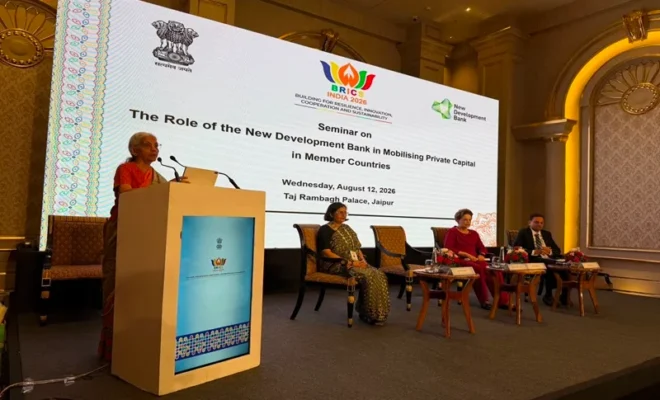
Another component of the BRICS agenda is the New Development Bank, which was set up as a development finance institution for emerging economies. Its increased contribution to development and modernization has been welcomed by the BRICS Ministerial Outcome Document.
India’s Push for a Fairer Trading System
Jaishankar also connected financial reform with the need for a fair and predictable international trading system.
India has emphasized the importance of a rules-based, open and inclusive trading framework, with the World Trade Organization remaining central to that system. Concerns around non-market practices, concentrated supply chains and uncertain market access were also highlighted during discussions.
This reflects the reality that financial and trade systems are increasingly interconnected. Disruptions in one can quickly affect investment, supply chains, inflation and economic growth elsewhere.
Why the BRICS Meeting Matters in 2026
The upcoming summit is particularly important for BRICS because the organization has grown considerably in size, consisting now of a broader number of emerging economies with varying economic profiles and foreign policies.
This has made the organization stronger both economically and geopolitically, but has at the same time posed another problem for it – the problem of maintaining a consensus between countries that have very different national interests.
According to the analysis conducted by the Carnegie Endowment for International Peace, one of the main problems that India will face during its 2026 presidency will be handling divergence in the new BRICS.
The New Development Bank and the Global South
NDB is especially relevant to the discussion of financial reforms since it is a mechanism that allows BRICS countries to enhance development financing in a non-traditional Western-dominated structure.
The BRICS outcome document noted the NDB as a crucial institution promoting sustainable development, infrastructure financing, and economic integration of emerging economies, as well as its growing ability to mobilize resources and increase local currency financing.
Overall, the goal is not to replace existing international institutions but to diversify and broaden their spectrum.
What Is Next?
The Foreign Ministers’ Meeting will help shape the agenda before the BRICS Leaders’ Summit scheduled to be held in 2026.
However, the Foreign Ministers’ Meeting also showed how difficult it was to reach agreement on all geopolitically sensitive issues. The Chair’s Statement and outcome document were issued instead of the usual joint statement due to disagreements among members regarding the situation in West Asia.
In this regard, the reform agenda becomes especially important since economic and institutional cooperation can become areas of BRICS member states’ mutual interest even in case of disagreement on geopolitically sensitive issues.
Conclusion
India’s vision of a new world order was very clearly articulated in the BRICS Foreign Ministers Meeting 2026. S. Jaishankar’s appeal for a rapid change of international financial architecture is reflective of India’s long-standing position that international institutions need to change along with the redistribution of economic power.
From better Multilateral Development Banks and development finance, reforms of the United Nations and trade system, India wants a multilateral architecture which offers a bigger voice to developing countries.
The overall message sent out by India through New Delhi is quite clear – the existing international system does not necessarily have to be changed, but it has to be reformed, updated and become more representative to stay relevant in a multipolar world.
Jaishankar’s message at the BRICS conference is not only about financial institutions, but also about the voices which have to be heard in shaping the international economy.
What’s shaping India’s trade, climate and supply-chain future?
Are India’s US exports truly strong?
Check out the deeper trade concerns analysts see behind India’s robust US export numbers.
Can India unlock US export growth?
Find out how ongoing trade talks could open new doors for Indian exporters.
Will India seal a tariff deal?
Uncover how India is navigating US tariffs while targeting a deal by autumn.
Could Arctic routes transform Indian trade?
Explore India’s plans for its first Arctic freight voyage and supply-chain diversification.
Is India losing sight of forests?
Dive into the CAG’s audit and concerns surrounding the Green India Mission.