
Trans-Border Glacier Disaster: China and Nepal Flood Alerts Impact Indian Hydropower Infrastructure
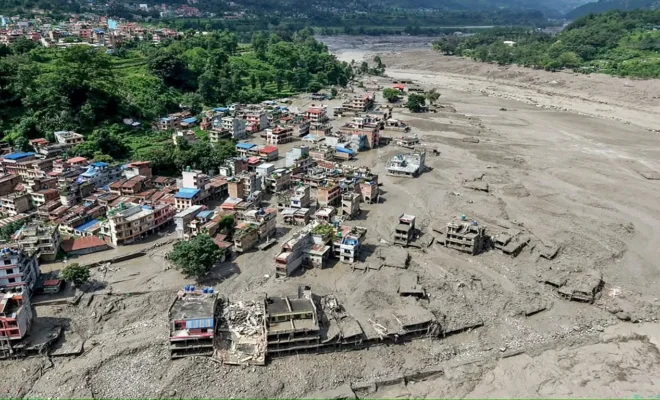
This massive disaster involving flooding in trans-boundary waters in the Himalayas, occurring near the Chinese and Nepalese border, has brought into focus issues concerning water systems in the area, the communities in the area, as well as power generation infrastructure. The event took place when the ice and rock fell on the China-Nepal border on August 26 and caused a large amount of flooding to take place in the Lhende Khola and Bhote Koshi river system.
For India, the disaster is significant in that the Bhote Koshi flows into the Trishuli system and then to the rivers which flow into India. Thus far, the devastation that has taken place has been focused in Nepal, but the disaster shows how the disaster at such an altitude can have an impact beyond borders.
What Caused the Flood in China-Nepal?
The first reports that were circulated regarding this issue claimed that the cause of the flooding was a quake, but this claim was quickly changed into glacial collapse and ice and rock avalanche causing the disaster. According to satellite data, there was collapse of part of glacier and rock at approximately 5,200 meters above sea level, leading to falling of ice, rock, mud and water into the rivers.
The debris seems to have blocked the Lhende River at first, but later the accumulating water and debris flowed downstream rapidly through the Bhote Koshi valley.
So far, there has not been enough information gathered for scientists to determine the exact chain of events of glacial collapse, blocking, and subsequent flood, thus the description of this event as a glacial lake outburst flood needs to be seen as an assessment that is evolving scientifically.
Why Nepal’s Hydropower Infrastructure Was Hit So Hard
Nepal is capable of producing a large amount of hydroelectric power in its Himalayan valleys, but it is also true that there is quite a lot of such infrastructure and the related access roads near rivers and mountains.
The last flood damaged some hydroelectric power stations and electricity transmission lines in Nepal’s Bhote Koshi and Trishuli corridors. It has been reported that nearly 430 MW of Nepal’s electricity transmission lines were hit, which amounts to a considerable part of its electricity generating capacity.
This example shows the dilemma of Himalayan hydropower projects: the rivers are the source of the water for electricity generation, but at the same time, they become pathways for very destructive floods, landslides, and glacier-related phenomena.
How Could This Affect India?
As most of the infrastructure damage occurred in Nepal, it is rather inaccurate to state that any Indian hydropower plants have been destroyed by the given flood without having any factual data on that.
However, the problem for India is downstream exposure and interdependence of Himalayan rivers’ basins. Bhote Koshi empties into Trishuli, which eventually empties into the Gandak basin and reaches India.
This implies that the drastic change of conditions in the upper part of the river basin can be relevant for the management of the lower one.
It means that for the Indian hydropower plants, the event is just another reminder of the potential risks coming from beyond the country.
Why Hydropower Projects Face Growing Himalayan Risks
Projects for hydroelectric generation in the Himalayas are set against a background of geologic instability, steep slopes, monsoon rains, melting glaciers and rapidly changing conditions at high altitudes.
The occurrence of a glacier incident does not have to happen in close proximity to a hydro-electric plant in order for problems to arise. The sudden release of water and debris above the dam would damage structures at intakes, tunnels, roads, bridges, transmission facilities and construction sites further downstream.
The recent incident therefore raises issues over whether hydroelectric planning should take into account cascading hazards rather than treating floods, landslides and glacier incidents as individual threats.
The New Flood Warning Issue
The latest disaster has also sparked discussions concerning cross-border flood warning systems.
As the original incident took place in Tibet prior to the flood reaching Nepal, the availability and rapidity of information from upstream locations became essential. Commentators in Nepal have raised questions about whether earlier warnings would have saved lives, and China has denied any accusations of failing to give appropriate warnings.
It is clear from the disagreement that there is a larger issue at hand; rivers are not concerned with political boundaries, while disaster warning systems often are.
Real-time information about changes in river courses, glacial lakes and alpine geography from upstream regions becomes vital for downstream nations such as Nepal and India.
Why the Situation Remains Dangerous
The disaster may not be completely over. Authorities have warned about a lake or temporary water body forming behind debris near the affected area, raising concerns that another sudden release could send additional water downstream.
This is particularly important for communities and infrastructure located along the Bhote Koshi and Trishuli corridors.
A second surge could create additional pressure on already damaged bridges, roads, hydropower facilities and riverbanks, making rescue and recovery considerably more difficult.
What This Means for India’s Himalayan Infrastructure
India should take the event as a lesson about how vulnerable their infrastructures are, which have been constructed along the inter-linked rivers of the Himalayas.
India has built extensive hydropower infrastructures in the Himalayan region especially in states like Himachal Pradesh, Uttarakhand, Sikkim and Arunachal Pradesh. But there is no verified report of the direct damage to any Indian hydropower plants from the flood in question, which originated from China and Nepal.
In other words, preparedness and information sharing is the most immediate lesson. Indian authorities working downstream require accurate hydrological information, early warning mechanism and contingency plan against unexpected transboundary river disasters.
Climate Change and Himalayan Risk
This incident is an added reason to be concerned about the risks from climate change and glaciers in Hindu Kush Himalayan region.
Experts and regional organizations have repeatedly warned that glacier and glacial lake changes, combined with extreme weather, could cause complex problems to local communities and infrastructures. The recent flood proves that how fast a high altitude disaster becomes a major downstream catastrophe.
Not all Himalayan floods are the result of climate change, and the scientific community is still figuring out what caused the recent disaster.
What Happens Next?
The first task is to rescue, evacuate and stabilize the damage done to infrastructure in Nepal and Tibet. Nepalese government officials have deployed thousands of security forces for search and rescue operations, and hundreds of people have been rescued from the affected areas.
The second stage will involve assessment of the damage done to hydropower plants, restoration of roads and bridges and monitoring of river flows and determining whether there are other blocked water bodies due to the accumulation of debris.
In case of India, the monitoring of the condition of downstream rivers is essential to determine if there has been any effect due to the disaster.
Conclusion
The China-Nepal glacier disaster is not only a disastrous flood. The incident has shown how transboundary are Himalayan water threats and how vulnerable infrastructure in the area is.
The destruction of hydropower stations in Nepal has demonstrated how quickly the event, taking place in the mountainous high altitudes, can affect the functioning of energy systems, while the connection of the river to downstream India raises a lot of questions related to early warning, sharing of hydrological information and resilient infrastructure.
At least, for the time being, the threat does not seem to be connected with the fact that the disaster has affected hydropower infrastructure in India to any significant degree. Rather, it has revealed the extent to which the water, energy and disaster management systems of the region are interconnected.
It becomes clear after the glacier collapse that the effects of the disaster are able to travel for hundreds of kilometers downstream, thus affecting other regions and infrastructures. The recent China-Nepal glacier disaster has once again demonstrated how interconnected the systems of hydropower security in the Himalayas are.
More stories you’ll want to know about.
How Is Voice AI Transforming Healthcare?
Check out how Karnataka is introducing Voice AI for healthcare and citizen services.
Why Are Mountain Routes Under Alert?
Find out why heavy rains have triggered travel advisories across mountain corridors.
Will Missing Crew Members Be Found?
Track down the latest developments in the ongoing Paradip shipwreck rescue search.
What’s Happening With Parandur Airport?
Dive into the key developments surrounding Tamil Nadu’s Parandur Airport project.
How Is India Rethinking Central Asia?
Uncover how the Middle Corridor is shaping India’s evolving trade strategy.