
OP-ED | COP17 Land Restoration Summit: India Demands Predictable Global Finance for Drought Resilience
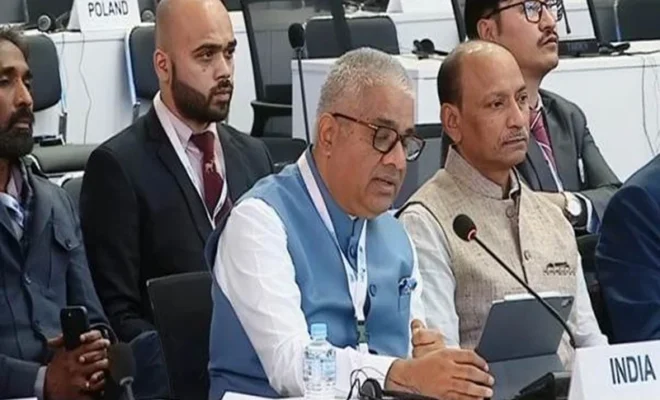
The world debate on climate change has been largely centered on emission levels, temperature targets and the move away from fossil fuels. However, at the United Nations Convention to Combat Desertification’s COP17 being held in Ulaanbaatar, Mongolia, another crisis needs to be equally discussed – the degradation of the land that is sustaining life.
What makes India’s position at the summit all the more relevant is the fact that it demands not more funds but diversified, adequate, predictable and sustained international finance for land restoration and drought resilience. This is what makes a difference. Restoration programs will fail if funding is erratic, short-term and unpredictable. It will need to last long enough to measure tangible ecological and livelihood benefits.
COP17, which is running from August 17 to 28 under the theme “Restoring Land. Restoring Hope,” has brought issues such as land degradation, drought resilience, water, food systems and rangelands to the center stage of international negotiations. According to estimates by UNCCD, close to 40% of the world’s land is degraded.
India’s intervention therefore deserves to be viewed as part of a larger argument: if the world expects developing economies to restore degraded landscapes and become more resilient to drought, international finance must become reliable enough to support that transformation.
Why Predictability Matters More Than a One-Time Pledge
The financing gap at the global level is colossal. UNCCD estimates that between 2025 and 2030, about $355 billion annually will be required for land restoration and degradation goals, while investments in annual estimates will be about $77 billion. This means a yearly gap of $278 billion.
The above numbers highlight the core challenge. The international community has consistently shown itself to be capable of making commitments regarding the environment and climate change. What is much more difficult is translating these commitments into predictable financial streams.
Land restoration is a process which takes a long time. It is impossible to restore a degraded watershed in a single budget cycle. Tree planting takes time. Soils need to be improved and managed. Resilience to drought can only be achieved through infrastructure development, water conservation and adaptation.
That is why the focus of India on predictable finance matters. It is not enough for funding sources to be available; they need to be predictable.
India’s Argument: Restoration Is an Investment, Not an Expense
Environment Minister of Union Bhupender Yadav put the point quite well in his statement during the COP17 ministerial dialogue: “Land restoration is not a cost, but an investment in food, water, biodiversity, livelihoods and long-term resilience.”
This is precisely what makes the framing essential.
It is a fact that land is usually treated like an environmental sector which competes with other economically crucial sectors for government money. Yet degradation of the land brings its own costs across several different sectors – poor quality of soils impacts agriculture, droughts impact rural income, water shortages bring additional burden to households and businesses, ecosystem degradation may even increase vulnerability to climate hazards like floods and heat waves.
Restoration will therefore bring its own benefits that go way beyond the limits of an environment ministry, making possible improvement of agricultural productivity, water conservation, rural employment opportunities and climate change adaptation.
Even UNCCD itself recognizes potential for economic benefits from land restoration, as stated during the COP17 finance dialogue: the estimated annual cost of inaction is $878 billion, while needed investments might yield around $1.8 trillion in annual benefits.
India Is Not Asking the World to Fund Everything
Another key aspect of India’s stance is the idea that international finance should be complementary to domestic efforts.
India demonstrated a hybrid green finance system that includes public money, private investment, and community participation in the areas of adaptation, sustainable land use, agriculture, forestry, afforestation, and biodiversity conservation. Sovereign Green Bonds are yet another means for India to channel the capital towards environmental and climate goals.
Another interesting initiative is India’s Green Credit Scheme. This scheme provides for the possibility to restore degraded forest land using both public and private sector contribution and issuing credits after five years of restoration and reaching 40% canopy density. Also, India referred to its compensatory conservation scheme where the money linked to forest diversion would be channeled for compensatory afforestation and ecosystem restoration.
All this enhances India’s negotiating position, providing evidence of developing countries’ willingness to utilize domestic means and innovative financial mechanisms. Yet domestic action will not take the place of international finance, since the problem at stake is worldwide.
According to Yadav, “Finance must be continuous, verifiable and linked to local communities.”
Indeed, it might well be the key principle behind India’s stance.
The Private Sector Cannot Be an Afterthought
Public finance will be insufficient to bridge the world’s restoration gap, as acknowledged by UNCCD COP17’s finance agenda, which explicitly calls for the involvement of multilateral development banks, development finance institutions, institutional investors, insurers, and private capital in the discourse.
However, attracting private capital means more than simply appealing to corporations to become more environmentally responsible.
Private investors demand return on investments, measurable results, predictable policies, and risk management tools, and restoration programs do not always offer those because the former often have socially dispersed benefits and slow returns on investment.
Blended finance, here, comes into play, allowing public and concessional funds to take care of early risks, guarantees to build investment confidence, and sustainability-based instruments to tie financing with tangible environmental achievements.
However, the goal is not to monetize nature at all costs. The point is to create financial schemes, through which private capital can invest in restoration without transferring the risk to local communities.
Drought Resilience Must Move From Response to Preparation
Drought is yet another reason why the finance issue can’t be delayed any longer.
Conventional drought management usually emerges when the rain is insufficient, water storage depletes and the losses mount up. However, resilience is developed long before a drought hits.
This includes investments in the management of the watersheds, groundwater replenishment, drought-proof farming, irrigation, soil preservation, early warning mechanisms and rural livelihood diversification.
The UNCCD has already included drought resilience as one of the top priorities for the COP17 meeting, whose agenda brings together issues of drought, water infrastructure and land restoration.
India’s role becomes especially important in this case because the country’s agricultural economy and rural population are closely associated with the variability of the monsoons and water scarcity. Resilient landscapes thus may serve as a kind of economic insurance.
The issue is not so much about how many dollars can be invested after a drought happens but rather how many economic losses can be prevented from happening beforehand.
India’s Own Record Strengthens Its Case
In addition to this, India has brought concrete proof of domestic actions undertaken on the ground. According to the Indian Government, the nation managed to restore 21.76 million hectares of land in the time period from 2011 to 2020, creating around 1.22 billion days of person employment.
This particular fact is quite relevant since it links restoration with employment and rural development, not viewing it as an independent measure for conservation.
Moreover, this point contributes to India’s overall position stating that the process of land restoration may be used to achieve several national goals at once. One and the same investment may lead to improving the ecosystem, creation of employment, enhancing agricultural productivity and adaptation to climate change.
The Real Test for COP17
COP17 will eventually be assessed not according to the number of speeches made but whether countries can transform the dialogue on finance into concrete structures.
Success would go beyond another assertion that land degradation requires urgent action. Success would be measured through the development of more concrete commitments, financial tools, improved access to concessional funding, and alignment between international organizations and restoration plans at the country level.
UNCCD’s Finance Day itself has been structured to achieve precisely that, with discussions around blended finance, insurance, public-private partnerships, sustainability-related instruments, and how land restoration could become part of the mainstream financial decision-making process.
India has an opportunity to show that developing countries are not just consumers of environmental finance. They are also the test beds for new thinking in restoration, adaptation, and resilience.
A New Compact for Land and Drought
The broader lesson learned from the intervention of India at COP17 is that the world requires a new financial deal for land.
Developing nations cannot be expected to take on the burden entirely of restoring ecosystems that yield dividends outside their borders. On the other hand, international finance cannot achieve success without taking into account domestic ownership and tangible results.
The way forward is somewhere in between the two: enhanced domestic mobilisation combined with reliable international finance.
India’s call, thus, is for much more than a climate finance promise. It is a call for assurance: assurance that restoration efforts can plan beyond one funding cycle, that drought resilience is a form of infrastructure, and that the communities engaged in the most difficult tasks are not abandoned when the spotlight fades elsewhere.
Conclusion
This is true of the upcoming COP17, which comes at a time when land degradation is no longer a warning about future environmental problems. It is an economic challenge impacting food security, water security, jobs, migration, and stability.
In calling for diversified, sufficient, reliable and sustainable global finance, India rightly puts the question of finance at the heart of the land restoration agenda.
The point could not be simpler: land restoration takes patience, and patience needs predictable finance.
For the international community to make its restoration pledges a reality, finance will have to come with the same long-term perspective as the ecosystems to be restored.
Ultimately, it may prove to be the crucial measure of COP17, not whether the world agrees that land matters, but whether it is prepared to fund it.
Related Stories — Stay Ahead with These Key Reads
Could India-US Minerals Boost Chips?
Check out how India and the US are strengthening critical mineral supply chains for semiconductors.
Can BRICS Reshape Global Finance?
Find how Jaishankar is pushing for reforms in the global financial architecture.
What Makes IIMK’s Finance Lab Special?
Discover the Bloomberg Finance Lab’s features, benefits, and learning opportunities.
Can G20 Unite Against Global Crises?
Explore how G20 members addressed pandemics, recession, and vaccine accessibility.
Can India Win the Chip Race?
Dive into India’s semiconductor challenge and its position alongside the US, Taiwan, and China.