President Droupadi Murmu on Teachers’ Day 2026: Why Educators Remain Central in the AI Age
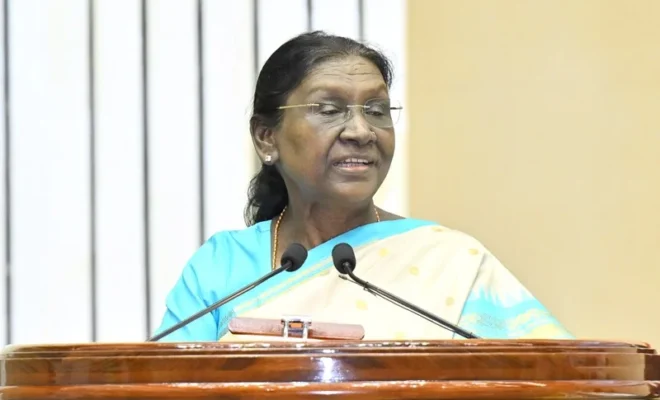
As India marks Teachers’ Day 2026, President Droupadi Murmu’s message comes in the midst of one of the biggest transitions in the world of education. While artificial intelligence can answer questions in seconds, summarise entire textbooks, translate languages, give explanations and help students do homeworks, instead of making teachers irrelevant, this transition makes their human contribution even more necessary.
As part of Teachers’ Day message, President Murmu pointed out that teachers are necessary to develop talent and build character. In addition, she called on the teachers to keep themselves updated about their subject, use new technologies, employ new teaching methods and encourage creative thinking and questioning by the students.
Undoubtedly, this is the key point in education in the era of AI: technology can provide easy access to information, but it doesn’t make wisdom out of information.
From Information Providers to Mentors
Traditionally, teachers were viewed primarily as individuals holding knowledge and passing it on to the students. It was the Internet that started to shift this paradigm by putting knowledge in easily accessible form. Artificial intelligence is causing a dramatic acceleration of this process.
Nowadays, a student does not have to wait until the next class to be taught about a certain mathematical principle or to look into a historical event. An AI would give him an explanation within seconds and tailor it to his level of comprehension.
Knowing the answer is not the same as knowing whether the answer is right, helpful or ethical.
This is where teachers turn out to be irreplaceable. Now they are supposed to teach how to question the information, analyze the evidence and spot misinformation. President Murmu’s focus on inquiry and independent thinking could not be more timely under these circumstances.
AI Can Explain, But Teachers Can Understand the Child
There is one very compelling argument about the relevance of educators that does not revolve around the question of technology but humanity.
The teacher knows there is a student behind all grades. She knows whether an usually lively child has become withdrawn, whether the student needs encouragement, and whether an apparent bad performance is really the result of external factors.
AI can detect patterns in a student’s performance, but the teacher can base a relationship on those patterns.
As President Murmu put it, teaching is an obligation that transcends mere academic education. She emphasizes that teachers educate students to be good human beings by identifying their unique capabilities and motivating them to excel.
It is of great significance in the era of artificial intelligence. There cannot be any educational exchange between the student and a machine.
Character Cannot Be Automated
Perhaps the most critical element in education would be one that cannot be quantified easily.
While a student may rely on AI to gain their knowledge faster, who will teach them to be responsible in the use of this knowledge? Who will make them learn about empathy, truthfulness, accountability and respect? Who will push them when the easiest way out may not be the best one?
These are some of the factors that position character education as the focal point of the discussion on the impact of technology.
In her 2026 address, President Murmu once again reiterated how crucial teachers are in building character and nurturing responsible individuals.
The Teacher Must Also Become a Lifelong Learner
There is, however, an important responsibility on educators themselves.
Instructors cannot teach their students to thrive in an age of AI without being connected to the technology that is driving this age. Specifically, President Murmu urged teachers to constantly update themselves about technological changes, use technology, and be innovative in teaching.
This is not to say that all instructors have to become experts in AI technologies.
What is required is sufficient technological insight into when AI can add value to education, when it poses dangers, and when human intervention is required.
Thus, the classroom of the future could very well incorporate AI-based personalized learning together with human discussion and mentoring.
India’s AI Moment Is Also an Education Moment
For India, the discussion holds particular importance.
The country has a very large and varied educational setup, with a huge variation in the availability of technology, teaching aids, and educational facilities. The use of AI has the capacity to provide top-notch learning facilities to students who might not be having access to it otherwise.
However, the use of technology can worsen the inequality prevailing in the society if access is uneven.
That is why the role of the teachers becomes very important in the whole scenario. Teachers can help in translating the use of technology into effective learning.
It is important to remember that the goal is not to develop classrooms with technology for technology’s sake but with classrooms where technology makes it easier for teachers to teach and for students to learn.
Teachers’ Day Is About More Than Celebration
While Teachers’ Day is celebrated in India on September 5, the birthday of a philosopher and ex-president of the country, Dr. Sarvepalli Radhakrishnan, to pay respect to teachers,
Teachers’ Day in 2026 is also a chance to pose the question of what a teacher should be in the era when machines can do many things which were thought of as specifically human.
The clue to the answer may be the distinction between teaching information and people.
While the AI can enable learning to become faster,
teachers can make it meaningful.
While AI can open up possibilities,
teachers can help students to choose which of these possibilities to pursue.
While AI can give answers,
teachers can teach what questions to ask.
The Classroom of the Future Needs Both
There shouldn’t, therefore, be any debate between teachers and AI.
The true value comes from teachers working with technology and keeping their focus on the human aspect of teaching.
An AI-assisted teacher might have more time mentoring students, rather than engaging in administrative work. Digital tools might make it easier to find knowledge gaps, but it will be up to teachers to decide how to deal with them. The technology might increase the educational opportunities available, whereas teachers will add necessary context, motivation, and perspective to that.
That’s what the future can bring.
President Murmu’s Teachers’ Day speech encapsulates this perfect blend: teachers have to adapt to technology and foster talent, character, critical thinking, and curiosity at the same time.
Conclusion
The arrival of AI does not diminish the importance of teachers. It forces us to understand their importance more clearly.
If all that education was meant to do was impart information, then machines could do a lot of what teachers do at some future point.
But education involves more than the development of judgment, curiosity, self-confidence, values, and sense of responsibility.
These are not just data sets to be processed.
Rather, they are skills that require the human touch.
As India forges ahead into the era of artificial intelligence, those who succeed as educators might turn out to be those who know how to use the technology without forgetting its human dimension.
It is for this reason that even in 2026, the teacher will still stand at the center of the classroom.
Stay Updated on India’s Biggest Moves
How Are India-Poland Ties Evolving?
Check out the latest strategic push covering cyber security, space and critical minerals.
Can AI Finally Stop Spam Calls?
Uncover how TRAI is using artificial intelligence to tackle unwanted calls across India.
Can Recycled Textiles Transform Government Buying?
Find out how GeM’s new MoU could boost recycled and upcycled textile procurement.
What Will RAKSHA Change in Defence?
Dive into Rajnath Singh’s 10-year framework for strengthening India’s defence diplomacy.
Can BIO-NIVESH Take Biotech Global?
Explore how India’s new investment bridge aims to turn biotech startups into global players