
BIO-NIVESH: India’s New Biotech Investment Bridge to Take Startups From Lab to Global Markets
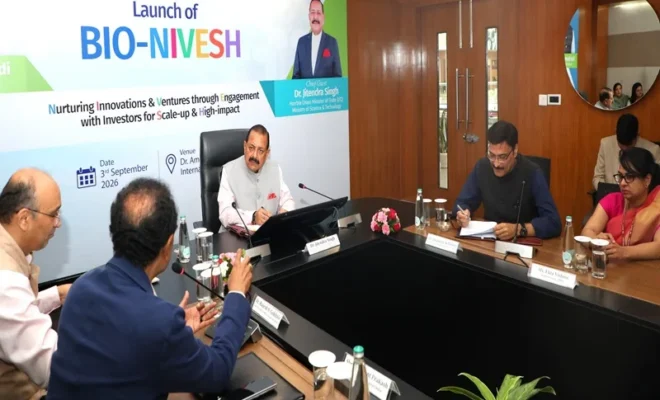
India has embarked upon another innovative initiative to boost its biotech startup ecosystem through the launching of BIO-NIVESH, an innovative platform aimed at fostering collaboration between prospective biotechnology innovators and private investors to turn scientific innovations into commercial successes.
The Ministry of Science and Technology launched BIO-NIVESH on September 3, 2026, when it hosted a roundtable meeting of biotechnology startups and investors. In this first-ever edition of BIO-NIVESH, 20 prospective startups in the field of biotechnology and deep tech met more than 50 investors to discuss investment, commercialization and scaling up matters.
What Is BIO-NIVESH?
The BIO-NIVESH platform was created as a link between the innovation network for biotechnology in India and the private investor community. However, the purpose is not only to provide a new venue for startup presentations; it is about creating more interaction between scientists, entrepreneurs, investors, business and governmental organizations.
This particular platform concentrates on biotechnology innovations that have already left the realm of research and are close to technology translation and scaling and innovation-driven manufacturing process. This is the critical phase for biotech companies, where innovative research requires serious investments and regulatory and marketing efforts to become products.
Dr. Jitendra Singh emphasized this by noting, “Innovation without investment is incomplete while investment is unsustainable without innovation.”
Why Private Investment Matters for Biotech Startups
The difference of biotechnology from other conventional technology segments lies in the fact that the development process from idea to realization may last for years and require scientific verification, licensing, testing and manufacturing and marketing of the innovative product.
Government assistance can facilitate the process of passing through the first research and development stage, but scaling up the successful innovation usually necessitates substantially more private funding.
And here comes BIO-NIVESH. With direct involvement of investors in negotiations with businesses at their critical development stages, the system seeks to provide better access to the “patient capital,” which, according to the government, can be necessary for biotech innovations.
How the First BIO-NIVESH Edition Worked
The BIO-NIVESH had a two-way engagement format unlike a traditional investment pitch event.
The first round entailed an engagement between selected startups and investors. Twenty startup companies have been selected for this round depending on aspects such as innovation, level of development, market potential, scalability and readiness from a regulatory perspective.
The second round entails an interaction between Dr Jitendra Singh, selected startups and investors, where the discussions will revolve around access to funds, commercialization, scale-up and policies that can foster innovation-led growth.
It is important to note that this two-way approach is important since the investors get an idea about the real biotechnology challenges and founders learn the requirements of private capital.
From Laboratory Discovery to Market Product
Among the most difficult tasks that the biotech sector faces in India is turning science into commercially viable products.
A discovery made within the four walls of a laboratory is not in itself a business proposition; it requires funding, production facilities, regulatory approval, market entry and a team of people who can manage the process.
This is what BIO-NIVESH aims to achieve by bridging this gap.
The larger objective of the Government is to ensure that Indian innovations make their way to industry via entrepreneurship and market and beyond.
Dr Jitendra Singh’s “Big Five in Five Years” Idea
Another proposal came up at the roundtable which can turn out to be quite significant in terms of investments in biotechnology in the coming years.
Dr. Jitendra Singh proposed the concept of “Big Five in Five Years”. The thought process is to direct investments in developing a few big biotechnology companies which could become anchor enterprises for the entire ecosystem.
It is believed that successful big companies will provide opportunities to smaller startups, suppliers, researchers and entrepreneurs who are operating around them.
It is not a concrete plan yet, and is more of a proposal which shows how the government wants Indian biotechnology companies to evolve beyond the stage of being startups to becoming global giants.
Why India Does Not Want to Miss the Next Biotech Revolution
Along with this, there is also a much bigger warning on the part of India with respect to its place in the new technology wave.
According to Dr Jitendra Singh, the future Industrial Revolution might be based on biotechnology and India must avoid getting into the situation that it faced at the time of the IT Revolution in being late into it. The connection between BIO-NIVESH and BioE3 policy of the Government was also drawn by him.
The lesson is very clear – scientific capability will not be sufficient for India; what it needs is capital and companies and ecosystem in order to translate its scientific superiority into industrial superiority.
What Could BIO-NIVESH Mean for Investors?
Investors will find it useful in terms of having early access to biotech and deep-tech firms that may have huge commercial value in the future.
The platform also helps investors understand the scientific process involved in the development of biotech firms. This is crucial as traditional venture capital approaches do not always apply to those technologies which take a long time to research and validate.
Through interaction with the founders, scientists, and government officials directly through the platform, BIO-NIVESH can bridge some of these information gaps.
What Could It Mean for Startups?
For new ventures, the main advantage may come from the availability of investors who know that the biotechnology field needs a long-term approach.
Instead of presenting a pitch deck, they will be able to describe their technology, its development status, the regulation process, difficulties of production, and future market prospects to the prospective investors directly.
Should the concept prove effective, new ventures will receive not only financial backing but also the necessary partnerships and expertise to scale up.
According to the government, the platform must be measured in terms of the partnerships it has formed, investments attracted, technologies scaled up, and products taken to market, and not only the number of pitches performed on it.
BIO-NIVESH Is Designed to Continue
The launch scheduled for September 3 should serve as the start of an ongoing process, and not just a single event.
BIO-NIVESH is supposed to be a recurring event, with plans made for future events in other cities as well. The goal is to increase participation and create links between regional biotech hubs and potential investors.
It might prove especially useful for those companies which do not operate in major biotech clusters within the country.
What Happens Next?
But the real test for BIO-NIVESH will come when those meetings are over.
A truly successful platform will transform those conversations into financial backing, collaborations, commercial pilots, manufacturing capabilities, and ultimately products that are available in the marketplace. Indeed, this is precisely what the government itself has said would define the success of the platform.
This is not just speculation – BIO-NIVESH may prove to be a valuable addition to India’s efforts to build a biotech ecosystem capable of competing globally.
Conclusion
In launching BIO-NIVESH, the Indian government has marked a change in approach from innovation-driven policy to one that aims to bridge the gap between innovation and private capital.
By bringing startups and investors face-to-face, the government hopes to tackle one of the greatest divides between scientific discovery and successful commercialization – the availability of capital willing to back innovations in the biotech field over their many years-long journey.
Already in its first year, with 20 startups and roughly 50 investors participating in the event, BIO-NIVESH has defined its basic approach. But its true impact will only be known if these conversations turn into investments, scaling of companies and consumer-facing products entering the global market.
Explore the Big Ideas Shaping India’s Future
How Is India Advancing Global Tech?
Check out how India and the US are deepening cooperation in semiconductors and AI.
What’s Next for India-US Defence Tech?
Discover how iCET is driving new joint technology and manufacturing initiatives.
Why Was RGCB Campus Renamed?
Find out why the Centre’s decision to name the campus after an RSS leader sparked criticism.
Can Voice AI Transform Public Services?
Explore Karnataka’s new Voice AI pilots targeting healthcare and citizen services.
Why Must Industry Drive India’s R&D?
Uncover why stronger private-sector participation could shape India’s next innovation wave.