Rajnath Singh Releases 10-Year ‘RAKSHA’ Defence Diplomacy Strategy Framework
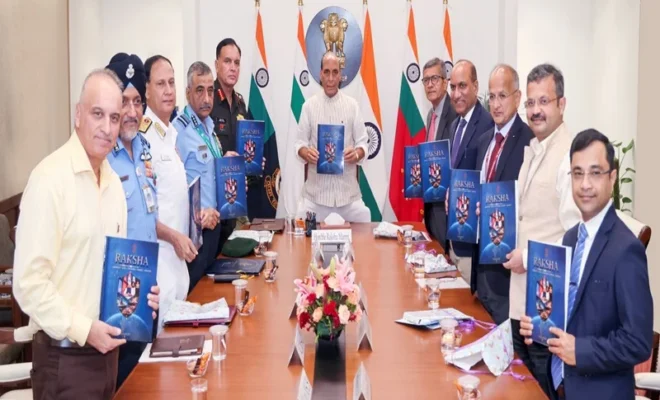
The Defence Minister, Shri Rajnath Singh, has recently announced a ten-year framework for defence diplomacy called “RAKSHA”. This is considered a major initiative which would enable giving strategic direction to India’s defence diplomacy.
The “RAKSHA” framework would help enhance India’s defence relations and build military ties with friendly countries in such a way that the defence diplomacy would be more aligned with Indian security and foreign policy concerns.
The ten-year framework, therefore, intends to bring about more structure into India’s strategy to engage strategically with other countries in the defence sector.
What Is the RAKSHA Defence Diplomacy Framework?
RAKSHA Defence Diplomacy Strategy is a framework that has been planned for guiding the Indian approach to dealing with foreign armed forces and defense establishments.
While defence diplomacy is not only about military exercises, but can also include many other elements such as defense dialogue, capacity building, defense exchanges, naval cooperation, technology cooperation, and exercises, by framing them in a 10-year strategic framework, the government hopes to provide continuity in the defense diplomacy initiatives of India in spite of changing circumstances.
Why Does India Need a Long-Term Defence Diplomacy Strategy?
The security situation in India is becoming more and more complex as competition among powers, changes in alliances, maritime security issues, new technologies, and new military doctrines impact defence policy.
In such an environment, strategic partnership can help India acquire more strategic depth.
Taking a long-term view can help India transcend the situation where the partnership was driven by defence procurement alone. Instead, there can be increased emphasis on cooperation in the areas of development of technology and training of personnel.
Thus, the concept of RAKSHA can be viewed as an attempt to incorporate defence diplomacy into India’s national-security strategy.
Strengthening India’s Defence Partnerships
The main purpose of the framework would be expected to be that of reinforcing the relationships of India with strategically significant countries.
India has a long tradition of working on defense cooperation with its partners in the Indo-Pacific region, Europe, West Asia, and elsewhere.
Military exercises and defense dialogues are a chance for the military of the participating sides to become familiar with each other’s operational practices.
With the implementation of the framework, this relationship could gain an institutional character instead of being exercise-based.
From Defence Buyer to Defence Partner
One of the major changes in Indian defence strategy is the attempt to transform from being a buyer of defence equipment into a defence producer and collaborator in terms of technology.
The RAKSHA strategy of defence diplomacy strategy works towards achieving this larger goal.
The increased capacity for manufacturing within India opens avenues for defence exports and defence collaboration.
The defence diplomacy strategy can help India achieve both national security as well as its defence ambitions.
It is not only about selling equipment, but establishing a more complex relationship.
Focus on the Indo-Pacific
The Indo-Pacific is expected to be a significant feature of India’s defense diplomacy.
India has always stressed the importance of an open and free Indo-Pacific and increased its defense cooperation with the states in the region.
Military drills, maritime domain awareness, humanitarian assistance, disaster relief, and naval cooperation have become increasingly significant aspects of this partnership.
A decade-long framework enables India to build up more predictable defense engagement with its partners in the region.
Emerging Technologies and Modern Warfare
In contemporary defence diplomacy, military capabilities are no longer the only considerations.
Military operations in the current scenario are being transformed by artificial intelligence, drones, cyber warfare, space technology, electronic warfare, and autonomous technology.
Defence relations in the future for India will therefore be increasingly about cooperation on technology as well as conventional military collaboration.
RAKSHA is timely in view of nations looking for trustworthy partners who can collaborate in this area.
Advanced defence technologies are important both for strengthening military readiness and also for technological innovation.
Capacity Building and Training
Training and capacity building is yet another key aspect of defence diplomacy.
There have been an increasing number of training courses, exchanges and professional education that have helped India improve ties with other nations.
This provides the military personnel from the other nations the opportunity to learn about the Indian system and at the same time gives Indian military personnel the opportunity to familiarize themselves with different environments.
In this way, ties and understanding can be improved between the armies of different nations.
Defence Diplomacy and Strategic Autonomy
This framework must also be considered in light of the importance India places on strategic autonomy.
Unlike most other nations, India has strategic relations with several powers and not only one strategic bloc.
In the long run, strategic defense diplomacy can aid India in developing strong partnerships without being tied down by any bloc.
This is especially true in an era when international geopolitical competition will be at its peak.
Strategic autonomy for India does not equate to strategic isolation but to strategic multi-partnership.
What Could the 10-Year Timeline Change?
The greatest strength of such a long-term framework is that of consistency.
Any defence collaboration requires many years before any tangible results can be achieved. Any training programs, technology collaborations, joint development ventures, and military-to-military linkages may not always be possible to create in one political or budget cycle.
A framework for 10 years allows India to develop these collaborations with more foresight.
India’s strategic objectives could be made clear to its partner nations through such a framework.
What It Means for India’s Global Defence Role
RAKSHA’s defence diplomacy approach indicates the desire of India to make its voice heard and be more actively involved in the shaping of the security environment internationally.
While India is one of the world’s leading military powers at present, the role it plays in the international relations of the country depends on more than just the size of its military forces. India can strengthen its military and industrial ties through the implementation of defence diplomacy.
This means that in the coming decade, defence diplomacy may become an increasingly important part of Indian foreign policy.
Conclusion
The 10-Year RAKSHA Defence Diplomacy Strategy Framework by Rajnath Singh can be considered as a step taken by India to add more structure and forward-looking approach to its international defence diplomacy.
The focus goes beyond conventional military cooperation and is on strategic partnerships, technology, capacity building, defence manufacturing, and regional security.
With changing geopolitics and fast-changing military technology, the capability of India to create long-term defence ties may prove as significant as its capability to improve its military strength.
The RAKSHA framework indicates India’s move from short-term defence diplomacy to long-term 10-year strategy based on partnerships, technology, capacity building and its increasing role in global security.
More Rajnath Singh stories you should know
How Did DRDO Missile Transfer Unfold?
Check out how Indian private firms will produce indigenous missiles through DRDO technology transfer.
Why Did India Choose 83 Tejas?
Find out why Rajnath Singh praised India’s indigenous defence deal for 83 Tejas fighter planes.
Will MSP Keep Rising For Farmers?
Uncover Rajnath Singh’s assurance on continuous MSP increases amid ongoing farmer protests.
What Does The Defence Bill Mean?
Browse the key details of the Defence Bill presented by Rajnath Singh in Lok Sabha.
What Is ISC Dhruv’s Significance?
See why Rajnath Singh inaugurated ISC Dhruv and what it means for India’s defence sector.