
PM Modi Chairs Chintan Shivir Session: Why Urban Water Management and ‘Jal Utsav’ Are Now a National Priority
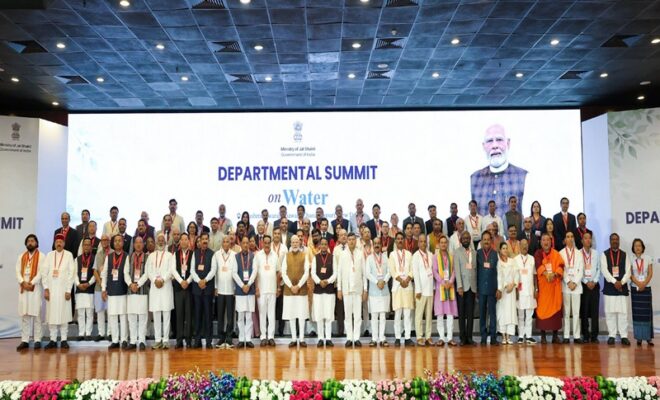
Narendra Modi’s last Chintan Shivir session has highlighted one of the most urgent urban issues in India – the problem of urban water management, where the increasing number of citizens and rising constructions create a need for increased amounts of water.
The meeting discussed the urgency of the issue as well as suggested an approach of ‘Jal Utsav’, which aims at transforming the movement of water preservation into a more popular trend. It is important that the water issue in India now can not be viewed in purely rural terms. Growing urban centers face such problems as groundwater depletion, water wastage, poor drainage system, water pollution, and inconsistent availability of drinking water.
Thus, the meaning of this particular event is much wider than water preservation at households level only.
What is the Chintan Shivir?
Chintan Shivir serves as a forum where discussion and debate can take place about the major governance and development priorities. Apart from dealing with issues of policies and their announcements, such discussions provide an opportunity to explore the challenges that can emerge in the future along with possible methods for improving implementation.
The last discussion on the issue of urban water management is a testimony to the significance of water security in India’s developmental experience. With increasing population in cities, and expansion of urban centers, the urban system faces increasing burden of providing safe drinking water along with other issues regarding urban water management.
The main problem here is that cities cannot go on treating water as inexhaustible natural resource anymore.
Why Urban Water Management Needs Urgency
There has been rapid urban growth in India, and as such, there is extra strain on the existing infrastructure for water management. An increase in households, commercial spaces, factories, and public utilities means that the demand for water increases by the day.
Urbanization can also lead to reduction in the capacity of rainwater to get absorbed underground. This happens because of roads, concrete, and urban constructions that do not allow the water from rain to replenish the underground water sources.
As such, there is a tricky situation whereby as urban centers need more water, their ability to ensure replenishment of their water sources becomes harder.
Therefore, the importance of managing urban water urgently cannot be overemphasized. The challenge is not just getting new water sources but also making use of the existing sources better and more efficiently.
From Water Supply to Water Security
The discussion on urban water requirements has slowly started moving away from the conventional view of just meeting water demands.
For sustainability purposes, the urban centers should start thinking in terms of full cycle management of water. This involves examining the source of water, its distribution, losses, wastewater treatment, and recycling of treated wastewater.
Activities like rainwater harvesting, aquifer recharge, treatment and reuse of wastewater might be incorporated into such an approach.
The aim is to establish an urban system that will conserve water at different stages rather than consume it and dispose of it.
It is especially necessary in growing urban centers where present-day decisions might impact water supply for several decades to come.
What Does ‘Jal Utsav’ Mean?
‘Jal Utsav’ as an idea gives the water discussion a participation angle.
It essentially brings the discussion of water conservation not just as the government’s duty but also as something that can be turned into a community event and habit.
The idea can motivate citizens, educational institutions, resident welfare associations, municipal corporations, and other community organizations to engage in initiatives related to water conservation.
This is essential since government efforts alone will not address urban water stress. Consumption behavior too has an impact on water demand and resource utilization in urban areas.
‘Jal Utsav’ is an attempt to celebrate water as a community effort.
Why Cities Need Better Rainwater Management
Rainwater is an essential resource in urban India because of the possibility of having a situation whereby there is a heavy downpour and yet a shortage of water.
The city may have heavy rains during the monsoon season but at the same time suffer from water stress after some months due to the discharge of the rainwater rather than harvesting and recharging water systems with rainwater.
Proper rainwater management could provide a solution to the situation.
Harvesting of rainwater, improving drainage and recharging of ground water could minimize runoff and preserve water resources.
This makes rainwater management an integral aspect of water security in cities.
Wastewater Could Become a Major Resource
Wastewater reuse is another important element in the contemporary urban water management.
Urban areas produce huge amounts of wastewater daily. If treated correctly, a lot of it may be used for non-consumptive purposes, such as landscape irrigation, various industrial processes and some municipal applications.
It helps to preserve fresh water resources and introduces more sustainable model of urban water consumption.
The general idea is very simple – once the water became a part of urban system, it cannot be considered as waste.
The Role of Citizens in ‘Jal Utsav’
However, any water conservation campaign will ultimately depend on the level of involvement of people outside the government offices.
Individuals can stop wastage of water, societies can develop their capabilities to harvest rainwater and institutions can educate people and students about water conservation.
Small actions become big in the context of an entire city.
This is where the concept of ‘Jal Utsav’ can prove to be quite relevant. Rather than promoting water conservation as a campaign, it can promote individuals to practice water conservation in their normal behavior pattern.
Importance of Water Security for India’s Future Urban Areas
Urban areas of India are anticipated to grow in the coming future, and hence water security will be an important aspect of urbanization.
A city will need water not only for individual use but also for hospitals, schools, businesses, industrial units and transport.
Hence, any deficiency in water can have implications that go beyond the problem of inconvenience.
It can impact public health and the economic activity.
What the Chintan Shivir Message Means
What emerges from the session, however, is that India’s water problem will need not just one but a combination of several ingredients.
It is not enough for urban water management to be an ad hoc affair of being dealt with when the levels of water in the reservoirs drop and shortages manifest.
The emphasis on ‘Jal Utsav’ brings yet another aspect to this equation.
Conclusion
“Water Management in Urban Areas” – the Chintan Shivir discourse by Prime Minister Narendra Modi – draws attention to a critical issue for India’s future: water security will be critical to the survival of its cities.
With urban populations on the rise, cities will have to save water, reduce wastage, replenish groundwater, manage rainwater, and maximize re-use of water.
Where institutional action has not been adequate, the ‘Jal Utsav’ model aims to ensure that water conservation emerges as a movement involving all citizens of India, rather than remain an exercise exclusively in the domain of the government bodies.
A daunting task lies ahead, but the lesson that Indian cities have learned clearly is that waiting for water scarcity to turn into a problem before changing policies would mean disaster.
‘Jal Utsav’ is no ordinary campaign for water; it symbolizes the concept that ensuring water security for India’s future will involve good governance and citizen participation.
Catch up on the key stories shaping India’s politics, economy, sports, and policies.
What Is Modi’s Vision For 2047?
Check out the roadmap shaping India’s journey toward a developed nation.
What Reforms Could Boost India’s Economy?
Find out which economic reforms experts believe could strengthen India’s growth.
How Did Yo-Yo Test Transform Fitness?
Uncover how the Yo-Yo test helped improve athletes’ fitness and performance.
Why Did Modi Defend Farm Bills?
Dive into PM Modi’s message to farmers and the benefits he highlighted.
Why Should States Rethink Lockdowns?
Look into why PM Modi urged states to reconsider short-term lockdown strategies.