
Nvidia CEO Jensen Huang Urges India to Build a ‘Local AI Economy’: Why Infrastructure Is Now the Biggest Race
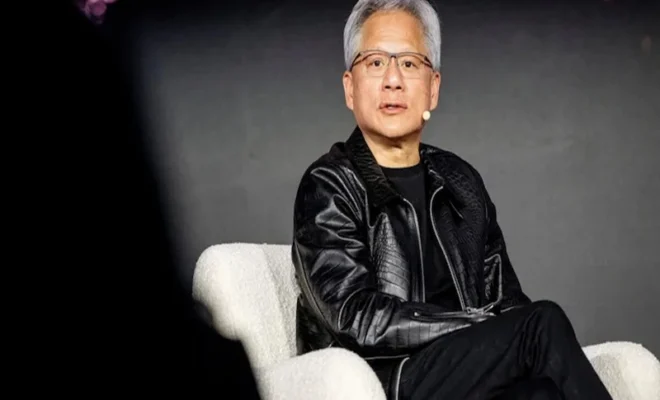
The CEO of Nvidia Jensen Huang has placed the artificial intelligence plans of India under the limelight, calling upon India to go beyond the mere use of AI technologies and create an AI ecosystem of its own in its favor.
India has reached a stage where it needs to take a step further in terms of artificial intelligence. The usage of AI technology is rising rapidly in all spheres of life including business, government agencies, schools, hospitals and start-ups, however, access to the required computing power, data centers, computer chips and other infrastructure required for developing AI is a problem.
Thus, Huang’s argument is more than that of just selling his company’s GPUs to India.
What Does a “Local AI Economy” Actually Mean?
An indigenous AI economy refers to the development of an ecosystem where AI does not come in ready-made form from outside but is made and implemented by using domestic capabilities.
In case of India, it can take the form of availability of supercomputing capabilities, setting up of AI data centers, training Indian language models, developing startups and incentivizing businesses to develop their own AI products.
The need is especially pertinent in view of the fact that AI has become more and more infrastructure-centric. An organization might have very talented engineers and an innovative concept in mind but would find itself unable to develop or run complex AI algorithms due to lack of computing power.
This message from Huang brings infrastructure front and center in India’s AI plans.
Why India Needs More AI Infrastructure
AI demands huge computational capacity. Thousands of specialized computer chips may be used in training advanced models, and yet even larger computational capacities would be needed to operate those models for millions of people.
In other words, computing facilities, along with AI facilities, are as essential to the functioning of the digital economy as roads, ports, and electricity networks.
India already has a well-developed technological sector, and a lot of engineers. However, the next stage of AI progress would require significantly increased computing capacities in India.
Additional capacities could help Indian companies, research institutions, and enterprises to work with AI and not rely only on computing facilities based outside of the country.
At the same time, additional capacities could enable small companies to work with AI in spite of high costs of international cloud computing services.
Why Jensen Huang’s Message Matters
Huang’s remarks are especially significant in light of the fact that Nvidia lies at the heart of the global AI hardware eco-system.
The company’s graphics processing units (GPUs) have emerged as indispensable hardware for training and using modern AI. With AI computing demand soaring through the roof, access to powerful hardware and the supporting eco-system has become a matter of strategy for many governments and companies across the world.
This is why Huang’s advice for India to speed up its development of AI infrastructure cannot be treated merely as a suggestion from the technology industry.
The nations that construct their AI infrastructure earlier than others may enjoy better developed internal eco-systems of developers, start-ups, cloud services, researchers and enterprises.
India’s Opportunity Goes Beyond Chatbots
The AI economy that can develop in India has the capacity to be far larger than the chatbot market for consumers.
AI could increasingly impact the manufacturing industry, financial services, healthcare, agriculture, logistics, education, and administration.
India has an interesting prospect of creating AI-based technologies that will have the ability to operate in its multitude of languages.
Models and use cases that could potentially tackle those challenges that cannot be solved by general AI technologies – including language-specific educational technologies, farming advice systems, and government services aided by AI.
This is when infrastructure plays a pivotal role. Provided that Indian companies have access to domestic computing, they can create products tailored specifically to their needs.
The Data Centre Race Is Becoming an AI Race
The conventional data centre industry was mostly known for its involvement with cloud computing, enterprise software and digital services.
However, AI is reshaping this situation.
AI-oriented data centres need huge amounts of power, cooling technology, high-speed networks and specific computing hardware. The more computing workloads increase, the higher capabilities of infrastructure providers are required in order to deal with much denser workloads.
India will benefit economically if it develops infrastructure for AI faster than other countries do.
Implications for Indian Startups
Another area which can benefit from developing local AI infrastructure is Indian startups.
At the moment, an AI startup incurs a lot of expenses just to have access to computing power needed to train models, run tests and deploy models.
Development of local AI infrastructure will help startups to get rid of some of those barriers.
Moreover, it will promote creation of Indian-specific AI companies and not rely completely on foreign AI platforms.
Long-term goal of such policy would be to develop an ecosystem of AI development in India in order to create AI products and then sell them outside India.
India Needs Talent and Infrastructure Together
Infrastructure by itself, however, is not enough to make India’s AI economy succeed.
India already boasts one of the biggest technology talent pools in the world, yet there is a need for expertise in specific niches like machine learning, semiconductor engineering, data science, computing architecture, and AI safety.
It’s the combination of talent and local access to affordable infrastructure that will drive success.
That is the reason why Huang’s statement should be seen not only as a hardware story, but rather as an ecosystem story.
Energy Is a Crucial Element in the Equation
In addition to the problem of infrastructure, there is another important element of the AI infrastructure race.
Large-scale AI data centers are very energy intensive facilities, and thus an expansion of computing capabilities implies development of energy infrastructure.
Consequently, India’s vision of the future AI economy would have to fit in with its overall energy strategy.
Otherwise, the construction of new data centers without proper access to electricity and cooling capacity could become a bottleneck.
Thus, AI economy implies coordination of technology, energy, telecommunications and infrastructure policies.
Can India Become an AI Superpower?
India offers a number of strengths, including a sizable domestic market, a substantial technology labor pool, an entrepreneurial environment, and increasing appetite for AI use cases.
However, in order to become a world-class AI hub, India needs more than just to take advantage of AI tools invented elsewhere.
Much harder is to build the infrastructure and capabilities that allow creation of such AI solutions domestically.
This is what Huang’s proposal of an AI economy at home stands for.
And if India succeeds in both building its computing infrastructure and growing its talent, models, applications and business, AI can become yet another important pillar of the Indian digital economy.
What Happens Next?
The next step in India’s road to AI will definitely be associated with the development of infrastructure.
More AI data centers, better computing capabilities, a stronger semiconductor industry, local AI models and research capabilities could determine the speed with which India transitions from an important AI consumer to a significant AI producer.
This is why Huang’s message is highly timely: India’s success in AI will not only be about using AI intelligently, but also creating it.
Conclusion
With Jensen Huang’s urging India to develop its own AI ecosystem, there has been a clear indication that there has been a new turn in the technology race around the world.
Today, AI is not only a software play but also an infrastructure play, one that requires the development of chips, computing, data centers, electricity, networks, people and investment.
There has never been a greater opportunity for India but for India to ensure that it has its own AI ecosystem, the country will have to do things fast before it continues relying on other infrastructure technologies.
India has the talent and markets to have its AI revolution. The next question is: Can India create enough computing infrastructure?
Curious about what’s next in tech? Explore these stories.
What Awaits at Bengaluru Tech Summit?
Check out the dates, speakers, and AI expo highlights.
Why Is Intel Cutting Jobs Now?
Find out why Intel plans to reduce its workforce.
What Did Modi Discuss With CEOs?
Uncover the key takeaways from Modi’s New York tech meeting.
Can Microsoft Challenge NVIDIA With Chips?
Browse Microsoft’s plan to develop its own AI chips.
What Makes AMD’s RX 7000 Powerful?
See the flagship GPUs and their RDNA 3 capabilities.