80th Independence Day: PM Modi Announces ‘Shakti Ki Sapt Dhara’ Roadmap for Viksit Bharat @2047
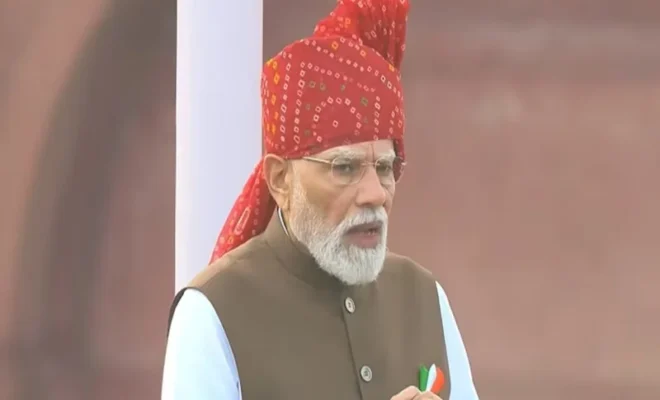
India celebrated its 80th anniversary of Independence on August 15, 2026, with Prime Minister Narendra Modi delivering his address to the nation from the iconic Red Fort and introducing an ambitious seven-point growth model named “Shakti Ki Sapt Dhara” which translates to seven streams of strength. This strategy has been crafted to fast-track India’s growth trajectory in order to achieve Viksit Bharat by 2047, when India will complete 100 years of independence.
While traditional frameworks focus only on a particular sector, this new framework combines manufacturing, agriculture, technology, infrastructure, defense, sustainability, and India’s soft power. Modi emphasized the fact that these different aspects are interrelated and can be used as sources of strength for India’s self-reliance and global success.
What Is ‘Shakti Ki Sapt Dhara’?
“Shakti Ki Sapt Dhara” can be translated to mean seven streams of strength. In his speech on Independence Day, Modi has adopted the construct to illustrate how India can acquire the capacities that are needed to realize the concept of Viksit Bharat.
The seven streams include manufacturing strength, agricultural and food production strength, strength of technology and innovation, Gati Shakti, strength of defence, the green and blue economy, and the soft power of India.
The fundamental logic here is that the transformation of India into Viksit Bharat by 2047 would involve making advancements in industries, agriculture, labs, infrastructures, military, environment, and diplomacy.
Manufacturing Power: Turning India Into a Global Production Hub
Manufacturing lies at the core of this first stream. This stream aims for India to position itself as a strong player in the global manufacturing arena and be able to produce quality products at affordable prices.
The reason behind such emphasis is due to the ongoing process of diversification in global supply chains where major companies are not limiting themselves to manufacturing locations. In his speech, Modi has highlighted the need for India to position itself as an important player in the global supply chain where Indian manufacturing companies can compete on the global level on the basis of cost, quality, and scale.
A stronger manufacturing industry in India may result in more employment opportunities, exports and decrease in dependency on imports.
Agriculture and Food Production: From Farming to Value Creation
The second stream relates to agriculture and food production. This goal not only aims at expanding the production in agriculture but also intends to make improvements in the areas of productivity, food processing, and value creation for agricultural produce.
This may be possible with the assistance of technology which can be used for proper irrigation, agricultural research, logistics, storage, and processing. It will also enable the farmers to venture into food-processing industries rather than limiting themselves to raw produce.
This is why agriculture becomes an important element of the Viksit Bharat program because rural development and economic development must go hand-in-hand.
Technology and Innovation: India’s Next Growth Engine
Technological innovation constitutes the third stream under the Sapt Dhara paradigm. Modi gave special importance to Artificial Intelligence, semiconductors, and homegrown technological capacities while addressing the nation on Independence Day.
Among the announcements made is the government’s proposal to train 1 crore, or 10 million, young Indians in AI over the coming year. The idea is to equip young people for a future economy driven by Artificial Intelligence and high-level digital technology.
Another significant feature is that of the semiconductor ecosystem. Plans are afoot from the government side to develop seven to eight semiconductor factories in the coming one to two years.
Explore the biggest Independence Day 2026 stories, celebrations, and national highlights.
What Makes Independence Day 2026 Special?
Check out key celebrations, announcements, and patriotic moments shaping August 15.
Will Vande Mataram Make History?
Discover how the full six-stanza rendition adds a historic touch to Red Fort celebrations.
Can ₹1 Bring More Freedom?
Find out how BSNL’s Freedom 2.0 offer brings affordable calling and 24-day validity.
How Will Red Fort Resound?
Browse the historic Independence Day ceremony featuring the complete Vande Mataram rendition.
What Did Modi Highlight Today?
See the key takeaways from PM Narendra Modi’s Independence Day speech.
Gati Shakti: Building Faster Connections
The fourth initiative is called Gati Shakti and it involves infrastructure, connectivity and logistics.
In order for India to be able to produce and sell its products on a global scale, it relies significantly on the ability to transport products from one place to another effectively. Improved infrastructure can therefore make a significant contribution to economic competitiveness.
Gati Shakti is the strategy that aims to improve connectivity of infrastructure projects to create an interconnected system rather than isolated networks.
Raksha Shakti: Strengthening Defence Capability
The fifth stream deals with Raksha Shakti, that is, defence power.
In recent times, the government has been giving importance to the development of defence technology at home and being independent of foreign military equipment. This objective is given in the context of Viksit Bharat through the Sapt Dhara scheme.
A robust home defence industry has both strategic and economic implications since it can boost manufacturing, research & development, aerospace industry and other high-tech sectors.
Green and Blue Economy: Growth With Sustainability
The sixth stream comprises green economy and blue economy, wherein the concepts of environmental sustainability and the maritime potential of India are considered part of the development agenda.
Green economy involves renewable energy and energy security among others, whereas blue economy involves the economic potential of India’s oceans and coast, along with maritime infrastructure.
Energy security was a vital part of Modi’s speech, where he declared a goal to reach a nuclear energy capacity of 100 GW by 2047. At the same time, Modi emphasized the significance of nuclear energy for the energy security of India’s future.
Thus, both green and blue priorities suggest that Viksit Bharat vision does not rely on the idea of economic growth only.
India’s Soft Power: Taking Culture to the World
The seventh stream is soft power, concerned with India’s cultural and civilisational influences and diplomacy.
Thus, India’s global influence becomes increasingly more defined not only through its economy and military might, but also through its culture, traditions, cinema, food, yoga, tourism and international relations.
Thus, in accordance with the Sapt Dhara model, cultural influence should be regarded as a strategic resource. The greater presence of India in the global cultural space may assist the nation in its economic endeavors and help improve its international cooperation capabilities.
Relevance of Sapt Dhara for Viksit Bharat @2047
The relevance of Sapt Dhara is explained by its comprehensive approach. Thus, India’s development is perceived as a multi-sectorial transformation, where economic might, technological resources, infrastructural development, defence, sustainability and cultural influence mutually support each other.
Modi announced 2047 as the year of such transformation, the 100th anniversary of the nation’s independence. Now the task of the government is to translate the general idea into the specific measurable results at state, industry and community level.
At the same time, Prime Minister noted that India should speed up its development in order to accomplish its tasks within a few years, which could not be achieved within several decades before.
What It Means for Young Indians
Young people are an integral part of the roadmap because several sectors that have been proposed for development such as AI, semiconductor, manufacturing, defence technology, entrepreneurship and advanced infrastructure require a substantial number of skilled workers.
The announcement of AI training to be provided to one crore young people especially brings out the focus of the government in preparing the next generation for futuristic technologies. The other major announcement made by Modi is that of providing free online training to students aspiring for competitive exams.
Conclusion
The Sapt Dhara roadmap 2026 provides Viksit Bharat @ 2047 vision with the more structured form of seven aspects. Be it industries and farms or AI labs, transportation, defence mechanisms, sustainable energy or cultural diplomacy, the roadmap tries to bring together different aspects of the future development of India.
However, the ultimate success of the roadmap would depend upon its implementation. In other words, it would depend on how well these priorities are translated into investments, jobs, innovations, infrastructures and better opportunities for citizens in the coming decades.
Sapt Dhara is the seven streams blueprint of PM Modi that is meant to guide India from a developing economy towards a developed nation by 2047.