
Indian Navy Launches ‘Shruti’: Key Features, Role and Significance of the Next-Generation Patrol Vessel
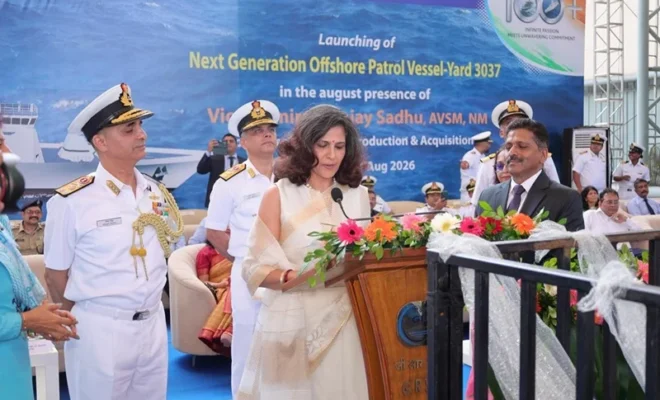
Another significant step towards enhancing its maritime surveillance capacity and shipbuilding capability has been taken by the Indian Navy with the launching of the NGOPV named “Shruti” at Garden Reach Shipbuilders & Engineers (GRSE) on August 11, 2026.
Known as Yard 3037, Shruti is part of a programme that involves building 11 NGOPVs. These ships are being built at GRSE, Kolkata and Goa Shipyard Limited (GSL), showcasing India’s constant efforts of designing and manufacturing naval vessels within the country.
The ship can perform several tasks apart from regular patrolling such as maritime surveillance, search and rescue, security of the offshore assets, humanitarian assistance and disaster relief and piracy.
What Is Shruti?
The ship ‘Shruti’ is a Next Generation Offshore Patrol Vessel, which refers to the type of naval ship whose primary objective is to be present in the maritime area.
While frontline ships are heavily armed with weapons and their sole objective is combat, offshore patrol vessels are supposed to cater to all those requirements of a naval presence at sea that do not include high-intensity warfare.
The NGOPVs of the Indian Navy are meant to add more ships to the offshore patrol vessel fleet. According to the Ministry of Defence, the new ships will help improve surveillance and defence in areas of interest and also assist in search and rescue efforts.
When and Where Was Shruti Launched?
Shruti was commissioned on August 11, 2026, from GRSE in Kolkata. The launching ceremony was carried out in keeping with Indian Navy tradition, where representatives from both the naval force and shipyards were in attendance.
Shruti is formally known as Yard 3037. The launching of this ship marks yet another step in the development of the series of 11 ships in the NGOPV project, which is currently ongoing in both GRSE and GSL.
The first ship in the series, Shachi, was launched in GSL on March 31, 2026. The second ship, Sanghmitra, which is formally known as Yard 3039, was launched in GRSE in May.
What Are Shruti’s Key Features?
Most importantly, the versatility of the vessel makes up for the unique nature of Shruti. In other words, it was designed not only to perform one task but several.
The ability to conduct surveillance is especially valuable because the offshore patrol vessels are able to operate for extended periods of time and cover certain areas. Thus, it gives the Navy new means of maritime surveillance, which are not going to distract from more important tasks any frontline combatants.
Furthermore, the NGOPV program envisages the presence of several capabilities that are going to allow the ship to provide such services as search and rescue, protection of offshore resources, humanitarian assistance and disaster relief, and anti-piracy activities.
All those roles will prove their usefulness in view of the growing maritime interests of India throughout the Indian Ocean.
How Will Shruti Help Maritime Surveillance?
Maritime surveillance is one of the key functions of the ship.
India is endowed with an extensive coastal area and operates in a maritime environment which includes shipping routes, energy assets at sea, fishing and sea lines of communication. Being vigilant about such a wide area would involve using a number of naval and coast security platforms.
This ship like Shruti could help provide such maritime surveillance through persistent naval presence in the maritime domain. Hence the function of this ship is not limited to patrolling along some coast, but helping the Navy maintain vigilance and manage situations in its maritime interests.
The employment of additional NGOPVs will further help the Navy in managing its routine maritime surveillance and security tasks effectively.
Why Is Anti-Piracy a Major Role?
Counter piracy is another essential duty for naval ships operating near the heavily trafficked international shipping lanes.
In the past, India has used its naval ships to protect commercial shipping and deal with security threats in the larger Indian Ocean area. A small fleet of modern patrol vessels would help with such duties without having to use only destroyers, frigates and other frontline combatants of the Navy.
As a multi-role ship, Shruti is suitable for duties where presence, surveillance and quick action are needed more than any significant offensive capacity.
That leaves the country’s larger ships free for missions which require special combat skills from them.
How Could the Ship Be Used For Disasters Relief Efforts?
The value of the ship lies not only in security missions.
The Indian Navy participates actively in rescue efforts during natural disasters, evacuations, humanitarian emergencies and similar situations in the Indian Ocean area. The ships could serve to provide transportation, communications, logistics and emergency services in case the regular infrastructure was destroyed or not accessible.
The NGOPV program includes Humanitarian Assistance and Disaster Relief among the intended missions of such vessels.
What Does Shruti Mean for Make in India?
Launch of this type of naval platform is also crucial since the platform has been designed and developed indigenously.
The Ministry of Defence has aligned the NGOPV project with the overall government strategy of Aatmanirbhar Bharat and Make in India. The construction of 11 ships by GRSE and GSL represents an effort to increase indigenous ship building capability and minimize reliance on imported naval platforms.
Serial construction has special significance for India’s defense industry. Construction of several naval platforms based on the same design enhances efficiency in production and helps develop industrial capacity.
Why Is Shruti Strategically Important?
The value of Shruti is not just in its being one additional warship, but rather in what else the NGOPV project brings to India’s naval architecture.
Modern navies have various classes of ships for different purposes and missions. To use a heavy and modern frontline warship for regular patrols, rescue or counter piracy will waste assets, which should have been left for higher-level missions.
Having a larger fleet of OPVs increases the versatility of the Indian Navy.
Shruti thus can help in creating layers of security, where specialized patrol vessels take care of regular patrols and other low-intensity tasks, while destroyers, frigates, etc. take care of more difficult missions.
What Will Come Next for Shruti?
The launch of the ship does not mean that it becomes a part of the Indian Navy right away.
After the launch, the vessel still needs to go through several stages of equipping, testing and trials, after which it is commissioned into the Navy. Naval vessels usually require thorough testing to make sure all the necessary propulsion, navigation, communications, reconnaissance equipment, etc. is working fine.
Nevertheless, the launch is a very important construction milestone.
Must-Read Naval Security Updates
What Is Operation Sankalp About?
Dive into how Operation Sankalp is strengthening security across the Arabian Sea.
Why Was INS Vagir Commissioned?
Check out how INS Vagir is boosting India’s maritime defense capabilities.
How Is Navy Day Celebrated?
See how powerful warships and aircraft marked the nation’s Indian Navy Day celebrations.
Why Is Goa Raising Objections?
Look into the controversy surrounding the Indian Navy flag-hoisting issue ahead of 15 August.
How Is Thailand Securing Trade?
Find out why Thailand has launched a three-day Andaman patrol to protect global Indian Ocean trade routes.
Conclusion
The commissioning of the Shruti into service goes beyond the simple fact of adding yet another patrol craft to the Indian Navy’s fleet. It marks the Indian Navy’s larger efforts towards enhancing maritime surveillance capabilities, operational flexibility and building up more naval platforms.
As a vessel meant to perform a variety of functions such as surveillance, search and rescue, offshore-asset protection, anti-piracy operations and Humanitarian Assistance and Disaster Relief operations, Shruti is capable of executing many of the tasks which maintain the maritime security network of India.
The launching of Shruti from GRSE also underscores the increasing importance of India’s own shipbuilding capability as well as its efforts to develop an indigenous naval construction base.
Shruti is not just another combat vessel; its real value lies in offering the Indian Navy a modern and indigenous platform to conduct maritime surveillance, security, emergency response and anti-piracy operations.