PM Modi Marks World Rhino Day: How India’s Conservation Push Helped the Greater One-Horned Rhino Recover
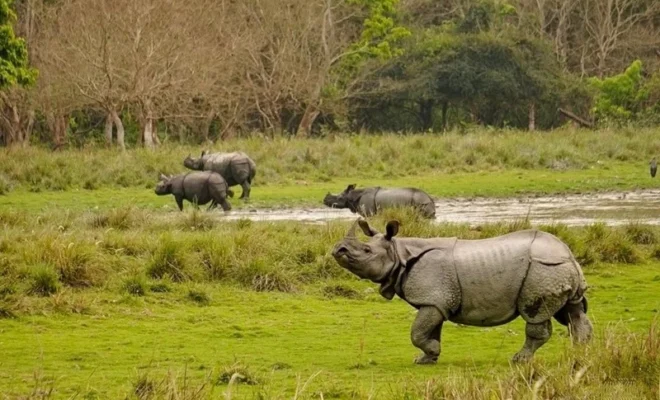
India marked World Rhino Day 2026 with a renewed focus on the conservation of the greater one-horned rhinoceros, one of the country’s most recognisable wildlife species. Prime Minister Narendra Modi highlighted India’s conservation efforts on September 22 and praised the people and authorities working to protect rhinos across their range states.
The occasion also brought a new development: the initiation of Project Rhino, which will provide financial and technical support to rhino-bearing states for protection, habitat management, genetic improvement and better understanding of rhino population dynamics.
The announcement comes against the backdrop of a remarkable recovery story. Assam now holds nearly 80% of the world’s rhino population, while conservation and reintroduction efforts in Bihar, West Bengal and Uttar Pradesh are expanding the species’ protected range in India.
Why the Greater One-Horned Rhino Matters
The great one-horned rhinoceros is synonymous with the savanna and wetlands of the Indian sub-continent. Having faced tremendous threats to its existence due to poaching and habitat destruction, the species has become a classic case study for the success that wildlife conservation efforts can produce.
India’s conservation experience is especially significant in this regard because, apart from the conservation of individual species, the survival of the rhinoceros species calls for the preservation of vast grasslands and wetlands ecosystems, proper management of protected areas, and prohibition of hunting to allow for population growth.
Speaking on World Rhino Day, Prime Minister Modi highlighted the significance of India in terms of being a custodian of the rhinoceros species.
Kaziranga’s Role in India’s Rhino Recovery
As far as India’s history of rhino conservation is concerned, the Kaziranga National Park in Assam continues to hold significant importance. The national park has a huge percentage of the greater one-horned rhino population in India.
However, it is the anti-poaching operations of the park that have been duly acknowledged by the Prime Minister of India. As Modi noted, the operations of Kaziranga against rhino poaching need to be appreciated in light of the fact that almost 80 percent of the world’s rhinos are found in Assam.
The case of Kaziranga highlights that rhino conservation cannot be achieved through just one approach.
How India Expanded Rhino Conservation Beyond Assam
While Assam continues to be the heartland of the Indian rhino habitat, the conservation drive has become more diversified beyond the state.
As the PM’s World Rhino Day address notes, the Indian rhinoceroses have either re-established themselves or are very much secure in certain regions of Bihar and West Bengal. In addition to this, the successful repopulation of the rhino in Dudhwa, in the state of Uttar Pradesh, has also become an important conservation achievement.
Besides providing for the growth of the rhinoceros population, these endeavors will also help mitigate the risks of keeping the species confined to a certain geographic location.
What Is Project Rhino?
The major announcement that has been made regarding World Rhino Day 2026 is Project Rhino.
The program is aimed at offering assistance to the regions where rhinos are found, financially and technologically. The fields covered by such assistance include species protection, habitat management, genetic management, and population dynamics.
In essence, this means that the conservation process is going further than just protecting the species from poachers. It also involves an understanding of how the population dynamics of rhinos work, how to manage their habitats, and genetic issues related to conservation efforts.
Why Habitat Protection Is Just as Important as Anti-Poaching
The protection of rhinos involves the protection of their ecosystem.
Greater one-horned rhinos are highly dependent on grassland, marshes and riverside ecosystems. Such habitats could be affected by factors such as invasive plant species, altered water sources, human presence and other influences.
This makes the habitat management a crucial aspect of the conservation process. With the rise in the population of rhinos, food, water, land and a safe place for breeding are essential requirements.
The habitat management aspect of the project Rhino by the government makes the conversation on conservation go beyond the war against poaching.
The Importance of Dudhwa’s Reintroduction Effort
Another significant component of conservation in India is represented by Dudhwa in Uttar Pradesh.
The successful reintroduction of the rhinoceros in Dudhwa was mentioned by Prime Minister Modi as “a piece of history-making.” This shows that the proper wildlife management could restore species to those places where the latter were once extinct or endangered.
However, there are certain considerations that have to be taken into account, as animals require proper environment and protection.
From Saving Animals to Managing Populations
Contemporary approaches to conservation are largely concerned with the study of population biology rather than the counting of animals only.
This is shown in the case of Project Rhino, which deals with studying the population dynamics and genetic enhancement. Such factors can allow conservation agencies to understand growth, movement, breeding, and health of various rhino populations.
Such a scientific approach is becoming very relevant when the population recovers. When a certain species moves from critical state to a growth phase, the conservation approach can change.
Why World Rhino Day Matters in 2026
World Rhino Day is celebrated each year on September 22 in order to increase awareness regarding the importance of protecting rhinos from various dangers such as poaching.
This year’s celebration in India is even more special since it not only acknowledges the successes of the past, but it is also associated with launching a new nationwide effort.
Hence, World Rhino Day is not just about recognizing and honoring an endangered species. It is also about sustaining the structures responsible for bringing back the rhino population and further improving them.
India’s Conservation Story Is Still a Work in Progress
The successful conservation efforts with regard to the greater one-horned rhino do not imply that all the conservation challenges have been overcome.
Rhinoceros poaching is an international problem that continues to be a concern, and habitat protection demands constant monitoring and investment. Changing climate and ecological conditions can impact wetlands and grasslands used by the wildlife as well.
India’s experience with conservation has shown that there can be great success when conservation is done consistently. The development of a new Project Rhino concept will enable India to move to the next stage of rhino conservation.
Conclusion
World Rhino Day 2026 has put the conservation story of India’s greater one-horned rhinos on the map. From the anti-poaching efforts of Kaziranga to rhino conservation in Bihar and West Bengal and the introduction project at Dudhwa, the Indian conservation method is gradually becoming a blend of all these elements.
Project Rhino makes an additional contribution to such a process through financial and technical assistance provided to range countries.
It can be stated that for the species that was on the verge of extinction due to its population reduction, the success story is only starting now and will be based on the further improvement of habitats, management, science and community engagement.
Wildlife, Conservation & India’s Latest Developments
How Is Assam Protecting Its Rhinos?
Check out the conservation efforts behind Assam’s growing rhino population.
Which Wildlife Retreats Should You Visit?
Explore India’s must-visit wildlife retreats for unforgettable nature experiences.
How Is Kaziranga Protecting Flooded Wildlife?
Find out how rescue and habitat monitoring efforts support wildlife.
Could Free Coaching Boost Exam Preparation?
Discover how PM Modi’s online coaching initiative supports competitive exam aspirants.
What’s Behind India’s Central Asia Push?
Uncover the uranium deal and key agenda at the SCO Summit.