
China Unveils Underwater Drone Mothership: What It Means for India’s Bay of Bengal Defence Posture
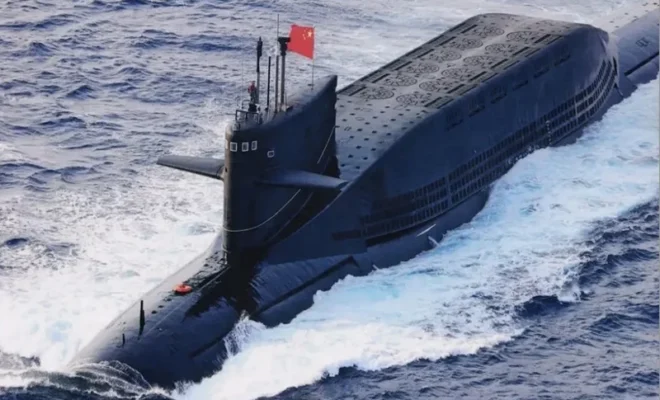
China’s ongoing effort towards naval modernization has seen another important development with the unveiling of what experts believe might become the world’s first purpose-built mothership for gigantic uncrewed submarines. According to a satellite image analyzed by Naval News, a large ship is currently under construction at Hudong-Zhonghua shipyards of Shanghai which looks like a mothership meant for launching and recovering large unmanned underwater drones.
While the development can have implications in China’s own backyard, the emergence of large autonomous underwater drones for Beijing might lead to rethinking maritime surveillance, seabed operations and even anti-submarine warfare tactics in the broader Indo-Pacific region, including the Bay of Bengal, for India.
What needs to be noted here is the distinction between what is and what can be concluded from the observation made. While the identity of the ship remains unknown till date, its possible purpose can be surmised from the available information.
What Is China’s Underwater Drone Mothership?
It looks like the ship being built in Shanghai is significantly larger than typical support ships for uncrewed underwater vehicles. According to Naval News, the new ship features a well deck at the stern of the ship with a massive cradle that can be lowered into the water by 12 vertical jack-up arms. The sizable hangar located just before the well deck would be big enough to hold around four very large uncrewed underwater vehicles or many smaller systems.
However, this design implies that the ship may not simply transport the equipment, but rather be able to act as a mobile platform that launches, retrieves, maintains, and re-deploys such systems.
This capability is significant since it will make possible the operation of large autonomous underwater vehicles from the mobile platform independent from fixed naval installations.
What Are XXLUUVs and Why Do They Matter?
The unmanned underwater vessels used in the system are referred to as extra-extra-large uncrewed underwater vehicle (XXLUUV). The vessels are significantly larger than the ordinary autonomous underwater vehicles used for oceanographic studies and mine-detection purposes.
According to reports published by the US Naval Institute early this year, China was developing two XXLUUVs larger than 40 metres in addition to some extra-large underwater vehicles.
The size of these unmanned submarines could help them carry larger batteries, sensors, and mission systems compared to other autonomous underwater vehicles. Such systems can be used for long-term surveillance, seabed mapping, intelligence gathering, mining operations and other sub-sea missions.
However, the exact operational abilities and weapon systems of the Chinese submarines are unclear at the moment.
Why the Mothership Changes the Equation
It makes such a large autonomous underwater drone much more useful if it can be shipped to an area close to the place where it is going to operate.
That is where the idea of the mothership begins to make sense strategically.
Rather than forcing each large autonomous underwater drone to operate on its own from a distant Chinese base, there would be the possibility of having a ship carry them to an area nearer the operational zone where they will operate. The ship may recover the drones, maintain them and send them off again.
That means there will be yet another element in the operations in undersea waters: the drone, the mothership that carries it, and the entire sensing system for commanding it autonomously.
It is thus not only another unmanned vehicle.
Why the Bay of Bengal Matters for India
This development is especially significant for India because the Bay of Bengal is part of the eastern maritime security landscape of the nation.
The area connects the Indian sub-continent with the Andaman and Nicobar Islands and falls under the broader maritime domain between the Indian Ocean and Southeast Asia.
India has traditionally paid much attention to maritime domain awareness and anti-submarine warfare operations in the area. India’s Navy is also enhancing its indigenous capability for underwater surveillance operations. In 2026, India inducted more units of the Mahe class Anti-Submarine Warfare Shallow Water Craft, which is used for underwater surveillance, anti-submarine warfare and mine warfare missions.
Therefore, the presence of large autonomous underwater systems will create one more type of activity in the underwater realm for Indian surveillance operations to identify and classify.
Does This Mean China Is Targeting the Bay of Bengal?
There is no publicly available information proving that the new mothership has been built for deployment in the Bay of Bengal.
At the moment, the vessel is under construction, and there is no publicly available information about its planned use. Specialists have made assumptions about its usage based on its design, and not because of an officially declared operational plan of China.
Hence, it would be too early to state that the mothership is a threat for the Bay of Bengal.
What can be said is that the technology has some influence on the Indo-Pacific undersea space. In case if China will deploy its large autonomous underwater vehicles in remote areas, the nations operating in the Indian Ocean will face an extra threat.
India’s Existing Maritime Response
India is already developing capabilities that would be necessary in this new environment.
The Indian Navy has been building up its anti-submarine warfare capability, and India’s maritime security approach is now paying more attention to information exchange and maritime domain awareness.
For instance, the Colombo Security Conclave recently held a tabletop exercise in Visakhapatnam in relation to coordination of illicit maritime activity and information exchange arrangements in the Indian Ocean Region.
India has also developed autonomous underwater capabilities in science and maritime applications.
Under the government’s Deep Ocean Mission, there are platforms available for the deployment of remotely operated and autonomous underwater vehicles.
While these do not directly respond to this Chinese mothership, they indicate the general direction that India’s maritime technology sector has been moving.
The Bigger Shift: From Submarines to Autonomous Underwater Networks
Perhaps the most important takeaway is that underwater warfare is becoming increasingly autonomous.
Traditional naval strategy has largely focused on submarines, surface combatants, aircraft and fixed surveillance systems. Autonomous underwater vehicles add another layer because they can potentially remain underwater for long periods while collecting information or performing specialised missions.
China has already demonstrated interest in this broader concept. The US Naval Institute has noted China’s development of autonomous and unmanned maritime systems capable of operating across the surface and underwater domains.
The new mothership could therefore be understood as part of a larger Chinese effort to build an ecosystem around autonomous maritime operations rather than as an isolated shipbuilding project.
What Indian Maritime Experts Will Be Watching
The obvious initial question for India is not just whether China has an innovative mothership for underwater drones. It is what impact such systems may have on the surveillance environment of the Indian Ocean.
The future surveillance difficulties may be to distinguish conventional submarines from autonomous underwater vehicles, detect unmanned systems around seabed facilities, and keep track of congested undersea environments.
The combination of satellites, maritime patrol aircraft, surface vessels, submarines, seabed sensors and autonomous systems that India has been developing may gain more importance with advances in undersea technologies.
The National Maritime Foundation has, separately, discussed the overall strategic significance of autonomous systems and the necessity of adapting Indian naval platforms to unmanned warfare.
Conclusion
The new underwater drone mothership in development in China is significant for naval innovation, although the actual function of the ship within the navy’s arsenal is yet to be determined.
What is known through satellite imagery is that it is a big ship that appears to be built specifically to carry and launch enormous unmanned underwater drones. The belief is that it could possibly carry a few XXLUUVs.
The importance for India, therefore, is not the mothership itself but the fact that it is indicative of how rapidly autonomous underwater technology is evolving.
Thus, the Bay of Bengal region would become increasingly important as far as maritime situational awareness, undersea surveillance, and antisubmarine capabilities go because of how major powers are finding ways of working under the sea.
China’s latest underwater drone mothership does not pose a direct threat to the Bay of Bengal at this point, but it is definitely indicative of an evolving undersea scenario that India would have to keep an eye on going forward with regards to autonomous maritime technology.
Key Stories Shaping India Today
Why Did India Reject The Statement?
Check out India’s response to the Pakistan-China joint boundary statement.
What Does India’s Gender Ranking Reveal?
Find the key takeaways from the WEF Global Gender Gap Index 2026.
Can Staff Transfers Solve University Shortages?
Uncover why staff redistribution may not address higher education challenges.
How Is Assam Protecting Its Rhinos?
Browse the latest rhino population figures and Kaziranga’s conservation efforts.
Why Are Subsea Cables Becoming Strategic?
Dive into how BRICS and Western nations are rethinking undersea security.