
India Rejects Pakistan-China Joint Boundary Commission Statement on Border Territory
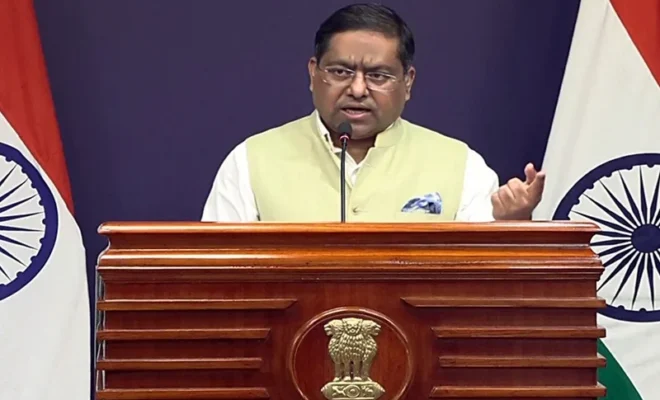
India has outright rejected the new Pakistan-China Boundary Joint Commission that was established, saying that Pakistan cannot make arrangements with China regarding areas in Jammu and Kashmir and Ladakh that India claims.
This rejection follows a meeting between the commission members in Islamabad on September 16 to discuss a number of matters related to border management, surveys of the borders, boundary pillars, and connectivity.
According to New Delhi, the agreement has no legal standing from India’s perspective and does not alter its position regarding Jammu and Kashmir and Ladakh.
What Is the Pakistan-China Boundary Joint Commission?
The purpose of the mechanism between Pakistan and China is to have a structure that will help handle practical issues on the border area.
These include, for example, taking care of the boundary, joint surveys, handling of boundary markers, cross border facilities and management of incidents at the border.
This explains why the meeting between the two in Islamabad was referred to as a mechanism for technical cooperation regarding the border.
This view is held differently by India since part of the land belongs to New Delhi.
Why Has India Rejected the Move?
According to MEA, India’s stand on the issue that it does not acknowledge the Boundary Agreement between Pakistan and China remains the same as it has been from many years.
MEA spokesperson Jaiswal stated that India’s position on the issue was “consistent and clear” and also dismissed the “so-called” Joint Commission. It is claimed by India that there is no accepted boundary between Pakistan and China regarding Indian territory.
In New Delhi, it has raised objections regarding Pakistan making any agreements with China for the territory which is illegally and forcefully occupied by Pakistan.
Why Does the Shaksgam Valley Matter?
One of the main issues that have led to this situation is linked to the China-Pakistan Boundary Agreement signed in 1963.
According to this agreement, China and Pakistan have defined their boundary within the territories surrounding the Pakistani-occupied Jammu and Kashmir, which include the region known as the Shaksgam Valley.
India has repeatedly rejected this agreement, and it believes that Pakistan did not have the right to transfer any land, which belongs to India. Hence, any agreement between China and Pakistan since then has been considered unacceptable by India.
What Has India Said About Jammu and Kashmir and Ladakh?
India has clearly stated that the Union Territories of Jammu and Kashmir and Ladakh are integral parts of India.
Moreover, the government has stated that any agreement between Pakistan and China cannot change the stand taken by India regarding the territories in question or confer legitimacy on the occupation described by India as illegal.
This is in line with the stand taken by India regarding the issue of territorial dispute in Pakistan-occupied areas of erstwhile Jammu and Kashmir.
Why Is This Happening Now?
This is an important point considering that India, China, and Pakistan are all simultaneously dealing with a number of interconnected strategic and territorial questions.
China and Pakistan have close political, economic, and security relations, and the China-Pakistan Economic Corridor runs through areas that India considers its own territory. New Delhi has raised repeated objections to projects in the area of Pakistan-occupied Jammu and Kashmir on the grounds that they relate to Indian territory.
The implementation of such a boundary arrangement has more than just technical importance. This is especially true from New Delhi’s point of view because of the possibility that a gradual framework for relations between China and Pakistan may be established through such arrangements.
Does the Commission Change India’s Sovereignty Position?
No, says the Indian government.
The Indian authorities have clearly indicated that the Pakistan-China agreement does not in any way affect India’s claim to sovereignty over the disputed territories. India has further made it clear that it will not recognize the efforts at altering the status of the disputed territories through the agreement between Pakistan and China.
In other words, the formation and functioning of the commission has no effect on India’s position.
What Did India Ask Pakistan to Do?
Alongside rejecting the commission, the MEA called on Pakistan to vacate territories that India says are under its illegal and forcible occupation.
Jaiswal also criticised what he described as “theatrics” and said Pakistan should instead withdraw from the areas under its occupation.
The language reflects how firmly New Delhi continues to oppose any Pakistan-China arrangement that it believes could affect India’s territorial claims.
What Happens Next?
The obvious query is what course Pakistan and China will now follow regarding the newly-formed body and whether its operations go beyond technicalities involved in the management of the border region.
In terms of India, the critical question is whether any future talks, surveys, infrastructure projects or border arrangements include the regions claimed by New Delhi.
This move takes place against a backdrop of India-China relations going through a cautious stage of engagement, as recently witnessed at the BRICS Summit where the two leaders had met and deliberated upon improving bilateral relations even as recognizing the importance of border-related issues in the overall relationship equation.
This makes the recent development in the Pakistan-China border very crucial for India’s broader regional diplomacy.
Conclusion
The refusal by India of the Pakistan-China Boundary Joint Commission is based on India’s stance over the regions of Jammu and Kashmir, Ladakh and the region covered by the 1963 Sino-Pak boundary agreement.
Whereas for Pakistan and China, the joint commission would serve as a means of facilitating practical border cooperation, the Indian side contends that neither Pakistan nor China can make any arrangement regarding disputed territories without Indian consent.
Though the commission for the moment doesn’t change India’s official stance, yet in future, the activation of the commission may become a major issue between India and Pakistan as well as China.
Key Developments Shaping India’s Global Position
Why Does India Rank 131st Globally?
Check out the key findings from the WEF Global Gender Gap Index 2026.
How Are Nations Securing Subsea Cables?
Explore how BRICS and Western nations are rethinking undersea security.
Why Are Arunachal Border Locations Important?
Find out why these 27 mapped locations matter strategically.
What Could the 18th BRICS Summit Bring?
Dive into the summit agenda and India’s role in hosting global leaders.
Why Does India Need Global Lithium?
Uncover why Argentina, Australia, and Chile matter to India’s mineral strategy.