
India Summons Pakistan Envoy Over ‘Unprofessional’ Naval Vessel Incident in Arabian Sea
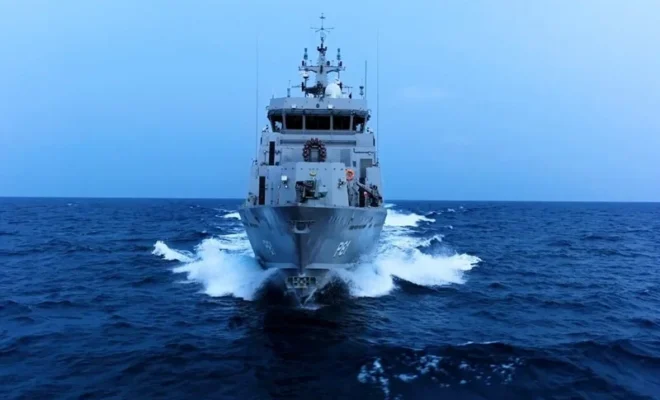
India and Pakistan are facing fresh diplomatic friction after naval vessels from the two countries were involved in a collision in the North Arabian Sea on September 15, 2026. India subsequently summoned Pakistan’s chargé d’affaires in New Delhi and lodged a strong diplomatic protest, describing the conduct of the Pakistani naval unit as “unacceptable and unprofessional.”
The incident took place in international waters while an Indian Navy frontline warship was reportedly carrying out a routine surveillance mission. According to Indian accounts, the Pakistani naval vessel PNS Hunain approached the Indian warship at high speed and manoeuvred in an unsafe manner before the collision.
What Happened in the Arabian Sea?
According to reports citing Indian officials, PNS Hunain approached an Indian Navy frontline ship at a rapid speed on the night of September 15th. As per the Indians, the maneuver was not only risky but unprofessional as well, leading to a minor accident.
There was no major damage to the Indian Navy ship and it went about completing its mission. On the other hand, the Pakistani ship suffered some damage and made its way back to the harbor. According to various reports, the damage done to the ship was localized in its forward area.
The event took place in the international waters of the northern Arabian Sea.
Why Did India Summon Pakistan’s Diplomat?
Following the event, India’s Ministry of External Affairs called upon the High Commissioner of Pakistan Charge d’Affaires Saad Warraich in New Delhi. India made what was referred to as a strong protest against the behavior of the Pakistani naval forces that caused the collision.
India further ordered its charge d’affaires in Islamabad to make the same protest with Pakistan’s Ministry of Foreign Affairs. This diplomatic action suggests that the government of New Delhi is considering the event as something more than just a regular maritime incident, and it would like Pakistan to deal with the behavior of its naval forces.
What Did India Say About the Naval Conduct?
The behavior of the Pakistani ship was considered by India to be “unacceptable and unprofessional.” Indian diplomats claimed that the maneuvers carried out by the Pakistani ship were not consistent with the necessary precautions in such circumstances when naval ships are operating in close proximity to each other.
India also referred to a bilateral arrangement of 1991 on the military operations and movements of military units. It is reported that according to this bilateral agreement, both Indian and Pakistani ships and submarines have to maintain a distance of three nautical miles in international waters.
The government of New Delhi has asked Pakistan to take measures in order to ensure that its military units comply with bilateral agreements.
Pakistan Has Presented a Different Account
The incident has also produced a counter-narrative from Islamabad, which has rejected India’s characterization of events.
Pakistan summoned India’s chargé d’affaires and lodged its own protest, describing the incident as “highly provocative and unacceptable.” Pakistan has alleged that the Indian vessel carried out dangerous manoeuvres and has disputed India’s account of responsibility.
Pakistan has also said the incident occurred within its exclusive economic zone during a naval exercise and raised objections concerning international law and the 1991 bilateral agreement. These claims contrast with India’s account that the collision occurred in international waters and resulted from the Pakistani vessel’s unsafe manoeuvring.
The competing accounts mean that responsibility for the incident remains disputed.
Why the 1991 Agreement Matters
The relevance of the agreement of 1991 is the reason why this case is relevant. This agreement is supposed to minimize the risk of escalation that would otherwise be associated with a potential accidental military collision.
Naval fleets of countries with tense relations may be found operating within overlapping maritime spaces, and that makes it very necessary to have adequate communication and predictable distance. As such, a collision between military ships is something that has diplomatic connotations in addition to the damage done to the ships involved in the collision.
Why the Case Is Important Right Now
The collision happens in a context where relations between the two states are already quite difficult. The two states are nuclear rivals and have a history of military confrontations and tensions.
The importance of the case comes from the fact that this is the first instance of direct engagement between the naval fleets of both states at a time when the relations are still quite tense. Reuters and other news outlets describe this as the first military confrontation between the two sides since their four days’ conflict last year.
What Happens Next?
The initial emphasis will probably be on diplomatic communication and the situation relating to the collision.
India has urged Pakistan to ensure that its military forces respect bilateral pacts and not have any such occurrence in the future. On the other hand, Pakistan has officially protested against the conduct of India and has offered its version of the incident.
Additional information about the maneuvers, location of the incident, and situation preceding the collision would add clarity to the two conflicting versions. In the meantime, the assertions regarding responsibility need to be viewed as the stance of the respective governments.
Why Maritime Safety Matters
Maritime interactions are more delicate than those in commercial shipping because the naval ships may be moving very fast or carrying out surveillance missions and exercises.
Even if a minor amount of damage is caused by the collision, there could be diplomatic repercussions due to the involvement of military ships. For that reason, it is very important that the navigation and communication rules are adhered to especially if the vessels belong to two nations with a fragile relationship.
This particular case highlights the importance of having these confidence-building measures in place.
Conclusion
India’s decision to summon Pakistan’s chargé d’affaires follows a collision between an Indian Navy vessel and Pakistan’s PNS Hunain in the North Arabian Sea on September 15.
India has described the Pakistani vessel’s conduct as “unacceptable and unprofessional” and says the incident involved unsafe manoeuvring. Pakistan has rejected that account and lodged its own protest, describing the Indian vessel’s actions as provocative.
With both countries using diplomatic channels to register their positions, the immediate issue is not only the collision itself but also whether established maritime agreements can prevent similar encounters from escalating further.
India’s Borders, Security & Strategic Resources
Why Did India Reject Border Statement?
Check out India’s response to the Pakistan-China joint statement.
What Does India’s Gender Ranking Reveal?
Find key takeaways from the WEF Global Gender Gap Index 2026.
How Are Nations Securing Subsea Cables?
Uncover how BRICS and Western nations are rethinking undersea security.
Why Are Arunachal Border Locations Significant?
Browse the 27 locations mapped by the Survey of India.
Why Does India Need Lithium?
Explore why Argentina, Australia, and Chile matter to India’s critical mineral strategy.