
Assam Rhino Population Reaches 3,260: Conservation Success and Kaziranga’s Role Explained
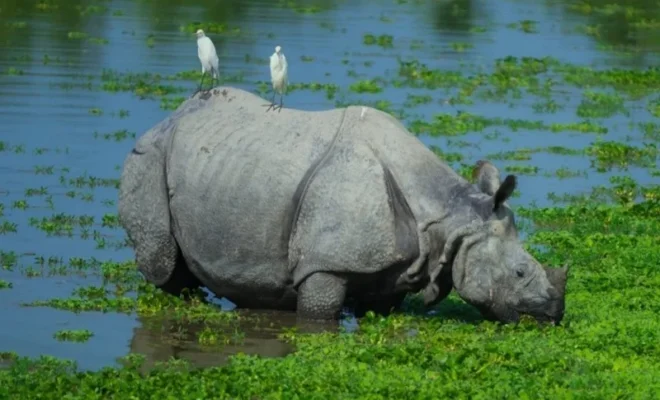
The one-horned rhinoceros of Assam has become one of the conservation success stories of India with the population of rhinos in Assam recorded to be 3,260. The number brings to focus the efforts made in conserving the rhinos in the protected areas of Assam, especially Kaziranga National Park, which continues to be the major home of the one-horned rhinos.
The number is important since rhino conservation in Assam has included decades of habitat conservation, poaching prevention, scientific research and translocation of the rhinos. Official government documents indicate that there has been a consistent long term rise in the rhino population of Assam even though the official wildlife database of the state still indicates the historical rhino census numbers up to 2018.
Why the 3,260 Rhino Figure Matters
The 3,260 rhinos reported in Assam signify the conservation narrative of the greater one-horned rhinoceros. Assam is one of the most significant places where the species still exist; their protected areas have been key to ensuring that no further reduction in their numbers took place.
According to government figures, the number of rhinos present in Assam’s Kaziranga, Manas, Orang and Pobitora in 1999 was 1,672, but by 2018, it had grown to 2,652, with 2,413 in Kaziranga alone.
That significant growth explains why Assam is considered one of the best examples of wildlife conservation.
Kaziranga Remains the Heart of Rhino Conservation
When mentioning the successful conservation effort of rhinos in Assam, it is inevitable for the Kaziranga National Park to be mentioned.
As the Assam Government calls Kaziranga National Park as almost the home of great Indian one-horned rhinoceros, Kaziranga is a UNESCO World Heritage Site and tiger reserve.
Importance of Kaziranga National Park can also be seen in terms of numbers of rhinos present there. As Assam government mentions that Kaziranga contains 2,413 rhinos according to 2018 census, whereas Golaghat District Administration has reported 2,613 rhinos in Kaziranga till March 2022.
The Kaziranga National Park has created grassland and wetland habitats in the Brahmaputra floodplains.
How Kaziranga Became a Rhino Stronghold
There are a number of factors behind the success of Kaziranga as an example of successful wildlife conservation other than just its natural environment.
The conserved environment provides grasslands, wetlands and water sources which act as a source for both food and breeding of rhinos. On the other hand, forest department officials have established mechanisms to counter any threat, such as poaching, that the animals might be facing.
According to the Assam Forest Department, Kaziranga is home to over 70% of the world’s one horned rhinoceroses. This shows the tremendous density of the species in the park.
The high density of the animal in the park is at the same time a problem as well because the high density makes the species vulnerable to disasters.
Why Assam Needed More Than Kaziranga
Rhino conservation experts have been aware of the fact that rhino protection should not involve grouping almost all rhinos in one protected area.
Conservation history documentation of Assam indicates that over 90% of the state’s rhinos at one time used to be found within Kaziranga, thereby putting the species at risk. This is how the Indian Rhino Vision 2020 project came about to solve this problem by developing more viable rhino groups in other protected areas.
This explains why places like Manas National Park, Orang National Park and Pobitora Wildlife Sanctuary are critical in the rhino conservation efforts of Assam.
The Role of Manas and Rhino Translocation
Rhino translocation has played a crucial role in the conservation plan of Assam.
As per the Indian Rhino Vision 2020 project, rhinos have been translocated from their strongholds to areas where conditions are favorable for creating or rejuvenating the rhinos’ populations. Government documents suggest that Kaziranga and Pobitora are the source locations for rhino translocations, while Manas is a destination protected location.
What this strategy aimed at was not just increasing the rhino population in other parks but creating isolated groups of rhinos that can contribute to the survival of rhino species.
This strategy also helped Manas to become an important rhino habitat once again after some previous loss of rhinos due to social unrest and poaching activities.
Anti-Poaching Efforts Made a Difference
Poaching has always been one of the most serious challenges to the rhinos of Assam, owing to the demand for rhino horns.
In this respect, it is impossible not to mention the importance of enforcement.
The Assam forest department has relied on protected area surveillance, enforcement against wildlife crimes, monitoring and conservation programs to alleviate threats to rhinos. The economic survey of the Assam government has also emphasized action against wildlife crimes and zero tolerance towards rhino poaching.
This has allowed more animals to survive and reproduce, thus helping their population recover.
What Makes the One-Horned Rhino So Important?
The great one-horned rhino is not only symbolic of wildlife in Assam but also much more.
Rhinos are grazing animals which are an integral part of the grassland ecosystems and their grazing patterns are a part of the natural ecological dynamics of the ecosystem.
Conservation of the rhinos then implies conservation of not just the wetlands, but all the other species present in the ecosystem along with the grasslands.
Kaziranga has elephant and wild water buffalo among many others including rhinos in its wildlife habitat.
Conservation Success Does Not Mean the Work Is Over
It is positive to see that the numbers of the population are increasing; however, there are many challenges for conservationists ahead.
One of them relates to the fact that the rhinos are concentrated in just a few protected areas. The threats including habitat fragmentation, flooding, human-animal interaction, diseases, and poaching continue to persist, and need to be monitored constantly.
In fact, in the conservation report from the government of Assam, one of the key points has already been made about the necessity of setting up rhinos in several protected areas rather than concentrating them in one Kaziranga.
Why Kaziranga’s Role Remains Crucial
Whereas Assam has moved to conserve rhinos in several landscapes, Kaziranga continues to be the focal point in the efforts towards the protection of rhinos in the state.
A large number of rhinos, proper habitat and conservation experience for decades make this landscape one that is essential for breeding and conservation. The landscape will serve as a base from which rhino populations in other landscapes can be conserved.
The aim therefore is not merely to have rhinos in Kaziranga but in all landscapes.
What the 3,260 Figure Tells Us
The stated 3,260 rhinos in Assam is not only an indication of a single population figure but the result of a well-formulated conservation effort that has been implemented for decades.
The trend can clearly be seen from historical population data: The population of rhinos in Assam increased from 1,672 in 1999 to 2,652 in 2018 in the four locations indicated in the state’s records.
The current stated figure is thus indicative of the role of conservation in the recovery of a threatened species.
Conclusion
In essence, Assam’s rhinos have a story that centers on their conservation through time.
Kaziranga formed the primary area for their conservation, while initiatives like the Indian Rhino Vision 2020 made it possible for the strategy to expand beyond the park alone. Manas, Orang and Pobitora have all been key components in the bigger picture.
That the number of rhinos is 3,260 is therefore not just important in terms of numbers, but also in terms of the conservation efforts of the greater one-horned rhinoceros in Assam.
On the other hand, having the species concentrated in certain landscapes makes it necessary to continue conservation and habitat protection.
Explore Key Developments Shaping India
What Does Haryana’s ELV Ban Mean?
Check out the new NCR fuel rules and affected vehicle details.
How Are Nations Securing Subsea Cables?
Find out how BRICS and Western nations are rethinking undersea security.
Why Is India Mapping Himalayan Borders?
Uncover how India’s new mapping strategy supports Himalayan sovereignty.
Which Arunachal Border Locations Were Mapped?
Browse the 27 mapped locations and their key significance.
What Is This Quantum Breakthrough About?
Dive into RRI Bengaluru’s single-shot quantum state control technique.