
UNGA 2026: S. Jaishankar Co-Sponsors New ‘Partners for Multilateralism’ Alliance Alongside Global Leaders: S. Jaishankar Co-Sponsors New ‘Partners for Multilateralism’ Alliance Alongside Global Leaders
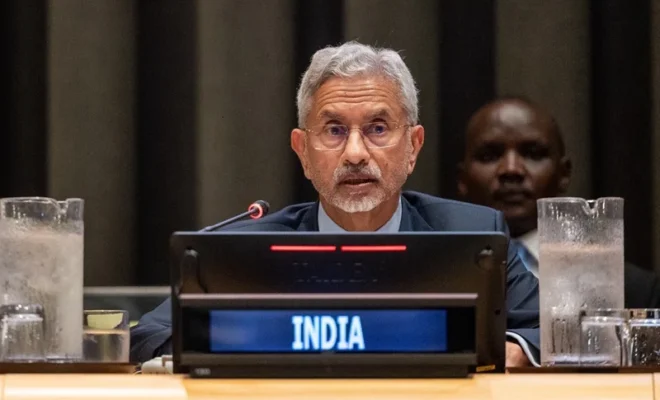
The 81st United Nations General Assembly has brought a new diplomatic initiative into focus, with India joining the inaugural Partners for Multilateralism, International Law, Peace & Prosperity (P4M) Summit in New York. External Affairs Minister S. Jaishankar co-chaired the meeting alongside European Council President António Costa, as leaders and representatives from several countries discussed how international cooperation can be strengthened at a time of growing geopolitical tensions.
The meeting comes against a backdrop of conflicts, economic uncertainty, supply-chain disruptions and increasing competition between major powers. For India, the initiative provides another platform to push for reforms in global institutions while emphasizing international law, broader participation and more transparent decision-making.
What Is the Partners for Multilateralism Alliance?
The Partners for Multilateralism (P4M) is a recent diplomatic approach aimed at fostering multilateral cooperation in place of forming an alliance that could be of a military or even of a treaty character. It was initiated by the European Union, Brazil, Kenya, and Canada; the first summit was attended not only by these but also by India, Australia and Barbados.
The principle is simple – to unite the nations and regions in the face of global challenges but without giving up the position of each one in its foreign policy. Its agenda is wide – ranging from international organizations reform, international law reinforcement to cooperation in areas where states cannot cope alone.
Why Did India Join P4M?
The participation of India is important because India has always advocated for a multilateral system which is more effective and representative. In the summit, Jaishankar stated that the current world order is under pressure due to geostrategic competition, tensions and conflicts. He stated that multilateralism should be more assertive in dealing with this situation.
In the case of India, P4M initiative is also important for India in the context of its advocacy for reform of international institutions and decision making that is more participative.
What Did S. Jaishankar Say at the Summit?
Jaishankar pointed out the “global 4F crisis,” which refers to fuel, food, fertilizer, and finance. According to him, the issues mentioned above are interrelated and cannot be dealt with separately by each country on its own.
Besides, he pointed out that any new technology needs proper governance and safeguards and that any disruption in the critical supply chains should be handled through increased diversification. Thus, Jaishankar brought issues of economic security, technology, and geopolitics in the same frame.
Why International Law Was a Major Theme
Another crucial aspect highlighted by Jaishankar is the need for international law and norms. In his view, multilateralism will function optimally where such laws and norms are respected.
The emphasis is crucial given that the present international climate is characterized by various disagreements among nations on the interpretation of international laws. It follows, therefore, that P4M can be viewed as a move to improve collaboration through established international institutions.
Who Is Behind the New Initiative?
The original idea is one involving the European Union, Brazil, Canada and Kenya. The first summit has broadened the debate to include countries like India, Australia and Barbados. Some of the leaders involved in the summit included President of the European Council, António Costa, President of Kenya, William Ruto, Australia’s Prime Minister, Anthony Albanese and Prime Minister of Barbados, Mia Mottley, and foreign policy representatives of Brazil and Canada.
The membership of the initiative makes it geographically diverse in nature.
What Does P4M Want to Change?
The project revolves around the belief that the current institutions of the world should become more representative, accountable, and effective. It is not about having more meetings at an international level; it is about improving the process of decision-making for the world.
It includes topics ranging from peace and international security, climate change and climate justice, new technologies, development funding, counterterrorism, global supply chains, and pandemic preparedness. Jaishankar pointed out that making progress in all these sectors would require countries to be willing to cooperate.
Why This Matters for India
Greater representation of the developing nations and the Global South in international decision-making has been one of the longstanding goals of India. Being part of the P4M would provide another avenue to discuss this agenda with European, African, North American, Latin American and Indo-Pacific countries.
It will allow India to be part of a flexible diplomatic platform without compromising on its participation in established fora like the G20, BRICS, UN and other multilateral organizations.
Is P4M a New Global Bloc?
In this context, no. Based on the descriptions provided, P4M seems to be designed as a malleable framework for cooperation, not a restrictive alliance with specific military and economic obligations. It centers its efforts on aligning approaches and building multilateral institutions based on the challenges faced.
This is crucial for understanding why this concept should be regarded as yet another diplomatic forum where nations can coordinate their approaches to global governance, international law, and common risks.
Why the Timing Is Important
P4M’s first-ever conference is being held at a time of high levels of uncertainty on the international stage. This is due to conflict, division, weak supply chains, and competition over new technology.
This is why Jaishankar’s speech highlighted the importance of strengthening multilateralism, not giving up on it. The reason for his argument was that global institutions require reform and increased engagement.
What Happens Next?
The immediate importance of this summit will be determined by whether the participating nations can convert the general principles outlined in New York into tangible cooperation. This initiative has created a platform, but its future importance will be based on how the members collaborate on topics such as institutional reforms, emerging technologies, supply chains, climate change and global economic security.
For India, the continuation of its involvement will give it another chance to push for a more balanced multilateral system, while engaging with nations that might not have the same geopolitical agenda as itself.
Conclusion
This year’s meeting at UNGA 2026 under the theme “Partners for Multilateralism” represents the emergence of a new diplomatic platform aimed at fostering international cooperation in an era of geopolitics and economics.
India was present through its Foreign Minister S. Jaishankar who also co-chaired the first discussion on the issue. The four focal areas highlighted by S. Jaishankar – “4F” crisis, international laws, reforms in institutions, and transparency and more participation – represent the broader perspective adopted by India in addressing global issues.
The new initiative is at an early stage, and its future influence will depend on how successfully the participating countries turn their common principles into cooperation. But for now, P4M is yet another diplomatic platform through which India is trying to shape the debate on multilateralism.
Five Stories You Shouldn’t Miss
Can EU Sanctions Override Indian Contracts?
Check out what the Delhi High Court ruling means for Nayara Energy.
How Will New CSCs Transform Rural India?
Find out how new Common Service Centres could expand rural services.
Could Red Hexagons Change Indian Eating?
Uncover what the new food-labeling symbol could mean for consumers.
Why Did Gujarat Warn About Garba Apps?
Browse the controversy surrounding “Rent a Garba Partner” apps.
What Happened in South Korea’s DMZ?
See what caused the landmine blast and injured three soldiers.