
The Red Hexagon on Your Food Packet Could Change What India Eats
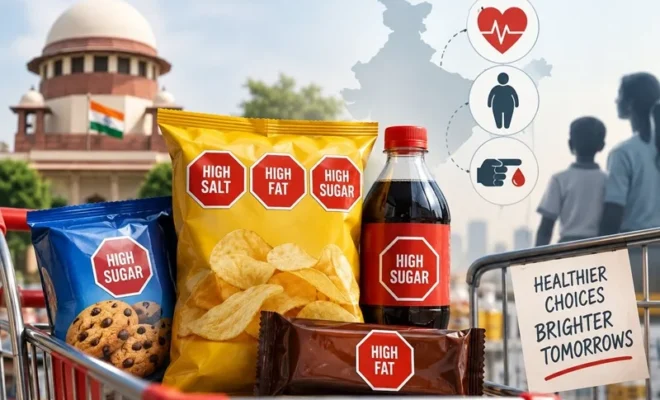
Indian consumers have been made to turn around a packet, locate an insignificant nutrition table and work out figures on sugar, sodium, saturated fat and calories before coming up with a decision on which product to include in their grocery list. This approach assumes that every consumer is capable of doing this.
The introduction of the new front-of-pack warning label with the red hexagon for foods or beverages with high amounts of certain nutrients such as sugar, salt and saturated fat is meant to make things different. In August 2026, the Food Safety and Standards Authority of India came up with this warning label for packaged foods and beverages that are high in sugar, salt and saturated fat.
The concept is very simple place the most important nutrition warning at the most conspicuous part of the packet the front of the pack.
Why the Red Hexagon Matters
This is the crucial difference between the front-of-pack warning label and the traditional nutrition labeling panel. The former educates and makes consumers understand the latter.
A shopper could easily evaluate the nutritional value of two breakfast cereals, cookies, instant meals, or drinks while standing at the end of a supermarket aisle in just a few seconds. However, asking the same person to determine how much sugar or salt there is in each portion would be impractical.
A clearly visible warning, such as HIGH SUGAR, HIGH SALT, or HIGH FAT, affects the decision-making process. It does not instruct consumers on which products to buy. It only tells what they are going to buy.
And this is a critical difference.
Food labeling is not supposed to dictate people’s diets. It is aimed at preventing the misleading perception of a product due to its marketing.
India Has Been Debating This for Years
This discussion is not new. FSSAI has long been deliberating the issue of front-of-pack nutritional labeling. Previous iterations included discussions of interpretive nutrition information and color codes. The previous document from FSSAI itself referred to front-of-pack nutrition labeling as a simplified form of nutritional information meant to assist in decision making for consumers.
The current proposal thus fits into a larger and far longer regulatory discussion.
What has changed is the urgency of the matter.
India is witnessing an increasing problem of obesity and diabetes and other such diseases related to improper dieting. At the same time, the role of processed foods in Indian diets has also increased manifold.
The discussion is no longer whether consumers should get nutritional information but rather whether this information is being given to them in the proper form.
The FMCG Industry Has a Different Concern
For the country’s massive fast-moving consumer goods sector, however, the red hexagon is far from just an insignificant design issue.
Packaging can be a strong marketing device. Color schemes, claims, images and phrases like “natural,” “light,” “energy,” “multigrain” or “healthy” can influence consumers’ perceptions even before they turn to the nutrition label.
A required warning placed right on the same package would thus be competing against that marketing language.
This is one reason why the idea has sparked opposition among leading food and beverage firms. Reuters noted that firms such as Coca-Cola, Nestlé and PepsiCo have been resisting the proposed warnings, contending that such labels might be misleading or ineffective.
Industry concerns need to be taken into account. There must be clear thresholds, scientific criteria and implementation requirements when it comes to regulations. Companies also require enough time to change their packaging and supply chain procedures in order for products to conform in various markets.
These are nevertheless two different issues.
The Real Battle Is Over Visibility
This debate must move beyond the naïveté of “government versus FMCG.”
What really matters is visibility.
Should the consumer know right away when a product has a high content of sugar, salt or saturated fat according to the regulatory criteria?
Or should they have to look for it? That is the essence of the matter. The introduction of the red hexagon does not decide on nutritional grounds for the consumer. The warning does not stop anyone from purchasing the product. It simply alters the amount of information presented at the time of purchase.
That is the very reason why front-of-pack labeling has emerged as a serious public health policy debate.
Why Children Make the Debate Even More Important
The question gets even more complicated when the targeted consumer is a child.
Children typically don’t analyze a product based on its nutritional content. Instead, they get influenced by the taste, brand name, packing, characters, advertising, and their familiarity with the product.
On the other hand, parents tend to make a fast decision while coping with job commitments, school activities, and all kinds of housework.
Thus, a warning label can give parents necessary information without turning them into experts in nutrition.
FSSAI has also been developing the rules regarding added fat, sugar, or salt in school food, which means that kids’ diet becomes a regulatory priority.
The Industry Should Compete on Better Products
There is another perspective on the red hexagon.
Rather than considering the warnings to be a danger to the FMCG companies, the firms could consider these as motivation to reformulate the product.
The firm whose product is now marked by high sugar warnings could take action towards lowering the sugar content the following day. The manufacturers can even consider reformulation of the product when the problem is related to salt.
That way, the regulations become a challenge among competitors.
Those firms which will be able to formulate a product which will be healthy yet at affordable prices would eventually profit from that change.
In other words, the future FMCG battle does not have to be about concealing the warning. It could be about eradicating the need for the warning.
The Government Must Get the Details Right
Backers of clearer food labeling cannot assume that all aspects of the proposal deserve unquestioning acceptance.
The thresholds need to make sense scientifically. The rules have to be consistent across product categories. There have to be clear exemptions. It needs to be understandable without being fear-mongering.
Perhaps most of all, the implementation process has to be based on strong science, not politics by any party.
The goal is not to scare people away from packaged foods or preserve old marketing habits but to provide them with useful information clearly presented.
The Red Hexagon Could Become a New Consumer Language
Food trends in India are changing very quickly. People are becoming health-conscious; however, knowledge about health should not be the outcome of people’s own studies alone.
The red hexagon has its strength in the fact that it needs no calculations.
It may eventually develop into visual communication that makes a consumer stop, analyze, and make a decision.
This doesn’t imply that a product itself is “bad.” It just shows that some specific nutritional aspect needs attention.
And this is the right purpose for regulation.
The Choice Should Ultimately Belong to the Consumer
While the best case for front-of-pack labelling is certainly not that regulators know what every Indian must consume.
They don’t.
Everyone has their own needs when it comes to nutrition and cost.
What the role of regulation should be is ensuring that information needed for making such decisions is clearly available and comprehensible and hard to hide.
With the proper implementation, the red hexagon may become not an icon of conflict between regulators and FMCG behemoths but rather an icon of transparency between food producers and consumers.
The packaged food industry of India has seen a remarkable growth. This means that its label has to grow along.
Ultimately, the red hexagon isn’t meant to tell Indians what to consume.
Key Issues Shaping India Today
What Did Supreme Court Question FSSAI?
Uncover what the delay means for health warning labels.
How Can You Host Indian House Parties?
Browse simple preparation timelines and menu ideas for hosting at home.
Why Is IMF Urging India On Rice?
Find out why the IMF has raised concerns about India’s rice export restrictions.
What Did Rahul Gandhi Criticize?
Check out the political exchange involving Rahul Gandhi, Narendra Modi, and India’s COVID situation.
Why Do Some Sell Free Ration?
Look into why some economically vulnerable families in Hyderabad reportedly sell ration for money.