
Indian Railways to Unveil India’s First 280 kmph Bullet Train by 2027
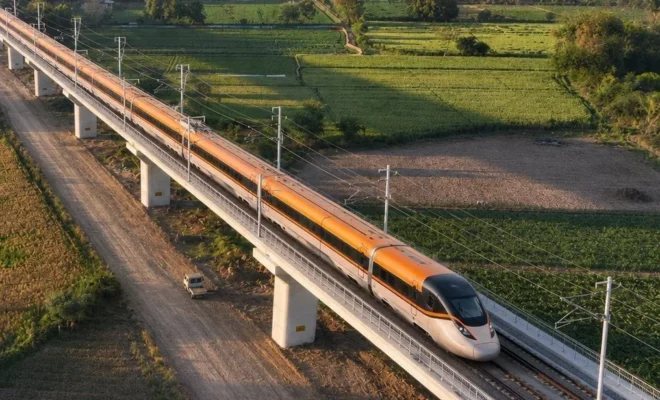
India is getting nearer to a significant milestone in its development of high-speed trains, as the country will get its first domestically made 280 kmph train by 2027. The high-speed train, which will be created under the Indian Railways’ domestic manufacturing initiative, is scheduled to be rolled out in the Mumbai-Ahmedabad High-Speed Rail corridor.
As per the latest official news, the indigenous train sets are being designed and manufactured by Integral Coach Factory (ICF), along with Bharat Earth Movers Limited (BEML). The development of the initiative is taking place as part of the overall push towards ‘Make in India’ and ‘Aatmanirbhar Bharat’ in the field of high-speed railways.
The first-ever high-speed rail services on the Mumbai-Ahmedabad corridor will commence in August 2027.
What Is India’s 280 kmph Indigenous Bullet Train?
The next train is often linked with the B28 indigenous high-speed train project. It is being developed specifically to prove that India has the capability of making trains that can run at much higher speeds than ordinary passenger trains do.
The train has a maximum designed speed of 280 kmph, but its commercial speed will depend on the infrastructure and conditions of the Mumbai-Ahmedabad High Speed Rail corridor.
This difference is critical to notice since 280 kmph is the train’s capability, whereas the design speed of the Mumbai-Ahmedabad corridor is 350 kmph and operational speed is 320 kmph.
When Will the Train Start Running?
According to the most recent government news update, the first high-speed train service in India is expected to begin operation in August 2027.
The first part of the route that is likely to be used for high-speed railway operations would be the Surat-Vapi section of the Mumbai-Ahmedabad high-speed rail corridor.
This was revealed earlier in some reports quoting the Railway Ministry of India.
It should be noted that travelers will have to wait before they can enjoy their ride on the bullet train from Mumbai to Ahmedabad.
What Is the Mumbai-Ahmedabad Bullet Train Project?
This Mumbai to Ahmedabad High-Speed Rail is India’s first High-Speed Rail (HSL). The route is about 508 kilometres long, passing through the states of Maharashtra and Gujarat, and the Union Territories of Dadra and Nagar Haveli, and Daman and Diu.
The corridor once complete will link Mumbai and Ahmedabad in about 1 hour 58 minutes with 12 stations proposed along the route.
It uses Japanese Shinkansen technology with dedicated high-speed rails, advanced signalling system, specialized infrastructural system, electrification system, and high-speed rail safety system technology.
Why Is the 280 kmph Train Such a Big Deal?
Importance of the train is not only because of its speed.
India has built many high-speed trains like Vande Bharat, but building a high-speed train that could run at the speed of 280 kmph is an entirely different technical feat altogether.
High-speed rail involves far more than a faster locomotive or coach. High-speed trains have to be integrated into a system comprising tracks, signals, brakes, traction, power, communication, aerodynamics and safety.
According to the government, India is working on developing the technology infrastructure for building high-speed trains in the future. Indian firms are also manufacturing components for high-speed rail.
Why India Is Building Its Own High-Speed Train
Indigenous Train project will help reduce dependence on importing fast-moving trains in the future.
While ICF and BEML are making the train sets, Indian research institutes such as IITs and engineers are helping in the entire process of development of high-speed rail network.
It is a strategic decision taken by the government to gain expertise that may come in handy in future high-speed rail corridors and not just the Mumbai-Ahmedabad line.
India will be able to produce high-speed trains in its factories in future.
Will the Train Actually Run at 280 kmph?
However, the speed of 280 kmph deserves some elaboration.
The B28 train made by Indians has been made to run at a top speed of 280 kmph; however, the Mumbai-Ahmedabad route has been planned for trains that can run much faster.
For example, the operational speed of the Mumbai-Ahmedabad route is expected to be 320 kmph, and its design speed is 350 kmph.
It must therefore not be mistaken for the maximum speed of the bullet train route.
What Will the Passenger Experience Look Like?
This will be a journey that will be significantly different from conventional Indian railways.
The Mumbai-Ahmedabad High Speed Rail corridor will be constructed using separate infrastructure and modern signaling systems as opposed to conventional railway tracks which will carry both passenger and freight trains.
Due to this dedicated nature, it will be possible for trains to travel at very high speeds while still controlling their operations.
Also, there will be specialized stations, maintenance, power supply and safety standards for high-speed railways along the corridor.
What Happens After the First Route?
The government is already looking beyond the Mumbai-Ahmedabad route.
The lessons learned from the first corridor are expected to lay down a template that will be used as a standard in future development of other high speed rails.
The government claims that engineering and construction standards, parts and maintenance standards may make it easier to develop the next corridors.
There are seven more high speed rail corridors which have been planned, hence making the Mumbai-Ahmedabad project a starting point for an extensive bullet train network in India.
Why 2027 Could Be a Turning Point for Indian Railways
If the current timeline holds, 2027 could mark the beginning of a completely new category of rail travel in India.
The introduction of an indigenous high-speed train would represent two milestones at the same time: India’s entry into commercial bullet train operations and a major step toward domestic manufacturing of high-speed rolling stock.
The first service may initially cover only a portion of the Mumbai-Ahmedabad route, but its significance will extend far beyond the first operational kilometres.
Conclusion
The maiden indigenous 280 kmph high-speed train of India will undoubtedly go down in history as one of the most important milestones in India’s railway industry.
The B28 project will help the country leverage its experience with high-speed rail technology from across the world along with its manufacturing prowess. With plans of launching its first Mumbai-Ahmedabad high-speed rail by August 2027 and the opening of the Surat-Vapi portion first, India is soon entering its much anticipated age of bullet trains.
The true story behind this, however, is not speed alone, but whether India will be able to convert its very own first high-speed rail into the base for the bullet train ecosystem of the future.
In terms of India’s bullet train story, speed will no longer be an import anymore.
Related Stories You Shouldn’t Miss
Could Japan’s Shinkansen Transform India’s Railways?
Check out how Japan’s Shinkansen trains could shape India’s bullet train journey.
Can Vande Bharat Outrun Bullet Trains?
Discover how Vande Bharat made headlines with its impressive railway speed record.
What’s Next For Indian Train Travel?
Explore the technologies transforming speed, safety, and passenger experiences across Indian Railways.
What Major Rail Projects Are Coming?
Find out about Maharashtra’s upcoming Vande Bharat trains, elevated roads, and more.
Will Tilting Trains Finally Arrive?
Uncover how tilting train technology could change high-speed travel across India.