
Mumbai Pune Expressway Missing Link Explained | Cable-Stayed Bridge
Last updated on July 10th, 2026 at 11:09 am
The Mumbai Pune Expressway Missing Link project is one of India’s most ambitious highway upgrades. It is designed to eliminate bottlenecks and significantly cut travel time between two of Maharashtra’s busiest cities.
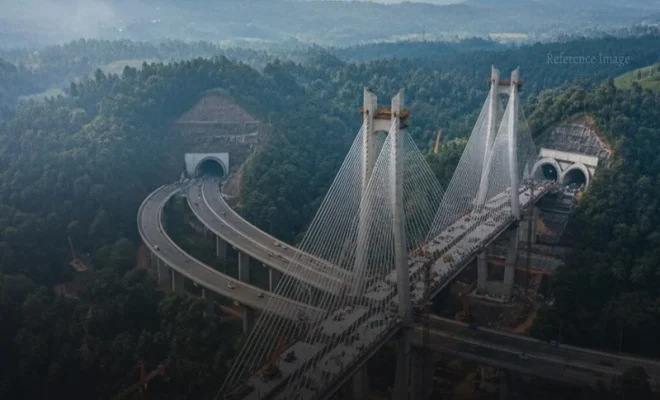
At the heart of this project is India’s longest cable-stayed bridge, a major engineering achievement built across the challenging terrain of the Western Ghats.
The development of the bridge is not just about faster travel. But it represents a shift toward smarter, safer, and more efficient road infrastructure in India.
What Is the “Missing Link” Project
The Mumbai Pune Expressway Missing Link refers to a new stretch being constructed to bypass older, accident-prone sections of the existing expressway, particularly near the Khandala–Lonavala ghat region.
The current route includes steep curves, heavy traffic congestion, and areas with frequent accidents. The missing link aims to replace this section with a more direct and safer alignment using tunnels and elevated bridges.
The project will establish a high-speed corridor that connects Mumbai and Pune through an improved route, which will decrease travel distance.
India’s Longest Cable-Stayed Bridge
The Mumbai Pune Expressway Missing Link project contains its most important feature, which consists of building the longest cable-stayed bridge in India. Cable-stayed bridges use a system of cables connected directly from the tower to the deck, allowing them to span long distances with fewer supports.
The Western Ghats region benefits from this particular design, which enables bridge construction across its hilly and valley areas. The bridge in this project not only showcases advanced engineering but also ensures minimal environmental disruption. It is done by reducing the need for multiple support structures in sensitive areas.
The structure functions as a modern infrastructure demonstration that merges practical use with effective design.
Tunnels and Engineering Innovation
The Mumbai Pune Expressway Missing Link extends beyond the bridge to include several extensive tunnels that traverse through the mountain range.
The tunnels enable vehicles to travel through the tunnels without any interruptions because of their design, which prevents both tight turns and high inclines.
The combined elements of the cable-stayed bridge and the other features enable passengers to travel more efficiently because both travel distance and time have been reduced.
Reduction in Travel Time
One of the biggest advantages of the Mumbai Pune Expressway Missing Link is the expected reduction in travel time.
Currently, the journey between Mumbai and Pune takes around 2.5 to 3 hours, depending on traffic conditions. With the new alignment, travel time could be reduced by 20–30 minutes or more, especially during peak hours.
This improvement is particularly significant for daily commuters, logistics operators, and intercity travellers.
Improved Safety on the Expressway
Safety is another major objective of the Mumbai Pune Expressway Missing Link project.
The existing ghat section is known for accidents due to sharp curves, fog conditions, and heavy vehicle movement.
By replacing this stretch with tunnels and a more controlled alignment, the new route is expected to reduce accident risks significantly.
Better road design, improved visibility, and fewer abrupt turns will contribute to a safer driving experience.
Environmental Considerations
The Western Ghats require special construction methods because of their sensitive ecological conditions.
The Missing Link of the Mumbai Pune Expressway uses tunnels and elevated structures to minimize environmental damage, which prevents the need for extensive land excavation.
The approach enables infrastructure development while maintaining the conservation of natural landscapes.
What This Means for Travellers
The Missing Link of the Mumbai Pune Expressway offers regular travellers a better experience, which provides them with more comfortable and predictable travel times.
The combination of shorter travel times and smoother road conditions, together with a safer travel environment,s will result in an improved overall travel experience.
The system helps drivers to experience less fatigue while enabling them to drive more efficiently during extended trips.
You Might Also Like
1. What makes Casio AE-1600HX special?
Explore the dual time tracking and long battery features that make this watch stand out.
2. Which devices get One UI 8.5?
Discover the supported devices and new features in the latest Samsung update.
3. What to expect from Vivo T5 Pro?
Check out the expected specs, features, and price ahead of its India launch.
4. How is Gemini improving smart homes?
Explore new regions, languages, and features introduced in Google Gemini for Home.
5. Why did OpenAI acquire TBPN?
Discover the strategy, impact, and future implications of this major acquisition.
Conclusion
The Mumbai Pune Expressway Missing Link is more than just a road project; it is a major step forward in India’s infrastructure development.
By combining advanced engineering, safety improvements, and efficiency gains, it sets a new benchmark for highway construction in the country.