Amit Shah Directs Security Agencies to Use AI Against Border Infiltration at MAC: What Changes Now?
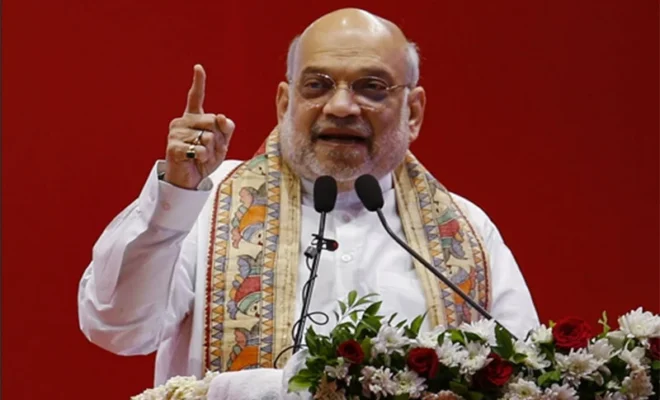
Amit Shah, India’s Home Minister, has instructed Indian security agencies to employ AI-based information analysis of data available at the Multi Agency Center (MAC) to formulate standard operating procedures to address issues of national security. This was announced at the ninth National Security Strategies Conference at New Delhi on August 24 and has been reported on August 25, 2026.
This marks an unprecedented effort of using AI and intelligence fusion in the ever-evolving security system of India. Moreover, Amit Shah further instructed the agencies to take strict action against infiltration, which suggests that technology-based surveillance and intelligence analysis will be playing an increasing role in addressing threats on the borders of India.
What Is the Multi-Agency Centre?
MAC (Multi Agency Centre) is a mechanism where intelligence and security agencies can collaborate and analyze information related to national security. This is done in order to make sure that intelligence is not kept separate in any agency in case of an emergency.
These topics were discussed in the National Security Strategies Conference along with the discussion on how intelligence could be fused, analyzed and operationalized through the mechanism of MAC.
Shah’s latest direction basically introduces the aspect of Artificial Intelligence in this intelligence sharing mechanism.
How Will AI Be Used?
The government’s statement does not refer to any particular surveillance technology, nor does it state how many different technologies will be employed. Rather, it was stated by Shah that the information that is obtainable through MAC systems be analyzed using AI with the results used to develop SOPs for various national security threats.
From a practical standpoint, it appears that AI can facilitate the analysis of large amounts of data at a pace that far exceeds human capacity. It can help security agencies identify links, anomalies, and signals in the data.
What is crucial is that AI would be used for analysis by security agencies, not as a substitute for human intelligence or decision-making.
Why Infiltration Is a Major Focus
In addition to the AI directive, Amit Shah also directed the security agencies to take strong action on infiltration.
This is because the management of borders has become one of the key priorities in national security for the Central Government.
India has been increasingly adopting the Smart Border Strategy that involves use of technology, monitoring and coordination between central forces, state governments and local bodies.
Earlier in July, Amit Shah had remarked that India was working towards a technology-led border security system, using AI, digital surveillance, anti-drone technology and integrated command centers.
The recent MAC directive is thus part of a wider strategy and not an isolated statement.
From Smart Borders to Smart Intelligence
The security strategy for India’s borders will increasingly evolve beyond traditional surveillance methods. While technology like sensors, cameras, drones, and even anti-drone technology can result in large volumes of data, the issue is to figure out what kind of data needs to be dealt with immediately.
This is where the application of AI can prove very useful.
Rather than having security officers sift through all the data available to them manually, it can help in sorting through data, finding correlations, and highlighting any data that needs further scrutiny by humans.
Ultimately, the aim is to convert intelligence into something actionable.
Why Faster Intelligence Matters
Security challenges do not always stay within their own domain. For instance, any potential intrusion can be linked to illegal immigration, organized crimes, smuggling of drugs, financing, etc.
Therefore, cooperation between agencies is extremely necessary.
The government has been giving stress on an integrated strategy to achieve border security. In July, Shah explained how a more comprehensive “quadrangular” security approach can be adopted which would involve border security forces, the state/district administrations, the concerned government bodies and even the local community.
MAC analysis through AI technology could possibly support this strategy in linking the unlinked.
The Siliguri Corridor Connection
The new emphasis on intelligence and border security has also come immediately following the review of security arrangements in relation to the Siliguri Corridor, which is of strategic importance, by Shah.
In the review held on August 22, the Standing Focus Group of the Multi-Agency Centre on the Siliguri Corridor had made suggestions for enhancing security in the area. This included discussions on illegal immigration, demographic shifts, border issues and vital infrastructure.
The Siliguri Corridor has been termed strategically crucial by the Indian government since it links mainland India to its northeastern states.
AI Is Not the Only New Security Tool
This recent announcement does not mean that India is all of a sudden jumping straight from conventional security measures to artificial intelligence (AI).
Instead, AI will become yet another component of an entire security system built on technology.
India’s Smart Border concept already involves drones, radars, cameras, and other technological devices.
In turn, AI may act as something that sits on top of all these technologies through its ability to analyze the data collected by them.
This opens up the possibility of creating an integrated security system where surveillance collects data, intelligence gathers information, and AI analyzes this data.
What About Privacy and Accuracy?
Moreover, the growing deployment of artificial intelligence in the realm of national security presents challenges regarding accuracy, oversight, and dealing with confidential information.
While AI systems can analyze information at a very fast pace, it must be verified by humans nevertheless. The identification of a certain pattern by an automated system does not necessarily imply that this pattern poses any security risk.
It is for this reason that the creation of standard operating procedures is crucial. As mentioned above, according to Shah’s instructions, the use of AI-based analysis is related to the creation of SOPs.
The Wider National Security Push
The directive on AI formed part of an even wider National Security Strategies Conference, which had more than 850 participants, including officials from various security forces and police organizations.
Other issues that were discussed at the conference include terrorism, radicalization, narcotic control, cyber crimes, irregular migration, and proxy warfare.
Shah demanded better training for the implementation of the PRAHAAR strategy against terrorism and radicalization, urging speedy response especially in cases where there were cross-border linkages and even in cases where trial-in-absentia can be used.
This shows that the AI drive forms part of the broader effort towards a more integrated national security policy.
What Changes for Border Security Now?
The immediate impact is not that AI will go about patrolling the borders of India itself. What will happen is that security agencies will be advised to use AI in the analysis of intelligence and responses to security threats.
This can eventually result in faster recognition of patterns in the intelligence databases, as well as better coordination between agencies and increased technological decision-making.
However, the success of such an approach depends on the quality of intelligence and reliability of AI tools used for analysis, among other factors.
Conclusion
The latest directive issued by Amit Shah is yet another example of India taking strides towards the use of technology for national security. Through the use of artificial intelligence for the analysis of information from the Multi-Agency Centre, the Indian government is working towards turning huge amounts of intelligence into rapid and coordinated actions.
The emphasis on infiltration is noteworthy since it makes it clear that the strategy is linked to India’s Smart Border concept, which involves the use of surveillance technology and coordination among agencies.
The overall message that is being conveyed here is that India is increasingly adopting a strategy of analysis of intelligence rather than simply gathering it.
Stay informed with the stories shaping India and the world.
Is Privacy Under Growing Threat?
Uncover the rising debate over biometric surveillance, protests, privacy, and civil liberties.
Why Do India-Russia Talks Matter?
Check out how trade, energy, and diplomacy shape India-Russia relations.
Can India Resist U.S. Pressure?
Find out why strategic autonomy remains crucial amid continuing American pressure.
Are India-Japan Naval Ties Changing?
Explore how new defence cooperation could reshape India-Japan maritime ties.
What Did India Tell UN?
Reveal India’s latest position on Palestine and the two-state solution.