
Biometric Surveillance and Protests: The Growing Debate Over Privacy and Civil Liberties
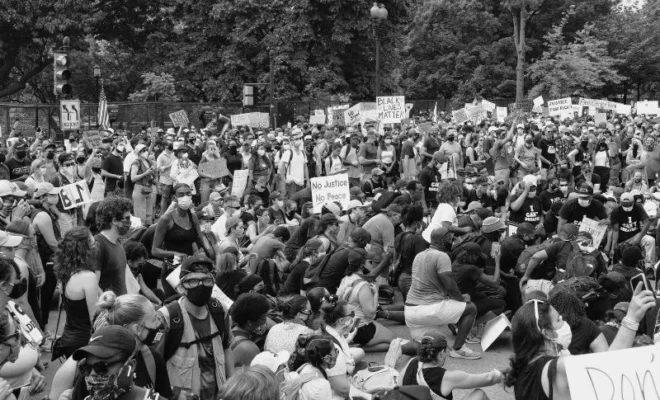
One of the most visible forms of democracy is the protest. Protestors meet, speak out, demand accountability and, at times, even challenge the government. But what happens when those people protesting their democratic rights are being observed, recognized, and digitized as well?
This is precisely the dilemma in India since the adoption of facial recognition technology and other biometric monitoring technologies was used in protests at Delhi’s Jantar Mantar. This dispute has now reached the Supreme Court, which will look into the matter of legality of this monitoring and whether using this against the protestors breaches their basic rights to privacy, dignity, freedom of speech, and peaceful assembly.
However, this is not the question of the role of technology in the process of law enforcement. Law enforcement may undoubtedly benefit from technology in searching for suspects, finding missing persons, investigating cases, etc. The problem is where to draw the line between targeted policing and mass surveillance.
The mere fact of a camera recording an open assembly is one thing. It is quite a different matter when artificial intelligence processes thousands of faces, builds biometric profiles, and tries to compare it with the databases.
It is what the dialogue about surveillance in India should focus on.
The Jantar Mantar Question
The Jantar Mantar controversy has thrown light on this very issue. In protests led by students recently, there have been mentions and claims about the deployment of facial recognition devices, CCTV cameras, mobile control units and other biometric surveillance devices near the area of the protest. There has been a petition to the Supreme Court about collection and possible sharing of biometric information of the protesters by the authorities.
However, the police have taken a different stance on this matter.
In an affidavit submitted to the Supreme Court, the Delhi Police have maintained that the facial-recognition devices were not deployed for indiscriminate profiling of all protesters. According to the Delhi Police, the purpose of deploying the device was to detect those people who had criminal records or histories.
This is why the issue should not be limited to the mere use of facial recognition technology. Instead, the discussion should move towards finding out how the technology was used, whose data was used and what measures were taken to prevent any misuse of the information.
This is not an issue that can be solved through technology alone. Law and transparency are needed to solve the problem.
Privacy Does Not End in a Public Place
The idea that there is no expectation of privacy once an individual leaves the privacy of his own home is one of the enduring misrepresentations that often surround discussions on surveillance.
The right to privacy that has been upheld by the Supreme Court in Justice K.S. Puttaswamy v. Union of India is not a mere right to withdraw from public view in one’s own house. It is about being autonomous and having the right to control one’s personal information.
The problem takes a constitutional twist in the case of biometric data. The face is more than just a photograph; facial recognition software can convert the picture into a biometric template which can be compared to databases, thereby establishing a person’s identity.
It alters the whole process of surveillance itself.
While CCTV cameras can monitor crowds walking down a street, facial recognition software could answer the following question: Which exact individuals were present?
The Constitutional Test: Legality, Necessity and Proportionality
The jurisprudence of privacy law in India presents an excellent starting point in analyzing issues surrounding state surveillance.
According to the Puttaswamy decision, there should be legality and a legitimate state interest and proportionality for a restriction on privacy. The state needs to have the legal power to carry out the invasion, the state interest in question should be legitimate, and the measure used should fit the legitimate state interest.
In a situation where facial recognition is used at the scene of a protest, the issue becomes more difficult to sort out.
For example, if the police obtain credible intelligence that someone who has a criminal record is planning to take part in a protest, targeted identification could have a constitutional justification different from the use of facial recognition on all the people in the crowd and matching them with a criminal database.
The first is directed surveillance while the second has the potential of becoming generalized surveillance.
This is important in terms of proportionality because this concept is not only about the legitimacy of the state’s interest.
India’s Regulatory Gap
One of the most awkward aspects of the debate is the fact that India does not have any statutory mechanism that comprehensively regulates the use of facial recognition and artificial intelligence-driven biometric surveillance by the police.
While the Digital Personal Data Protection Act, 2023 provides a legislative framework to regulate data-processing, it has certain exemptions for government data processing which leads to questions regarding how effective it can be in terms of restricting government surveillance. The other important piece of legislation to consider in this debate is the Criminal Procedure (Identification) Act, 2022; however, some have noted that the provisions in this act do not explicitly mandate indiscriminate biometric surveillance of public assemblies.
It is exactly for this reason that the Jantar Mantar litigation is important.
Security Is a Legitimate Concern — But So Is Dissent
Any discussion on civil liberties will not ignore the issue of security at all.
The task of law enforcement is rather difficult. Sometimes, mass demonstrations might be attended by people having criminal intentions. Violence might arise even in a peaceful rally. Recognition of a suspect would contribute to preventing crime and ensuring the safety of demonstrators as well as others.
This technology might make the work easier.
So the answer is not that this surveillance technology cannot be used in any way.
The question is whether its usage is specific, transparent and accountable.
A system aimed at identification of a clearly defined group of suspects within the framework of legal authority is entirely different from the one that quietly recognizes everybody participating in the political rally.
The former one might be just an investigation technology. The latter one may turn into social control.
The Chilling Effect on Protest
Perhaps the most dangerous result of the misuse of surveillance does not lie in the creation of the database per se but in the change in the behavior of people simply because of its existence.
Consider an example of a student at a university who wishes to take part in a peaceful demonstration. She understands that there are surveillance cameras that will help recognize faces, match identities with government databases and retain the information.
She may choose not to participate in the demonstration.
No policeman needs to make threats. No arrest needs to take place. The very thought of possible recognition changes one’s behavior.
This is called the chilling effect and it is a very serious matter in a democratic state.
The right to freedom of peaceful assembly becomes void when citizens cannot use it without being excessively afraid of being watched because they took part in it.
A democratic state must not put a person into a dilemma of choosing between the expression of a lawful political point of view and one’s biometric identity.
Accuracy Is Another Problem
However, there is also a question of technology, which must not be overlooked: facial recognition does not always work.
False positives can arise due to lighting, angle of camera, poor image quality, changes to the face and the limitations of the database used.
A false positive in a typical commercial application is merely annoying. But in law enforcement, a false positive could have far more dire implications.
The implications could go beyond a mere mistake if an identification system wrongly names someone as a criminal or mistakenly links an uninvolved protestor with an investigation.
This is one reason that automatic identification systems must never be regarded as proof positive of guilt or misconduct.
Human confirmation, clearly defined criteria, accountability measures and recourse must be built in.
The Private Technology Question
The increased participation of private technology firms introduces yet another dimension to the discussion.
In the event that police forces employ any of the facial recognition technologies created by private corporations, then the public must be informed about how the data collected through such technology is dealt with.
Who owns the technology? Who runs the servers? Is the data stored temporarily or permanently? Can the vendor have access to the data? Can the data be used to train algorithms? Can it be sent to another organization? What happens after the investigation?
These are no mere technical appendices.
They determine the ultimate ownership of some of the most personal data an individual may have.
The case taken up to the Supreme Court has posed specific questions regarding the technologies, databases, SOPs and private organizations in question.
Transparency Must Become a Requirement
It must not be assumed that the government has the right to withhold all information pertaining to the operation of the surveillance system in order to protect legitimate investigations.
However, secrecy must not become an end in itself.
At least citizens must be informed about the legal basis of biometric surveillance, the population groups subject to surveillance, the use of the information gathered, the periods of data storage and access, the processes of overseeing the system, and deleting the information gathered illegitimately or unnecessarily.
Otherwise, the citizens will have to trust a system they cannot see and cannot challenge.
This is unacceptable.
The Larger Democratic Question
The broader issue underlying the discussion about the use of biometric surveillance is this: What kind of democracy do Indians want to see evolve in the age of artificial intelligence?
Modern technologies now make it possible to identify people very quickly. They make it possible to link images, databases, and identities in a way that was never possible for the previous generation of police.
The fact that something can be done does not necessarily mean that it should be done without any restraint.
That is precisely why there is a constitutional right to privacy – the government has so much power that civil liberties need to be protected even when politics is contentious, the people are agitated and the state feels under threat.
The Jantar Mantar row must not be seen as simply a case of demonstrators versus police or techies against privacy advocates.
It must be turned into an exercise in creating democratic norms for an age of technology.
Conclusion: Security With Boundaries
India does need modern policing. It needs better technology to fight crime, protect citizens and respond to genuine threats.
But effective policing and civil liberties are not enemies.
The challenge is to create systems in which surveillance is lawful, targeted, necessary, proportionate and accountable.
If biometric technology is allowed to operate without clear boundaries, today’s protest surveillance could become tomorrow’s routine monitoring of political participation.
The question is therefore not whether the state should be allowed to see.
The question is whether citizens should have the right to know when they are being watched, why they are being watched, what happens to the information collected about them, and who is accountable when that power is abused.
That is not an obstacle to public safety.
It is the foundation of public trust.
Stay informed with the latest political developments, election debates, governance updates, and national security stories shaping India today.
How To Download Admit Card?
Check out the simple steps to access your UPSC CSE Prelims 2026 hall ticket online.
Why Was Hemant Soren Arrested?
Find the key details behind Hemant Soren’s arrest and Champai Soren’s swearing-in as Jharkhand CM.
What Sparked Delimitation Report Criticism?
Uncover why political parties strongly opposed the J&K Delimitation Commission’s draft report.
Why Criminal Candidates Still Contest?
Look into how Bihar polls revived concerns over parties ignoring Supreme Court directions on candidates.
What Triggered Missile Inquiry Decision?
Dive into the reasons behind India’s decision to launch a high-level probe into the misfired missile incident.