
India Reaffirms Support for Palestine and Two-State Solution at UN: Key Takeaways from Official Statement
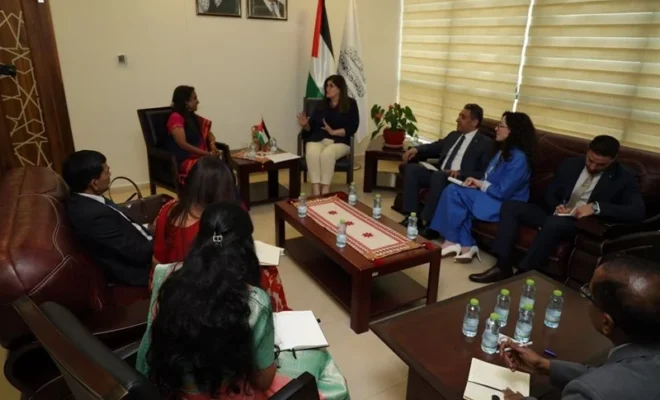
India has yet again expressed its traditional support for the Palestinians and for a two-state solution to the Israel-Palestine issue. This was conveyed during the visit of External Affairs Ministry Secretary Sripriya Ranganathan to Egypt, Palestine and Lebanon in her meetings with Palestinian Foreign Minister Varsen Aghabekian Shahin.
This is important in the context of the ongoing humanitarian disaster in Gaza and the renewed efforts to find a political solution to the ongoing conflict. India’s policy still retains the element of support for the statehood of Palestine combined with the policy of dialogue and diplomacy.
What Did India Say About Palestine?
The Indian side expressed its traditional support for a negotiated two-state solution at the time of its meeting with the Palestinian Foreign Minister. According to the Representative Office of India in Palestine, the sides discussed issues related to India-Palestine relations, with the importance of the humanitarian situation in Gaza being noted and addressed through continuous diplomacy.
It is important how India expresses itself in terms of the political settlement of the conflict. India has always been a strong advocate of the sovereignty and viability of Palestine as an entity living peacefully next to Israel.
India’s Concern Over the Humanitarian Crisis in Gaza
In addition to its political stance, India also had concerns regarding what it called the serious humanitarian situation in Gaza. The recent statement highlighted the need for the provision of unhindered and uninterrupted humanitarian assistance to civilians.
This humanitarian angle is an integral part of India’s foreign policy messaging at present. New Delhi has consistently called for humanitarian assistance in addition to making it clear that the conflict needs to be settled politically.
What Is the Two-State Solution?
Two-state solution essentially means the creation of an independent Palestinian state side-by-side with Israel wherein both would coexist peacefully within accepted arrangements.
India has always supported such a solution for decades now. The Ministry of External Affairs has earlier mentioned that India favours the two-state solution whereby a sovereign independent and viable State of Palestine is established within secure and recognized boundaries.
India Also Supports Palestinian Statehood
India’s stand does not end there. In July 2026, India reiterated its support for Palestine’s candidacy for UN membership at the second Ministerial Meeting of the Palestine Donor Group in Brussels.
This stand carries weight as it shows that India still supports the establishment of Palestine as a sovereign nation despite its long-standing relations with Israel.
India has strived to have an equilibrium West Asian policy where support for Palestine is coupled with strategic, economic and technological relations with Israel.
Why India’s Latest Statement Matters Now
The time when the reaffirmation was made is significant, as it reflects the continuing relevance of the issue of humanitarian concerns in Gaza on the international stage. It is noteworthy that the recent statement by the Indian government has emphasized that the humanitarian aid and the political settlement go hand in hand, rather than being considered independently of one another.
For India, the point here is that the humanitarian aid is required immediately, but the peace will require a political process able to solve the Israeli-Palestinian conflict.
It clarifies why dialogue and diplomacy are still the main themes of Indian statements.
India’s Development Partnership With Palestine
However, India’s involvement with the Palestinians is not only in terms of declarations made through diplomats. There is also a development partnership in various fields like health care and education among other areas.
In the latest meetings, the two sides have reviewed the overall development cooperation. Palestinian officials have also thanked India for its continued development cooperation.
This shows how India’s diplomatic stance can also take concrete form where India continues to provide developmental cooperation to Palestine along with its political support.
Position of India Has Always Remained Consistent
The latest statement has not been a major deviation from the existing policy of India. As per the Ministry of External Affairs, India always supported a negotiated solution leading to the establishment of an independent, sovereign and viable Palestine living side by side with Israel in peace and security.
India has also made it clear that India has consistently voted in accordance with its policies on the Israel-Palestine issue at the United Nations. According to the latest reply in parliament, India has voted in favor of many resolutions at the United Nations on the Palestine-Israel issue but abstained from voting on some.
What Happens Next?
The immediate issue at hand is turning such diplomatic backing into concrete achievements. Access, protection, dialogue, and negotiations will continue to form the core elements of any lasting resolution to the crisis.
India’s latest position demonstrates that New Delhi will continue to support humanitarian aid and diplomatic efforts to resolve the Palestinian-Israeli conflict through negotiation.
For India, the two-state solution represents the key concept through which a lasting resolution to the conflict could be achieved.
Explore the UAE–India Partnership and Global Shifts
What Makes the EU a Global Power?
Check out key facts on EU members, population, economy, and global influence.
How Does BRICS Boost UAE Growth?
Find out how BRICS membership strengthens the UAE’s economic and environmental efforts.
What Is UAE Doing Against Financial Crime?
Uncover the UAE’s latest measures to tackle money laundering and terrorism financing.
How Will India-UAE Trade Grow Further?
Browse how the new business council aims to strengthen bilateral trade and partnerships.
Can India-UAE Talks Ease Visa Challenges?
See how the latest consular meeting addresses visas, migration, and citizen concerns.
Conclusion
India’s most recent statement in support of Palestine and the two-state solution is in consonance with New Delhi’s policy in West Asia. At a time when humanitarian problems persist in Gaza, India has once again stressed the importance of humanitarian aid, diplomacy and negotiations along with its stand for Palestinian statehood.
The implication is thus double-edged: while India still supports the Palestinian aspiration for statehood, it firmly believes that a solution needs to be arrived at through negotiations that help both parties live in peace and security.
The latest statement by India underscores its traditional stand regarding the problem: humanitarian aid to the Palestinians, Palestinian statehood and a two-state solution are important components of India’s West Asian policy.