AI in the Judiciary: Balancing Automated Efficiency with Human Justice in India
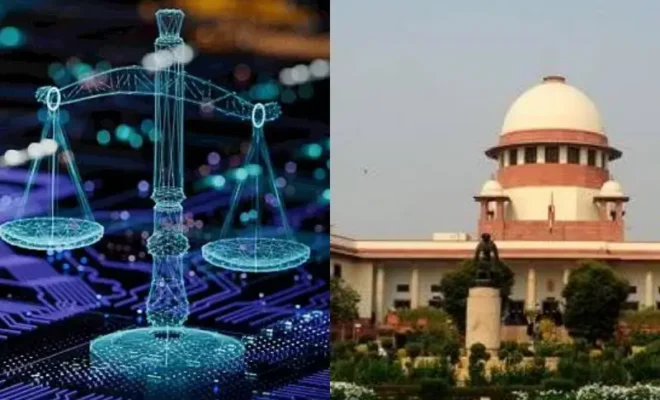
It is imperative for the judiciary of India to be at the right juncture where technology is concerned. Considering the many cases pending in the courts, artificial intelligence (AI) can provide a way forward to enhance legal research, streamline processes, and increase accessibility. However, incorporating AI in judicial decision making poses a challenge to determine whether technology can facilitate justice without losing its humanity.
This problem does not lie in either technology or tradition, but rather in setting boundaries between the two.
The Promise of AI in India’s Judicial System
Some of the challenges facing India’s judiciary include case backlog, delays in procedures, linguistic issues, and expensive litigation. AI technology can solve most of these challenges through automation of routine tasks and access to legal information.
Legal translation from one language to another can be made easy using software like Supreme Court Vidhik Anuvaad Software (SUVAS). SUPACE, another Supreme Court portal was created to provide assistance in research on law and case record analysis. Legal transcription, document processing, and scheduling through AI can ease administrative processes.
Such software may be of great benefit in district and subordinate courts since there is a shortage of resources as well as the burden of huge case loads. Document processing in a more efficient manner and access to precedents would allow judicial officers to spend time on analyzing evidence and arguments and deliver fair judgments.
In addition, litigants will also benefit from the use of such technology as they will be able to process legal information without having to rely on expensive professionals.
However, efficiency is not synonymous with justice. A quickly disposed of case does not have to be a well-decided case.
Why Human Judgment Must Remain Central
Judgment requires more than determining relevant law or matching facts with past judgements. A judge will have to examine evidence, interpret constitutional tenets, evaluate arguments, and weigh the peculiarities of a particular situation.
An AI tool can handle vast amounts of data, but what it generates is dependent on training data, system design, and the quality of the data fed into the system. An AI-generated tool can misquote legal authorities, miss context or generate an outcome that reflects the biases present in the historical record.
The issue is most dangerous when it comes to criminal prosecutions, requests for bail, family matters, and vulnerable communities. If a system is trained on historical results, it can perpetuate inequalities if it is accepted uncritically.
The issue came to light in India’s Supreme Court‘s decision of July 2026 in Pooja Ramesh Singh v. Jammu and Kashmir Bank Ltd. This case involved the reliance on fabricated AI-generated legal authorities. The case shows how legal authorities generated by AI tools have to be verified independently.
The rule of thumb is clear: an AI can help with legal reasoning but not be accountable for the consequences of a judgment.
Building a Responsible Regulatory Framework
In light of these issues, the Supreme Court has come up with a draft of Regulations for Use of Artificial Intelligence in Courts, 2026 and solicited feedback from concerned stakeholders. These Regulations will focus on principles of Human Primacy, Judicial Independence, Fairness, Transparency, Accountability, and Data Protection.
The measures described above will be vital in ensuring safe and effective use of AI tools by courts; however, there will be a need to follow up with implementation. All legal citations, case summaries, or translations created through artificial intelligence need to go through an appropriate level of human verification. It must be ensured that judges are able to disregard AI recommendations and that there will be a way to object any serious mistake on the part of parties involved.
Security is yet another issue which cannot be overlooked. Court records may have personal, financial, and health related details of individuals and may be exposed to violation of privacy if entered into the wrong type of AI systems. Therefore, the need is to develop secure AI systems for handling judicial data.
AI systems used in courts must also be independently audited for accuracy, bias, and reliability.
Bridging the Digital Divide
Uneven distribution of the advantages provided by AI in courts will continue to persist if India takes into consideration the digital disparity between different areas of India. Courts in metropolitan cities will have better access to such advanced technology compared to the ones in rural or poor parts of India.
Judicial personnel needs to be trained on how to detect mistakes made by AI technology. Services provided through AI technology should also be accessible for persons with disability, poor connectivity, and digital illiteracy.
Efficiency Must Serve Justice, Not Replace It
There is no need for India to fight AI in order to protect the autonomy of the country’s judicial system. It needs to establish its place within AI. Helping in automating the routine and mundane procedures, enhancing translation services, making legal research more organized are all good things. Leaving the decisions of responsibility, credibility, freedom, and constitutional rights to the machines is another matter altogether.
Thus, the future development of AI in the Indian judiciary should be based on one idea: while machines can help in the process, it should be up to the human judge to take the responsibility for the results.
The trust in the judicial system of the state lies in the justice of its decision-making, in fair hearings, and in people knowing that each one of them gets to hear the case. AI can help achieve these goals, but it will never be able to replace them.
It is not the speed that India should seek when developing the future of its judiciary but the availability of justice.
Healthcare Boosts, Environmental Battles & Breaking Developments
Can Seven New ESIC Facilities Transform Healthcare Access?
Discover how ESIC’s planned medical facilities could strengthen healthcare infrastructure across India.
Why Are Tamil Nadu Delta Farmers Facing an Irrigation Crisis?
Explore how monsoon failure and Cauvery water shortages are affecting farmers in the delta region.
Why Is Kerala Targeting Invasive African Catfish?
Uncover why Periyar Tiger Reserve has launched a special operation to protect the local ecosystem.
What’s Behind India’s Proposed Ban on 54 Chinese Apps?
Find out what the reported app ban could mean for national security and digital access.
What Happened in the Hathras School Bus Collision?
Get the key details of the Aligarh – Agra Highway accident that reportedly left 15 people injured.