
OP-ED: Vaishya Tekri and the Ashoka Question: What the New Excavation Can Reveal
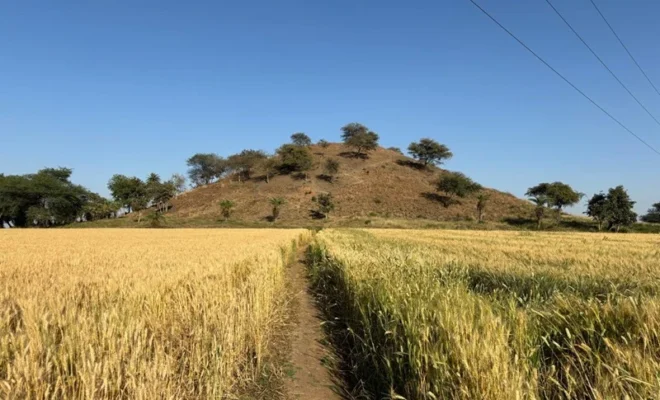
For nearly nine decades, there existed a historical enigma concerning a massive mound situated just outside the walls of Ujjain. Vaishya Tekri, which has been declared a protected archaeological site and has connections with a huge Buddhist stupa, was partially unearthed in the late 1930s. However, the project was dropped without the monument being completely deciphered. This year, the government of Madhya Pradesh and the Archaeological Survey of India intend to re-examine the site.
It seems logical enough. Preliminary findings have revealed that the mound hides a massive monument from the Mauryan period having a diameter of 350 feet and a possible initial height of more than 100 feet. That means that the monument was considerably bigger than the Great Stupa at Sanchi, which stands at 54 feet tall today. Consequently, recent news has labeled Vaishya Tekri as a potential giant of the Buddhist architecture greater than the Sanchi Stupa.
However, the crucial question is not whether the monument was bigger than the Sanchi one but whether modern archaeology could finally reveal its identity and other information.
Why Vaishya Tekri Matters
However, Ujjain was not a city that played an accidental role in ancient Indian civilization. The ancient city of Ujjayini was a major city and was an important political, economical and cultural center of the Malwa region. Moreover, Ujjain increased its importance during the reign of the Maurya dynasty. Ashoka himself is traditionally linked to Ujjain during his early years, having been the viceroy of this place.
In such a case, the Vaishya Tekri site becomes especially interesting. If it will be possible to date the stupa as Mauryan and to link its construction to the time of Ashoka through archeological data, it will help add the physical aspect to the episode of Ashoka’s life.
This is precisely the point where caution becomes essential.
Just because there was a Buddhist stupa built during the Mauryan period in Ujjain, that does not mean that the stupa has been constructed on the orders of Ashoka. It is the archaeological evidence that would establish this connection. There have been previous studies about this structure which link it to Ashoka as well as Devi, the supposed wife of Ashoka, linked to the place known as Vidisha. But being connected does not imply proof.
What the 1938–39 Excavation Already Told Us
This excavation of Vaishya Tekri is not starting from scratch as there is previous evidence of archaeology at this location. According to reports, an enormous mound is not a natural phenomenon but archaeological one, as well as it has been discovered that the construction consists of rammed material from the area and an exterior built-up of bricks. Moreover, there were some peculiar structural elements discovered that showed planning of how to cope with huge pressure created by such a construction.
However, even more important was the discovery of the punch-marked coin and Avanti cast coin that could be used to prove dating of this construction to the Mauryan period, as well as sizes of the bricks corresponded to this period.
However, the excavation was not finished, and according to reports, it was stopped due to a gas leak when workers lost their consciousness. Everything that was left underground could serve as historical archives until better archaeological methods appeared. This fact gives additional significance to the new excavation.
The Ashoka Question Is Bigger Than One Emperor
It is tempting to focus on finding Ashoka’s footprint in the excavations. This would certainly be natural, yet it might mean reducing the complex story to the person’s name.
The issue here is not the identity of Ashoka but the implications which the discovery could have for the history of Buddhism spread and Mauryan state’s impact on the development of towns in central India.
The role of Ashoka in the history of Buddhism is truly enormous. The tradition of Buddhism describes Ashoka as a key patron who contributed to the construction, expansion, and dissemination of stupas and relics throughout his empire. Various archaeological data from his period of rule (pillars, inscriptions and monuments) made it possible to reveal the power of the influence of Mauryan state culture.
A Buddhist monument found in Ujjain would definitely contribute to that picture. Yet, it would also help us understand the dynamics of interaction between Buddhism and a thriving town.
This is why the excavations should not be considered a chance to prove “Ashoka built it.” The more valuable goal here is to find out the reasons for existence of such a Buddhist monument.
What New Excavation Could Reveal
The first key opportunity is chronology. Modern excavation techniques allow for far more precise dating of stratigraphic contexts than the early excavations were capable of. The new dateable material, construction levels, associated ceramics, coins and organic artifacts could narrow down the chronology of the monument and determine whether its initial phase indeed belongs to the Mauryan period.
The second opportunity is architecture. Only a full-scale excavation will allow archaeologists to discern the original plan of the monument, its ambulatory circuit, entrance structures, construction phases and relationship with other architectural elements in the vicinity. This evidence might help archaeologists to compare Vaishya Tekri to Sanchi and other early stupas not just by their dimensions.
The third issue relates to religious function. Archaeologists might discover relic deposits, inscriptions, architectural remains and/or other ritual artifacts that will greatly help archaeologists to understand the religious significance of the monument.
The fourth issue deals with patronage of the monument. While an inscription mentioning Ashoka’s name would be remarkable, even without such direct evidence, inscriptions, coins, administrative artifacts and construction remains could provide clues as to whether the monument was directly linked to imperial patronage or emerged in the framework of local Buddhist communities.
Ujjain’s Buddhist Past Deserves More Attention
Moreover, the renewed interest in Vaishya Tekri is an opposition to a stereotype about Ujjain. Nowadays, Ujjain is famous all over the world for its sacred geography of Hinduism and the temple of Mahakaleshwar and the connection of this place with the Kumbh Mela. However, ancient Ujjain had quite a different picture.
Earlier excavations around Ujjain, which include Vaishya Tekri, Kumhar Tekri, and other mounds, have provided evidence of Buddhist architecture and material culture. The Supreme Court’s description of the archaeology of Ujjain mentions that excavations at Vaishya Tekri and other mounds gave brick stupas, and excavations in other places of ancient Ujjain have provided material from several eras.
It means that there is no possibility to look at the history of this city in terms of one religion or one political identity. Ujjain was an urban center, where various traditions and communities were mixed through time.
In this way, Vaishya Tekri could become significant not because of Ashoka, but because it is another gate to the past of Ujjain.
The Risk of Making the Excavation a Political Symbol
Another reason to be cautious about the dig is that the ancient history of India cannot be separated from politics. Ashoka has a great deal of cultural resonance, and Buddhist, Hindu, Mauryan and issues of heritage have all been understood through the lens of political debate.
This just increases the importance of archaeology.
If the dig uncovers evidence that links the stupa directly to Ashoka, that is something to be praised. If the dig instead reveals that the stupa was constructed under some other Mauryan ruler, patron or Buddhist group, that is equally significant.
Archaeology works best when it is allowed to challenge our preconceptions rather than affirming them.
Why This Excavation Could Change the Story
However, the most interesting aspect about Vaishya Tekri is not finding out if there exists a monument “larger than Sanchi.” The most interesting thing would be to come up with a more reasonable reason behind the existence of such a monument.
Through inscriptions, relics, dated levels of construction, or even repeated constructions, scholars will be able to get a more detailed history of Ujjain during the Mauryan period and after.
It will help show the movement of Buddhism via trade routes, the connection between power and patronage of the religion, the engineering skills of the ancient people, and the importance of Ujjain in the Mauryan political ideology.
In this context, the mound is not just concealing a stupa, but an entire network of connections between power, religion, trade, and urban life.
Conclusion: Let the Evidence Answer Ashoka
Almost ninety years on, the Vaishya Tekri has finally been given the chance to have a second crack at recognition. The decision to excavate the site again provides archaeologists the chance to dig beyond what was done back in the 1930s and apply the modern techniques of science to an enigmatic structure that exists in Ujjain.
The Ashoka hypothesis is bound to capture all the attention. Was this his stupa? Was he really this far-reaching with his patronage? Was the structure somehow linked with the Buddhist networks that were prevalent during his rule?
These are some valid and pertinent questions. However, until the evidence speaks, the questions need to be left open.
The real discovery of Vaishya Tekri might turn out to be a bigger discovery than Ashoka himself: a better understanding of how an ancient Indian city became the center where empire-building, commerce, faith and architectural grandeur converged.
With patience and scientific analysis of the excavation process, Vaishya Tekri might just be able to achieve what few archaeological discoveries have managed to accomplish: turn historical speculation into evidence.
Stay informed with these must-read stories.
Who Is Driving Claude’s India Boom?
Check out who uses Anthropic’s AI in India and why the market matters.
Why Do Clean Voter Rolls Matter?
Find out why Trump’s praise highlights the importance of India’s electoral system.
Can Digital Trade Transform India-Singapore Ties?
Uncover how digital trade corridors and green ports are shaping bilateral cooperation.
When Does SNAP 2026 Registration Begin?
Browse the SNAP 2026 registration details for December management entrance exams.
What Is India-Japan Naval Deal?
Dive into the 2026 stealth naval hardware deal and its strategic significance.