
Sarnath Added to UNESCO World Heritage List After 28 Years: History and Significance Explained
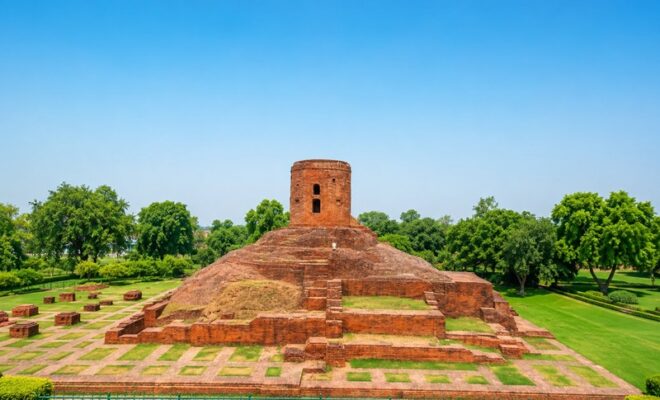
In a bit of a landmark moment for India’s cultural heritage, Sarnath in Uttar Pradesh has been officially put on the UNESCO World Heritage List, after spending 28 years on UNESCO’s Tentative List, sort of patiently waiting. The call was taken in the 48th session of the UNESCO World Heritage Committee in Busan, South Korea. So yeah, that makes Sarnath India’s 45th UNESCO World Heritage Site.
This recognition matters not just for India, but also for millions of Buddhists across the world, because Sarnath is the location where Lord Buddha delivered his first sermon after enlightenment was reached. With this step, conservation work is expected to get a fresh push, while the site’s international cultural presence and travel profile should also get a noticeable boost.
What Is Sarnath?
Sarnath sits roughly 10 kilometres out of Varanasi, in Uttar Pradesh, and it’s considered one of the holiest pilgrimage places connected with Buddhism.
As per Buddhist belief, it was here that Gautama Buddha gave his first sermon after he reached enlightenment at Bodh Gaya. People call this moment Dharmachakra Pravartana, or “Turning of the Wheel of Dharma”, and it basically signaled the start of how Buddhist teachings began to spread around. It’s also said that at Sarnath Buddha founded the first Buddhist Sangha, meaning a monastic community.
For over 2,500 years now, Sarnath has stayed a key hub for pilgrimage, wisdom, and inward spiritual practice.
Why Did It Take 28 Years?
Sarnath got put on UNESCO’s Tentative List in 1998, sort of the earliest bit of a route toward getting World Heritage recognition, yes.
A place may hang around on the Tentative List for years while officials work on thorough files that show its Outstanding Universal Value, plus conservation steps, authenticity, integrity, and a long run management plan.
India then officially put forward the “Ancient Buddhist Site, Sarnath” for the 2025–26 cycle, and after review by UNESCO’s advisory bodies, the World Heritage Committee, approved the inscription in July 2026.
Why UNESCO Recognised Sarnath
UNESCO did recognize Sarnath because it has this exceptional historical, spiritual, and archaeological importance, you know? The place has monuments that go from the 3rd century BCE to the 12th century CE, showing this long stretch of Buddhist religious work over centuries. Among them are stupas, monasteries, temples, sculptural remains, and also the remains of Emperor Ashoka’s pillar, which stands for the diffusion of Buddhism through Asia.
UNESCO also pointed out that Sarnath has remained a pilgrimage site and a source of quiet motivation for Buddhists worldwide for more than two millennia, keeping not only physical landmarks but also ongoing spiritual customs, still living in a sense.
Major Attractions at Sarnath
At Sarnath, the most iconic monument is the Dhamek Stupa, and it’s thought to pinpoint the spot where Buddha gave his first sermon.
Then there is the Dharmarajika Stupa, which was originally put up by Emperor Ashoka, but honestly, a good portion of it doesn’t really remain today.
If you wander around a bit, you can also see archaeological remnants of older monasteries and temples, which once made up one of the planet s most significant Buddhist learning hubs.
And probably one of Sarnath’s biggest historical gems is the Lion Capital of Ashoka. It originally sat right on top of Ashoka’s column at this very place; now the carving is used as the National Emblem of India, while the Ashoka Chakra from that same column is placed in the middle of the Indian national flag.
Why This Recognition Matters for India
UNESCO inscription is what makes Sarnath India’s 45th World Heritage Site, and it kind of reaffirms the country’s place among the nations with the highest number of World Heritage properties.
It also turns into Uttar Pradesh’s 4th UNESCO World Heritage Site, and that in turn further bolsters the state’s globally recognized Buddhist Circuit together with Bodh Gaya, plus other key pilgrimage destinations in the region. This recognition is expected to give a boost to heritage preservation, international tourism, and more academic attention regarding Buddhist history.
Impact on Tourism and Conservation
World Heritage status usually brings more international attention, you know, and it often helps conservation teams get stronger backing.
As for Sarnath, this kind of recognition is expected to pull in extra pilgrims, plus historians, archaeologists, and international visitors too, while at the same time pushing better site oversight and long-term preservation.
Officials are also thinking that the inscription will spark economic openings for nearby communities through tourism, hospitality, and various cultural engagements, but still making sure that the site’s historical character stays safeguarded for future generations.
Why Sarnath Remains Spiritually Important Today
Unlike a lot of archaeological places that mostly show older historical monuments, Sarnath keeps on being like a living, active place of worship, even today.
Buddhist monks and pilgrims from places such as Sri Lanka, Thailand, Japan, Myanmar South Korea and Tibet, still come to Sarnath throughout the year. They do this to remember the Buddha’s first sermon, and the feeling around it.
So, the UNESCO recognition here, it really honors more than just ancient architecture too. It also points to a spiritual tradition that still endures, and keeps inspiring millions worldwide.
Stay Updated on Global Developments
Why Must Indians Stay Indoors?
Learn why the MEA advised Indians in Iran to remain indoors.
Why Did India Issue Iran Advisory?
Find out why Indian citizens have been urged to leave Iran immediately.
How Did The Oman Attack Unfold?
Uncover the confirmed details surrounding the Indian sailor’s tragic death.
Is UAE Safety Affected By Tensions?
Check out how regional tensions could impact Indians living in the UAE.
What Happened To Frozen Assets?
Explore the latest updates on the release of frozen Iranian assets.
Conclusion
The inclusion of Sarnath as a UNESCO World Heritage Site kinda marks the successful end of a 28-year journey toward getting global recognition.
It is not just another line on UNESCO’s prestigious list; it sort of honours one of Buddhism’s most sacred spaces and also brings to the forefront India’s deep civilisational inheritance. And yeah, it helps make sure the legacy tied to Lord Buddha’s very first teachings will gain a wider international profile and protection, for generations to come.
After waiting almost three decades, Sarnath has finally gotten that global recognition many historians and devotees felt it truly deserved. This also reaffirms its role as one of the world’s most important centres of Buddhist history.