
India-Japan Stealth Naval Hardware Deal Explained | 2026
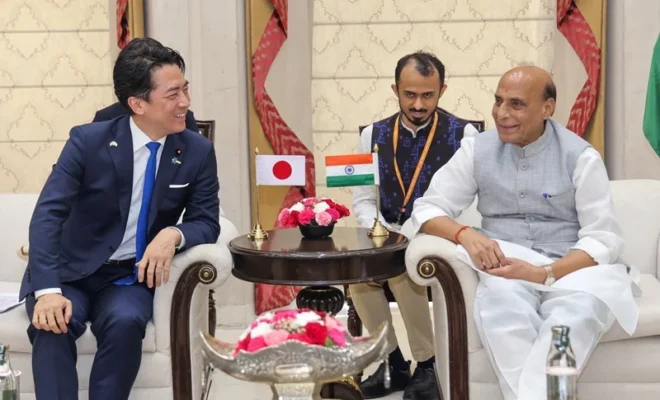
India and Japan are taking their defence relationship into a more technology-driven phase, with maritime security and defence-industrial cooperation emerging as major priorities. The latest discussions come as Japanese Defence Minister Shinjiro Koizumi visits India and meets Defence Minister Rajnath Singh, with both sides looking at deeper cooperation in naval technology, equipment, manufacturing and operations.
The development is significant because India-Japan defence ties are moving beyond joint exercises and strategic declarations towards actual military technology and industrial cooperation. A key example is the UNICORN mast, a Japanese-origin integrated naval antenna system designed to reduce a warship’s radar signature while consolidating multiple antenna functions into a streamlined structure. India and Japan signed a Memorandum of Implementation for its co-development in November 2024.
What Is the New India-Japan Naval Cooperation About?
The current push is centred on strengthening maritime security while expanding practical defence cooperation between the two countries.
The latest ministerial discussions are expected to cover defence equipment and technology, greater naval coordination, joint exercises, manufacturing and potential future cooperation in naval shipbuilding. Recent reporting says the two countries are also exploring joint development in naval shipbuilding and design.
This matters because India is increasingly seeking advanced defence capabilities while simultaneously trying to expand domestic manufacturing under the Make in India and self-reliance approach. Japan, meanwhile, has been gradually relaxing restrictions that historically limited its defence exports and international military-industrial partnerships.
Together, those developments create space for a much deeper technology partnership.
What Is UNICORN and Why Is It Called Stealth Technology?
UNICORN stands for Unified Complex Radio Antenna. It is an integrated mast and antenna system developed for naval applications.
Instead of having several antennas and communication systems protruding separately from a warship’s superstructure, the technology integrates multiple functions into a more streamlined mast.
That has an important stealth advantage. Fewer exposed structures can help reduce the radar cross-section of a vessel, making it more difficult for radar systems to detect and identify the ship.
India and Japan have already signed an agreement for the co-development of UNICORN masts for Indian Navy ships. The agreement was signed at the Embassy of India in Tokyo on November 15, 2024.
So, while headlines may describe the latest development as a brand-new stealth-hardware deal, the UNICORN programme itself has been under development through the India-Japan defence partnership for some time.
Why Does Stealth Matter for Indian Warships?
Modern naval warfare increasingly depends on who can detect the other side first.
A warship does not need to become literally invisible to gain an advantage from stealth. Reducing its radar signature can make detection, identification and targeting more difficult.
This becomes particularly important in contested waters where naval forces operate alongside aircraft, submarines, drones, satellites and long-range missiles.
For India, improving the stealth characteristics of its warships can strengthen survivability and enhance the Navy’s ability to operate in increasingly complex maritime environments.
The UNICORN system therefore represents more than an antenna upgrade. It demonstrates how relatively compact technologies can contribute to the overall signature management of a modern warship.
Why Japan Is an Important Technology Partner
Japan has extensive experience in advanced naval systems and operates a sophisticated maritime defence industry.
The Japanese Maritime Self-Defense Force has already used UNICORN-related technology on its modern warships, including the Mogami-class frigates. Japan’s experience gives India an opportunity to work with technology that has been developed within a mature naval ecosystem.
For Tokyo, deeper cooperation with India also fits into its broader effort to strengthen security partnerships across the Indo-Pacific.
The relationship therefore serves both countries’ strategic interests: India gains access to advanced technology and potential industrial collaboration, while Japan strengthens a major regional security partnership.
Why the Timing Is Important
The timing of the latest defence discussions is particularly significant because the Indo-Pacific is becoming increasingly contested.
India and Japan share concerns about maritime security, freedom of navigation, resilient supply chains and the stability of major sea lanes.
Japan’s Defence Minister Shinjiro Koizumi’s current India visit has placed maritime cooperation prominently on the agenda. Before travelling to New Delhi, Koizumi visited India’s Western Naval Command and boarded INS Chennai, an Indian-built guided-missile destroyer. The visit highlighted the importance both countries attach to naval capabilities and maritime security.
The symbolism is clear: the relationship is increasingly focused on the sea.
From Buying Technology to Co-Developing It
One of the most important changes in India-Japan defence relations is the movement from simple equipment transfer towards co-development.
The UNICORN agreement is significant precisely because it involves co-development rather than India simply purchasing a finished Japanese system.
That model potentially gives Indian industry greater involvement in development, integration, production and future upgrades.
It also fits India’s broader objective of developing domestic defence capabilities while collaborating with technologically advanced partners.
The long-term value could therefore extend beyond a single naval system.
What Could Come Next?
The immediate focus remains on implementing existing cooperation and identifying additional areas where Indian and Japanese defence industries can work together.
Recent discussions have included possibilities around naval shipbuilding, defence technology, equipment production and greater operational coordination.
Japan’s easing of restrictions around defence equipment transfers could also make future technology cooperation easier than it was in previous years.
However, turning strategic agreements into operational hardware will require sustained investment, industrial capacity, technology integration and lengthy testing programmes.
That is why the current discussions should be viewed as part of a longer defence-industrial journey rather than an overnight transformation.
What It Means for the Indian Navy
For the Indian Navy, the broader objective is to build ships that are increasingly capable of operating in sophisticated, sensor-heavy environments.
Stealth is only one part of that equation. Modern naval survivability also depends on electronic warfare, sensors, communications, air defence, weapons, networking and situational awareness.
The India-Japan partnership could contribute to this ecosystem by bringing Japanese expertise together with India’s growing shipbuilding and defence-industrial capabilities.
The potential result is a more technologically sophisticated Indian naval fleet with greater domestic participation in advanced systems.
India-Japan Ties Are Moving Into a New Defence Era
The significance of the partnership goes beyond one antenna or one warship.
India and Japan have spent years building strategic trust through diplomatic dialogue, military exercises and maritime cooperation. Their defence relationship is now increasingly moving towards technology development and industrial collaboration.
The current ministerial engagement is therefore important because it tests whether that political trust can translate into actual equipment, manufacturing partnerships and operational capabilities.
If successful, the model could eventually be extended to other advanced naval technologies.
Conclusion
India and Japan’s growing naval partnership marks an important shift in the way the two countries approach defence cooperation.
The UNICORN programme demonstrates the potential of combining Japanese naval technology with Indian development and manufacturing capabilities. At the same time, the latest defence talks indicate that both countries are exploring a wider relationship involving shipbuilding, technology, equipment and maritime operations.
For India, the objective is not simply to acquire better warships but to develop greater technological independence. For Japan, closer defence-industrial ties with India strengthen its strategic footprint in the Indo-Pacific.
The real significance of this partnership, therefore, may not be one stealth mast. It could be the beginning of a much larger India-Japan defence technology ecosystem.
What’s Making Headlines Right Now?
How Are India-Japan Ties Evolving?
Check out the latest developments in their strategic supply chain partnership.
What’s New In UPSC EPFO?
Find key details on vacancies, registration dates, and eligibility criteria.
Why Are Ministers Visiting Universities?
Uncover how the new initiative aims to connect with Gen Z.
What Happened During Kashmir Visit?
Dive into Sergio Gor’s meetings, agenda, and strategic significance.
How Will ISRO Data Help Farmers?
Explore how new satellite data can support agriculture monitoring.