
Supreme Court Questions FSSAI Delay on Front-of-Pack Health Warning Labels: What It Means for Consumers
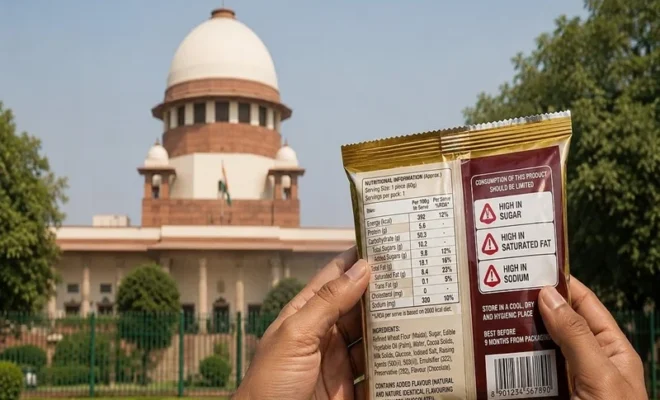
In effect, the Supreme Court has made the debate surrounding the front-of-pack labeling scheme for foods with high quantities of sugar, salt and saturated fats once again the subject of public attention in India. A recent case that came up before a Bench comprising Justices J.B. Pardiwala and K. Vinod Chandran during a hearing held on August 13, 2026, raised this problem by questioning the FSSAI regarding the lack of progress on this matter.
This matter should be of interest to the common person since this type of labeling scheme allows important information about nutrition to be provided before purchasing the food item from the packet.
What Are Front-of-Pack Warning Labels?
“Front-of-Pack Labels,” abbreviated as FOPL, are the warnings about nutrition written in large print on the front of packaged food items. This label system was designed so that consumers can easily distinguish the presence of nutrients like sugars, salts, or saturated fats in any food item.
This issue is particularly relevant to packaged snack foods and drinks where consumers have to read the nutritional information in small prints first to figure out what the food item contains in terms of nutrition.
Supreme Court has made it very clear that front-of-pack labeling will help consumers make an informed decision, especially families and children who do not have enough time to comprehend the complicated information on the labels.
Why Is the Supreme Court Questioning FSSAI?
The immediate issue centers on the failure to act promptly upon the earlier directions by the court on front-of-pack labeling.
The February 10, 2026 order issued by the Supreme Court highlights the ongoing efforts by the FSSAI on the front-of-pack nutrition labeling, which also includes their previous suggestion for an Indian Nutrition Rating (INR) system. This rating would involve using stars in the range from 0.5 to 5 stars and a higher rating would indicate a comparatively healthier product.
But the latest hearing reflects the displeasure of the court regarding the slow process of decision-making, especially considering the influence of the industry on the regulator.
Warning Labels vs Nutrition Ratings: What Is the Dispute?
One of the main differences in opinions lies in the content of the nutritional labels to be placed on the food packaging.
According to the first initiative by FSSAI, a food item was rated through the Indian Nutrition Rating system, where a star rating was given according to the nutritional parameters of the food product. However, the Supreme Court proceedings are based on labeling of products that are rich in sugar, salt and saturated fat.
According to the latest proposal by the FSSAI, nutritional guidelines for added sugar, saturated fat and salt will be provided through pictures instead of warning labels. The reason for this approach is the need to provide nutritional information to the consumer without creating any fear about that particular food product.
The difference, in this case, is not only about the label, but how nutritional information is to be provided.
More Food Safety Stories Worth Reading
Swiggy Instamart Facing Fresh Food Complaints?
Check out the key consumer concerns and what the FSSAI notices could mean for online grocery safety.
Tea Labels Getting New Rules?
Find out how FSSAI’s updated tea labelling norms may change packaging and product information in India.
Indian Restaurants Breaking Food Safety Rules?
Uncover the shocking food standard violations that have put several well-known Indian restaurants under scrutiny.
Planning To Start Business In India?
Browse the essential legal, financial, and registration steps every new entrepreneur should understand before launching.
Hyderabad’s H-FAST Unit Fighting Food Risks?
Get to know how Hyderabad Police’s H-FAST initiative is working to improve food safety enforcement across the city.
Why Does the Format Matter to Consumers?
For the ordinary consumer, there is a major difference between a warning label, a star rating, and a numerical nutritional table.
In the case of a numerical statement, it is incumbent upon consumers to know what the suggested consumption level is and how it compares with the level contained within a specific product. The use of a warning label, on the other hand, makes the issue of risk clear from the start.
This is especially pertinent in a country where there are different levels of knowledge about health and nutrition. As mentioned in the latest hearing of the case, one of the arguments presented to the court was that consumers do not need to do calculations while shopping for the products.
Why Sugar, Salt and Saturated Fat Are at the Centre of the Debate
The suggested warning labels deal with those nutrients that are nutritionally relevant in the case of excess consumption, especially with regard to added sugar, salt and saturated fats.
It should be noted that the broader issue of public health concerns is linked to the issues of obesity, diabetes and cardiovascular disease as well as the problem of junk food in relation to children. This issue was raised by the Supreme Court, which is concerned with the necessity of facilitating the understanding of nutritional risk factors.
Therefore, the main idea behind front-of-pack labeling is not an attempt to stop people from purchasing certain products, but to provide more information.
What Happens After the Two-Week Deadline?
Supreme Court has given two weeks to the Centre to enter its final order on the matter into the records. There is an indication by the Court that if the issue does not get resolved, it might go ahead with giving its own directions.
It certainly does not mean that mandatory warnings would start appearing on food packets right away. That would still need changes in the laws and procedure to be followed in order for such a change to take effect.
This move, however, puts tremendous pressure on both the government and FSSAI to settle the long-pending policy matter.
How Long Has India Been Debating Front-of-Pack Labels?
The problem is by no means a new one. The process to have front-of-pack nutrition labeling has been going on for several years at the FSSAI level.
Official records reveal that in September 2022, FSSAI made a notification with respect to the draft amendments with proposals for front-of-pack nutrition labeling and INR.
One of the reasons why the most recent Supreme Court intervention has been getting so much attention is the time it has taken so far.
What Does This Mean for Packaged Food Companies?
In the event of mandatory warning labels, food companies might have to undergo drastic shifts in their packaging.
Food companies would be required to re-design their packaging to calculate the nutritional values according to the regulations and include the mandatory warnings where appropriate.
This could also affect marketing efforts of the packaging of the food products as food items currently relying on front-of-pack claims could be more carefully examined.
Thus for the food sector, there would be two potential consequences from the decision.
What Should Consumers Do Right Now?
This does not mean consumers must wait until the new system is finalized to choose wisely.
Until the new mandatory system becomes operational, consumers are encouraged to read the nutritional facts found on packages, paying special attention to how much sugar, salt, or sodium, and saturated fat each contains.
Another thing to consider is not assuming a food item is healthy simply because of its packaging, appealing marketing, or appearance.
The goal of the proposed front-of-packaging system is to provide an easy evaluation tool, but consumers can already make better decisions based on the information available.
Why This Could Change Grocery Shopping in India
If warning labels become popular in India at some point in the future, the largest shift might not be regulatory but more psychological.
Consumers would start judging foods packaged in packets according to warning labels rather than depending mostly on the reputation of the brands or the claims made by manufacturers on the front of the packets.
When buying products like snacks, cereals, beverages, etc. for their kids, parents might find it highly relevant.
The decision of the Supreme Court has thus revived a debate that might ultimately alter what Indian consumers see each time they walk down a supermarket aisle.
Conclusion
This latest round of questioning by the Supreme Court on FSSAI has brought India’s ongoing debate over front-of-pack labeling to a critical juncture.
The Supreme Court has asked the Centre to clarify its position within the next two weeks and has signaled that it might step in if the regulatory process stalls.
But for consumers, the bigger question at hand is fairly clear – how quickly and efficiently does a packaged food product convey information regarding its sugar content, sodium content, or saturated fat?
This will affect how many millions of Indians read food labels and make their purchasing decisions.
The labels are not yet present on all the packets, but the Supreme Court’s latest move can help India go ahead and make its own system of front-of-pack labeling.