Sprite Tejas Express: How India’s First Private Train Just Got a Major Brand Makeover
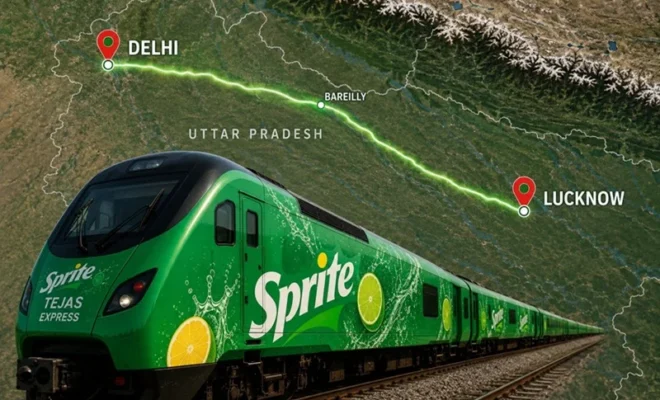
The Indian railways have seen some very interesting branding efforts come their way, with the Lucknow-New Delhi Tejas Express getting a makeover from the popular brand Sprite. What makes this incident newsworthy is the fact that the train happens to be linked to the first-ever “private” or commercial train in India.
According to recent reports, the Lucknow-Delhi Tejas has been branded as a “Sprite Tejas Express,” involving Coke’s branding and advertising on the train. The incident has sparked a debate about whether premium trains will soon become a platform for big brands’ campaigns.
What Is the Sprite Tejas Express?
The Sprite branding does not necessarily imply that there is a new train introduction and that the Tejas Express has undergone any change in management. On the contrary, the brand introduction relates to the commercial branding and advertisement of the existing Lucknow-New Delhi Tejas express train service.
The train has been labeled as India’s first corporate-led or “private” train experiment ever since its inauguration back in 2019. It is however worth mentioning that the phrase “private train” is somewhat misleading. The train service is being provided by IRCTC, while all the rail infrastructure services are within the Indian Railways system.
In this case, the newly branded Sprite implies branding of the existing premium rail service rather than privatization of the railroad service.
Why the Lucknow–Delhi Tejas Is Significant
The Lucknow-New Delhi Tejas Express is a unique train in the history of Indian railways. It was inaugurated in October 2019 as India’s first ever corporate train service, which was provided by the IRCTC. The train connected two major cities and offered its travelers a more luxury ride than other trains, with the aim of creating an experience closer to flying.
In addition to catering, comfortable seating, automatic doors, passenger entertainment, passenger charging facility, CCTV, and modern toilets, some other facilities were included in the train. The train’s premium positioning helped in branding the train in the commercial world.
What Does the Sprite Makeover Actually Mean?
The most obvious difference that comes to attention is the appearance of Sprite branding on the exterior of the train. The current posts made on social media indicate that the trains now operate under Sprite branding and advertising wrap, giving it an unofficial name of the “Sprite Tejas.”
The initiative indicates the changing nature of the use of railways in advertising. The brands now have more options than just using station hoardings, digital screens, or conventional posters for their ads, since the entire train can serve as an advertising vehicle.
The connection for Sprite itself is quite organic and natural in light of its emphasis on refreshment and coolness, especially in a country where train travel and summer advertising are extremely popular.
Why This Is Being Called India’s First Private Branded Train
The term ‘private branded train’ requires some clarification. The Lucknow-Delhi Tejas train has been widely referred to as India’s first private or corporate train, yet it is not privately owned in a traditional sense. It is operated by IRCTC, while Indian Railways bears the responsibility for the entire railway system.
What is fascinating about today’s innovation is that there is an extra layer of branding introduced into the process. Today, the train has become the medium for large-scale advertisement, creating a new bridge between luxury travel by rail and brand-oriented consumerism.
It is significant since labeling this train as a fully privately operated train implies that Sprite or any other private entity controls the railway system.
Don’t miss these IRCTC travel updates and booking tricks!
Planning a monsoon train escape?
Check out the latest IRCTC tourist train routes, fares, and package details.
Want faster IRCTC ticket bookings?
Find the 5 new website and app features designed to make reservations easier.
Can Tatkal tickets book instantly?
Uncover 4 quick booking tricks that may improve your chances of getting a confirmed seat.
RailOne or IRCTC for booking?
Browse the key differences between the two apps before your next train reservation.
Could one boarding mistake cancel?
Look into the IRCTC boarding rule that every train passenger should know before traveling.
Why Brands Want Railway Advertising
What a moving train provides that cannot be replicated by traditional advertising is the element of repeated exposure in different settings.
The Lucknow–Delhi railway route serves a number of big cities and moves passengers from one city that holds political, commercial, and cultural significance to another. Therefore, the visibility of a branded train can be gained not just by the passengers on board but also by people who see the train in stations and on rail routes.
In terms of a consumer brand like Sprite, the association makes it possible for the marketing campaign to gain visual appeal. Rather than seeing a conventional advertisement, passengers will be exposed to the brand in the travel setting.
What Passengers Can Expect
The Sprite makeover is more of a branding innovation and is not to be considered as a launch of an entirely new train service. The train itself is still the same Tejas Express Lucknow–New Delhi service.
It still retains its image as an elite chair car service because the train usually includes executive chair car, as well as AC chair car facilities, with other facilities. The train was planned with amenities such as automatic door opening, infotainment system, charging point, CCTV, and other passenger facilities.
While whether the change in branding will bring changes in passenger services, fare structure, or time table is a different issue, for now the discussion is limited to the branding aspect only.
Social Media Reaction
This changeover has already sparked an unexpectedly strong response from internet users. There are railway enthusiasts who have welcomed the branding, as long as it brings in extra money, and perhaps enhances passenger services. Other internet users have raised doubts about whether this branding might affect the aesthetics of a high-quality train.
Internet users have also brought up another point of discussion regarding this issue: If extra money is being made because of commercial advertising, then there should be some improvements in things like maintenance and catering services for the passengers.
Could More Trains Get Branded?
The Sprite Tejas development could open the door to more creative railway advertising if the model proves commercially successful.
Premium trains, railway stations, metro systems and other transport infrastructure already provide valuable advertising inventory. A fully branded train takes that idea further by transforming an entire service into a moving campaign.
If passengers and advertisers respond positively, similar collaborations could become increasingly common across India’s premium transport network.
Conclusion
The transformation of the Lucknow-Delhi Tejas Express with(Sprite branding) goes beyond just being a rather odd color scheme choice. It reflects the rising trend towards the commercialization of high-end railway services, as well as the increasing efforts of brands that are trying to go beyond their traditional billboard advertisement or digital marketing.
The Tejas Express was unique even before the recent rebranding campaign as it was the first private company-operated train in India. The rebranding campaign only serves to add to its rich history and turn this recognizable Indian premium train into an advertising vehicle.
The train remains the Tejas Express, although at present, it has a rather Sprite-like appearance. However, the bigger story behind this rebranding lies in what the experiment may portend for branded trains in the future.