
India’s Wheat Surplus Dilemma: Why Early Sowing Season Mandates Caution on Agri-Exports
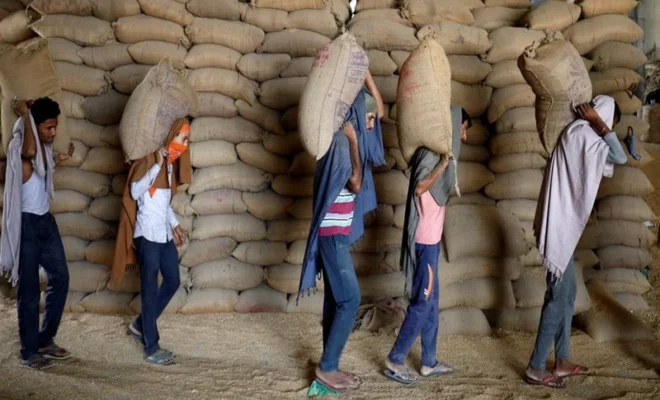
India embarks on its next wheat crop cycle with a rare blend of strengths and vulnerabilities. Government stocks are healthy, expectations about production have been good, and wheat exports are now allowed when they haven’t been in years. However, the start of the new rabi season is also a sign that agricultural surpluses cannot remain forever.
The critical issue, therefore, is not whether India currently has sufficient wheat for exports. Instead, it is how policymakers will be able to grow their exports without losing the necessary ability to ensure food security at home, manage prices, and deal with the weather.
This is important because wheat does not fit into the category of just another agricultural product in India.
India Has Built a Strong Wheat Buffer
The figures make for a good start. According to the government, wheat stocks in the Central Pool were at 513 lakh metric tonnes as of May 28, 2026, against the buffer norm of 275.80 lakh metric tonnes stipulated for July. Wheat procurement in the 2026 rabi marketing season had crossed 350 lakh metric tonnes by then.
The government had already reacted to the comfortable stocks situation by authorising additional exports. In April, another 25 lakh metric tonnes of wheat exports had been authorized, thus taking total wheat exports authorized in 2026 to 50 lakh metric tonnes, along with 10 lakh metric tonnes of wheat products. The government had claimed that the move would help improve market liquidity, prevent distress sales and protect farmer incomes and food security.
It is a significant step. India is no more viewing wheat exports simply as a food-security threat. Given the comfortable situation in terms of stocks and production, the country can use wheat exports as a tool for better stock rotation and price realization.
But it doesn’t mean that the country must always maintain wide-open doors for wheat exports.
The Early Sowing Signal Is Encouraging
The 2025/26 wheat crop presents another reason for cautious optimism. The Agriculture Ministry pointed out that 33.4 million hectares have been sown with the wheat crop, which indicates an increase in early and timely sowing compared to last year. Early sowing will help the crop avoid heat stress in the grain filling stage, which is becoming important in light of growing volatility of temperatures.
Moreover, the government stated that the addition in acreage and use of high-yielding and climate resilient varieties helped mitigate some of the risks related to weather. The production outlook remains cautiously optimistic amid heat stress and damage to the crop due to untimely rains and hail storms.
This is when the issue of export of Indian wheat crop becomes rather complicated.
A good previous crop does not necessarily mean another record crop. Early sowing ensures that the crop avoids heat stress in the late stages of its development, but it still leaves room for risks due to soil moisture, rainfall and temperature volatility among others.
The Next Wheat Crop Is Being Planned Under Weather Uncertainty
This is especially true this year, given India’s weather forecast that raises concerns about conditions that will affect its rabi crop.
According to Reuters, India’s rains in September were below average while the strengthening of El Niño was posing concerns regarding soil moisture in advance of winter crops sowing. Some of the crops whose planting conditions might be affected by residual soil moisture include wheat, rapeseed, and chickpea.
However, this doesn’t imply that India faces a wheat shortfall. Rather, it implies that India’s export policy should allow some space for maneuvering.
Policy for agriculture comes with a time lag. The wheat exported now cannot be brought back in case the next crop fails. At the same time, Indian farmers with high stocks and low prices cannot take full advantage of increased demand abroad.
The Export Debate Is Also a Farmer-Income Debate
There is a strong argument for exports when domestic supplies are comfortable.
Surpluses can affect market prices, especially during the harvest period. If farmers have no option but to sell their produce amid surpluses in the market, the advantage gained through increased production may become irrelevant.
The export policy announcement by the government in April mentioned preventing distressed sale and improving farmers’ earnings specifically.
It becomes all the more pertinent in the case of wheat-producing states like Punjab and Haryana, where procurement and markets play an important part in the economy of agriculture.
Another reason why the term ‘surplus’ should be used carefully is seen in Punjab’s experience of the current procurement season. While the government stated that wheat arrivals in Punjab as of May 6 were estimated at 122 lakh tonnes, lower than last year’s figure of 125 lakh tonnes, and lifting from mandis was higher than last year. Movement of wheat was described to be better, and additional capacity had been created in railways for evacuating mandis.
In short, a bumper crop doesn’t necessarily mean a glut which is difficult to manage.
Why Export Policy Should Remain Calibrated
India thus requires an export policy which will have the capability of responding to any changes in supply conditions rather than a policy that will tie it down either to permanent restrictions on exports or unlimited exportation.
This justification for export policy is quite obvious. In the event that government and private stocks are well above domestic needs, exports can be used to manage stocks and maintain prices.
However, in case there is weather uncertainty about the forthcoming crop, there must be room left to curtail exports in case the domestic availability turns out to be poor.
This is not a contradiction at all. This is only risk management. The government has already shown that it has the capacity to change its trade policy in line with changes in the market environment.
India Must Avoid Repeating the Boom-and-Bust Cycle
This larger lesson goes well beyond just the wheat case.
There have been times when India’s agricultural trade policy has had to choose between two conflicting goals: safeguarding consumers from food price increases and providing producers access to profitable markets.
Export policies that are too tight could reduce farmgate prices if there is an abundance of production. However, aggressive exporting followed by shortages could exert upward pressure on domestic prices and lead to a sudden policy about-turn.
A more consistent approach will provide producers, middlemen and exporters time to plan and at the same time provide the protection for food security.
In case of wheat, this will mean taking into account levels of stocks, procurement, production, weather and domestic prices.
The New Sowing Season Changes the Calculation
The start of the sowing season of wheat thus provides an apt opportunity to exercise caution.
India has plentiful stock. There has been excellent production. There have been adequate exports by the Government already.
But the next crop is yet to be harvested.
This distinction needs to play a role in shaping up the policy discourse.
There is sufficient leeway for India to utilize its wheat surplus without assuming that this favorable position is going to persist forever.
Conclusion: Export, But Keep the Safety Valve
It need not be a choice for India between farmers and food security. Exporting at a well-calibrated rate will accomplish both ends.
The trick lies in ensuring that surplus is leveraged in such a way that it adds liquidity and improves farmer economics while keeping enough reserves of food to take care of unforeseen circumstances like lower yield or unfavorable weather events.
The fact that we are in an early planting season makes one thing clear: the future is always uncertain in agriculture.
While today’s surplus will help the current crop, tomorrow’s food security will be dependent on today’s planting.
This is precisely the reason why India’s wheat exporting policy should always be future-ready but should not forget to keep a look out for the future in the next field.
What’s Changing in India’s Global Trade?
Why Did India Lift Wheat Export Ban?
Check out what prompted India to reopen wheat exports.
How Much Wheat Does India Export?
Find out how India supplies wheat to global markets.
Could Sugar Exports Face New Curbs?
Uncover why India may restrict sugar exports next.
How Did Wheat Ban Affect Prices?
Browse how India’s wheat ban influenced prices worldwide.
Why Did India Ban Wheat Exports?
Look into the reasons behind India’s earlier wheat export restriction.