India’s First LNG-Powered Train: What Changed at Sabarmati and What the ₹1,542 Crore Rail Upgrade Means
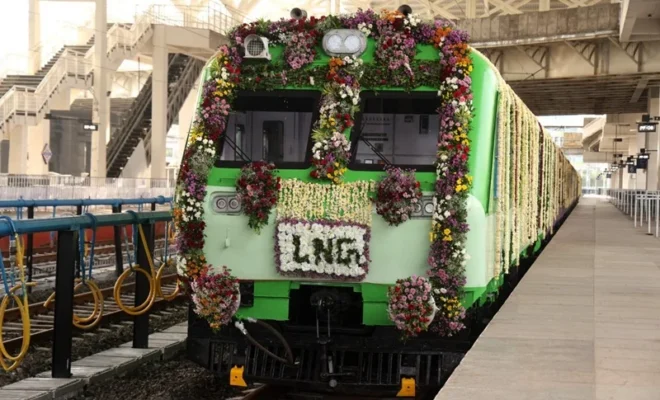
India has made another stride in making the railways environment-friendly and fuel-efficient by introducing the first LNG train of India from Sabarmati Railway Station in Ahmedabad, Gujarat. The train was flagged off by Union Minister for Home Affairs and Cooperation, Shri Amit Shah, in presence of Gujarat CM, Shri Bhupendra Patel, on September 27, 2026. This was also the day when laying of foundation stones took place for many railway schemes worth more than ₹1,542 crore.
It is a noteworthy development since this train will run on a combination of diesel and LNG fuel, and the entire Sabarmati initiative revolves around rail safety, freight transportation, signalization, locomotive maintenance, and connectivity.
What is India’s First LNG-Powered Train?
Unlike what many people might believe, the train does not solely rely on LNG as the fuel source. The train relies on a dual-fuel system that incorporates LNG and diesel.
Two 1,400-horsepower Driving Power Cars of the Sabarmati Integrated Coaching Depot have been modified to utilize both fuel sources. From reports, it has been established that LNG could replace about 40% of the diesel use in the system. Over 2,000 kilometers of testing trials had apparently been carried out before the system was launched.
The technology is aimed at reducing the reliance on diesel while lowering the cost of fuels and emissions.
How Does the LNG Technology Work?
LNG stands for liquefied natural gas. This is natural gas which is cooled down at extremely low temperatures such that it is liquefied. The liquefied gas is then converted back to gas before being used as fuel.
In the case of the Sabarmati project, LNG is used along side diesel and not as a replacement of the diesel. The dual-fuel combination will enable Indian Railways to experiment on alternative fuel technology without having to shift entirely from diesel.
How Much Fuel and Money Could It Save?
Based on the first results obtained from trials by the railways, there is potential for the system to deliver some savings in terms of operation.
As indicated in The Indian Express, the annual savings expected in each Driving Power Car is ₹11.9 lakh, whereas a rake of eight coaches can save ₹23.9 lakh per annum.
This, however, is dependent on how much the system is utilized.
The ultimate goal is the reduction of diesel fuel usage in railways, and searching for other fuels that are more environmentally friendly.
Why is the LNG Train Important for Indian Railways?
The Indian Railways have progressively decreased their reliance on diesel as electrification increases in the system. The use of the LNG train is yet another method for cutting down on conventional fuel usage, especially where alternative-fuel technology may be practically incorporated.
The project will also fall under the broader attempt to increase energy efficiency in railway operations.
Nevertheless, the introduction of the LNG train in Sabarmati needs to be seen as a technological breakthrough and not a clear indication that such trains will replace traditional locomotives in the near future.
What Does the ₹1,542 Crore Railway Package Consist of?
The LNG train is only a small part of the vast programme for development of the railways that has been announced in Sabarmati.
The railway package consists of a ₹700 crore WAG-12 locomotive workshop, an automatic block signalling system, enhancement of the Kavach train protection system, and doubling of the Sabarmati-Sarkhej railway line.
Overall, these initiatives aim at increasing railway safety and capacity, improving freight operations and connectivity in the Ahmedabad region.
₹700 Crore WAG-12 Maintenance Shed
The other large project of the Sabarmati development package is the construction of a new shed for the maintenance of the WAG-12 locomotive, that is located in Sabarmati.
At a cost of around ₹700 crore, this facility would facilitate the maintenance of up to 300 high horsepower WAG-12 locomotives. Each of these locomotives has a capacity of 12,000 HP and is capable of hauling very long freight trains.
Kavach to be Installed on 404 Kilometers of Railway Lines
Railway safety forms yet another component of the Sabarmati development scheme.
The Kavach automatic train protection system, developed indigenously, will be implemented on roughly 404 kilometers of railway lines in Ahmedabad division. The project carries an estimated cost of around ₹411 crore and relates to Ahmedabad-Palanpur and Ahmedabad-Samakhiyali railway routes.
Kavach is meant to avoid train collisions through the prevention of any overspeeding and signaling violations. It can automatically apply brakes on breach of certain safety parameters.
Automatic Signalling for 122.57 Kilometres
Apart from that, an automatic block signalling system for 122.57 km has been set up for the sections between Sabarmati and Kalol, Bhandu Motidau, Sanand and Jakhwada.
The approximate cost of the project is ₹118.83 crore. Automatic signalling enables trains to run at safe distances from one another and increases the capacity of the train traffic through a particular railway line.
This project becomes very relevant in the context of the growing demand in passenger and cargo traffic.
Sabarmati-Sarkhej Railway Line to Be Doubled
The other important development is the doubling of the 21-km Sabarmati-Sarkhej railway line.
The cost of the project is estimated at ₹313.27 crore. It is expected to be completed in March 2028. The project will add to the capacity and improve the connectivity to the Sarkhej-Dholera region.
What Does This Mean for Passengers?
For the riders, however, the immediate effect might be through the development of railway capacity, signaling and safety and not the LNG train.
As a demonstration and rollout of an alternative fuel technology, the LNG train contrasts with other schemes like automatic signaling and line doubling, which affect the performance of trains on routes.
Thus, this bundle of proposals can have some effect on connectivity and capacity in the Ahmedabad area as these different schemes are rolled out.
The Bigger Green Railway Push
This launch takes place in the context of the broader plan by the Indian Railways to cut down diesel use and go for more electrification.
During the launch, Amit Shah spoke about the fall in diesel use on railways over the last decade, and according to state media reporting, there has been significant expansion in electrification.
Conclusion
The use of India’s first LNG powered train can be seen as an interesting step towards using alternate fuel for railways. The new train, which runs on both LNG and diesel, will help save diesel fuel and reduce pollution.
However, the more significant thing is the launch of a huge railway project worth ₹1,542 crore-plus which includes alternate fuel technology, Kavach technology, automatic signaling system, WAG-12 facility, and double railway line.
All these steps prove that apart from making fast trains, railway modernization efforts cover various other aspects too.
India’s Railways Are Entering a New Era
Could India’s Bullet Train Hit 280 Kmph?
Check out the first 280 kmph bullet train planned for India.
What’s New About Sprite Tejas Express?
Find out how India’s first private train got a major makeover.
Which IRCTC Monsoon Trains Should You Know?
Explore routes, ticket prices, bookings, and special tour packages.
How Will India’s Hydrogen Train Work?
Uncover its route, key features, and potential benefits.
What Makes IRCTC Booking Easier Now?
Discover five new features simplifying train ticket reservations.