UN Secretary-General Guterres Backs PM Modi’s Call for Permanent UNSC Seat for India
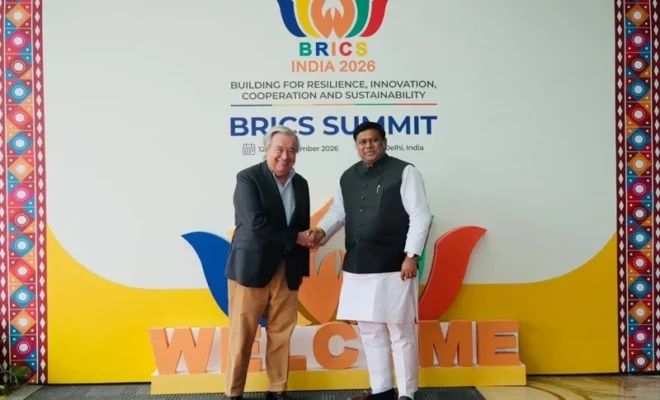
The long-held effort by India to gain a permanent seat at the United Nations Security Council has gained new impetus following an expression of support by UN Secretary-General António Guterres for urgent reforms of the Council and other international institutions.
This happened while Guterres was visiting New Delhi as part of the 18th BRICS Summit and had a meeting with Indian Prime Minister Narendra Modi and talked about the need for making multilateral institutions more reflective of the modern world reality. According to the UN’s account of the event, the issue of reforming multilateral institutions, including the UN Security Council, was raised by both parties.
It should be noted that there is a clear difference between the two: the support expressed by Guterres is for the reform of the Security Council, not an official announcement of India gaining a permanent seat, since the process of expanding the Council requires an agreement among UN members.
What Did Guterres Say About UNSC Reform?
The point which Guterres has made on several occasions is that the architecture of the Security Council needs to align with the realities of the present world rather than the geopolitical environment prevalent in 1945.
His stance was further fortified when he had his latest interaction with Prime Minister Modi. During the BRICS Summit, Guterres backed the general idea that the global organizations need to adapt themselves according to the changing realities of economic power, demography, and geopolitics.
This is particularly important for India because New Delhi has been advocating the need for reforms in the Security Council as far as its representation goes.
Why India Wants a Permanent UNSC Seat
India has been aspiring for permanent membership of an expanded and reformed Security Council for decades now.
This is based on a number of considerations such as the huge population of India, its economic clout, its diplomatic stature and its involvement in United Nations peacekeeping operations.
India also portrays itself as an important representative of the Global South. India’s stand is that states with large populations should have a permanent place in the decision-making process regarding peace and security of the international community.
India has repeatedly called for expanding both permanent and non-permanent membership of the Security Council.
Modi’s Push: From Rule-Taker to Rule-Shaper
There have been increasing efforts from Prime Minister Narendra Modi to relate India’s demand for UNSC membership with an overall theme of representation of the Global South.
The hidden message here is that developing nations must have a larger say in formulating international law rather than following the decisions of international institutions that are controlled by a small set of countries. This issue has received further attention owing to India’s presidency of BRICS. Both Modi and Guterres stressed the significance of multipolarity and reforms in multilateral institutions, including the UNSC.
Why Guterres’ Support Matters for India
However, despite the fact that UN Secretary-General cannot single-handedly appoint any country for permanent membership at the Security Council, his stance is significant from the diplomatic perspective.
For instance, Guterres has always been an advocate of the reforms within the Security Council which would increase its representation. Moreover, the UN officials once referred to Guterres as a champion of Security Council reform, which would be in line with the current realities, rather than the one established after World War II.
Thus, it is beneficial for India to use these recent remarks of the UN Secretary-General in terms of diplomacy since they support the main argument of its initiative.
India Has Also Gained Support From Other Countries
The view of Guterres follows several international statements which have come in support of India’s increased participation in a reformed Security Council.
The government of Slovakia has advocated India’s membership in a reformed and expanded Security Council, whereas Luxembourg’s Deputy Prime Minister and Foreign Minister Xavier Bettel has asked why a nation like India is not a permanent member of the Security Council despite being so big and influential on the world stage.
India also maintains its close relations with the other G4 nations Brazil, Germany, and Japan who have together been advocating for comprehensive reforms to the Security Council.
These are not guarantees of a permanent membership, but they clearly show that India’s claim has international recognition..
What About the Veto Power?
One of the main complications that arise during Security Council reform has to do with the veto right.
At present, China, France, Russia, the United Kingdom and the United States have the right to use their veto power.
Thus, India’s effort is not limited only to the increase in the number of permanent members. Reforming the Security Council would inevitably raise the issues related to the roles and procedures of its members.
Various solutions to the problem of veto rights were offered by various states, which makes the issue very complex.
Has India Actually Got a Permanent Seat Yet?
No. This is the crucial point for readers keeping up with the current news.
It should be noted that Guterres’ advocacy for Security Council reform doesn’t imply the official granting of permanent status to India.
The five current permanent members have not changed. A formal expansion would need a UN Charter amendment followed by a proper procedure.
Hence, the news regarding the granting of a permanent seat at the UNSC or the right to veto would be false.
India is still pursuing its diplomatic efforts to achieve the permanent membership of a reformed and expanded Security Council.
Why 2026 Could Be Important for India’s Campaign
The significance of the timing is linked to India’s attempts to play a greater role within multilateral organizations by holding various diplomatic events like the BRICS Summit.
India has initiated its application for membership on the Security Council in the year 2028–29 as a non-permanent member, thus implying that New Delhi is working on obtaining membership immediately and in the future.
At the same time, the G4 members continue to push forward their attempts to negotiate reform of the organization.
This combination of diplomatic events makes it possible for India to bring up the question of permanent membership within international discussion forums.
The Bigger Message for Global Governance
Discussion of the permanent UNSC seat for India is essentially one small piece of a much bigger discussion about the operation of global institutions in a multipolar world.
The distribution of economic and political power in the world has been transformed since 1945. Nations like India have assumed much greater significance in terms of world trade, technology, diplomacy, development, and international security.
The challenge is whether these institutions can adequately reflect the transformation.
The most recent position of Guterres seems to suggest that he thinks that reform cannot be endlessly deferred.
Conclusion
António Guterres’ most recent call for reform of the Security Council marks the beginning of a new wave of backing from a high-profile source for India’s efforts at getting a permanent seat.
This is indeed a major development, but it does not mean that the UN has officially decided on giving India its permanent membership.
The first thing for India is a diplomatic success, as the UN top management recognizes once again the need to reflect contemporary realities in the composition of the Security Council.
The tough part still remains in turning this overwhelming international opinion into a change in the institution itself.
António Guterres has reinforced the case of India in the effort to get a more representative UN Security Council, but India has not yet become a permanent member of the Security Council.
Key National Stories to Explore
Could India Secure A Stronger UN Role?
Check out India’s campaign priorities for the UNSC non-permanent seat for 2028–29.
Can India Build A Drug-Free Youth?
Find out how PM Modi’s campaign aims to create a healthier, drug-free generation.
Could Rosatom Help India Reach 100GW?
Uncover how Russia’s nuclear power proposal could support India’s ambitious energy target.
Can Free Coaching Transform Exam Preparation?
Explore PM Modi’s initiative offering competitive exam coaching from leading educators.
What Is India’s Vision For 2047?
Reveal how ‘Shakti Ki Sapt Dhara’ outlines a roadmap toward Viksit Bharat @2047.