South Africa Backs Bigger Global Role for India: Why BRICS Is Not an Anti-West Bloc
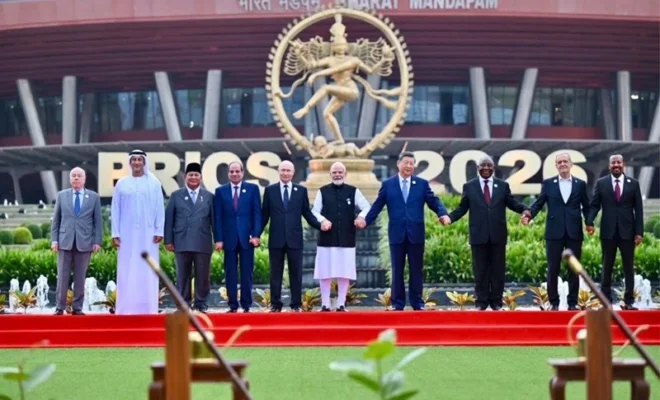
There have been new developments in terms of support to India’s involvement in the evolving global order from South Africa, as the BRICS Summit being held in New Delhi focuses more on giving a louder voice to the Global South. While South Africa has always seen BRICS as a platform of cooperation and development and not a block meant to counter the Western nations, the foreign policy messaging currently being done by the nation is also based on strategic autonomy and partnerships across the geopolitical divide.
The message is important for India since New Delhi has been ensuring that BRICS remains a broad platform of diplomacy and economic cooperation and not an explicitly anti-American or anti-Western coalition. Recent discussions on the Summit have also made this clear.
Why South Africa’s Message Matters for India
South Africa and India have a common interest in increasing the clout of developing and emerging economies within international institutions. Pretoria has often complained that the current international governance framework does not take into account the strength of the Global South.
President Cyril Ramaphosa of South Africa acknowledged Prime Minister Narendra Modi’s hospitality at the BRICS Summit of 2026, and stressed the need for multilateralism during times of immense international uncertainty. The President emphasized the relevance of international bodies such as the United Nations in ensuring international cooperation and peace.
This provides an excellent diplomatic opportunity for India. New Delhi is in a position to project itself not just as one of the BRICS members, but also as a possible connecting point between the developed nations and the emerging and developing economies.
BRICS Is Not Being Positioned as an Anti-West Alliance
It can be said that the most important realization emerging from the current BRICS discussion is that BRICS as an alliance lacks a common ideological approach towards the West.
In this case, the South African country has a policy of non-alignment and has always maintained that it did not want to become part of a clash of interests between superpowers. According to the South African government, BRICS is more of a forum for collaboration and cooperation in areas of shared interest than being an alternative to the present international forums.
The reason for emphasizing this point is that there are several countries in the BRICS alliance that have a diverse approach towards their foreign policy. While some countries try to be autonomous from western organizations, others have a long-standing relationship with the western nations like US and Europe.
India is one such country, which is equally an important ally of the west as well as a BRICS member.
India’s Strategic Autonomy Is the Bigger Story
India’s positioning within BRICS is based on its larger foreign policy strategy of strategic autonomy.
Traditionally, India has never aligned itself entirely with one geopolitical bloc. It maintains contacts with the US and the EU and with Russia; it is part of BRICS and also interacts with other Southern states.
The present summit of BRICS is a continuation of this policy. India has tried to focus on cooperation in the fields of trade, technology, development, logistics, health, climate and digital innovations instead of making this group a forum for pure geopolitical confrontation. Recent commentary about the BRICS summit has also noted India’s attempts not to turn BRICS into an overtly anti-Western coalition.
That makes India’s role particularly distinctive: it does not have to choose between the West and the non-West, but can maintain contacts with both parties.
Why South Africa Wants a Stronger Global South Voice
BRICS is especially important for South Africa because it enables developing nations to voice themselves within discussions that have always been controlled by the great Western powers.
“Pretoria has characterized BRICS as one of the mechanisms of cooperation among emerging and developing economies and creation of a more equitable international system.”
Its agenda up until 2026 includes reforms in global governance, economic development, trade and investments, finance and the voice of the Global South.
The importance of India as a large nation in terms of population, economy and diplomacy as well as its presence in various international organizations makes this goal attainable.
India’s Opportunity as a Bridge
However, the importance of India within BRICS goes beyond its economic standing.
In fact, with the expansion of BRICS, there are countries in it that have differing interests and differing ties with Western nations.
While the diversity of BRICS makes achieving consensus even more difficult, India’s capability of maintaining dialogue between the divided nations within BRICS makes India even more important within BRICS.
India has thus tried to position itself in just such a manner.
New Delhi, therefore, provided India the chance to portray BRICS as a realistic forum for cooperation and not as a rival to the United States or Europe.
What This Means for the Global Order
But there is a much bigger picture beyond BRICS. The world order is evolving into one in which the international community becomes increasingly fragmented and multipolar with rising states increasingly desirous of having a voice in global affairs.
The stance taken by South Africa in this context is an example of such an evolving world order. The South African government has maintained that multipolarity means greater collective responsibility, adherence to international law, and agency for the Global South.
India’s approach easily falls in line with this understanding. India has not sought to dismantle the existing institutions but sought reforms so that developing nations have more representation in them.
Why the India-South Africa Partnership Matters
India and South Africa have had long diplomatic and economic relations, but the BRICS forum provides a far more extensive international platform for their partnership.
Both nations believe in the need to increase the voice of the developing world in international institutions and seek multilateral solutions to international problems.
These common views may become increasingly relevant as the BRICS alliance grows and tries to balance differences among its members as well as create a common agenda.
South Africa’s view of an active role of India is important not only on a bilateral level, but contributes to the larger case about India taking up a leadership position in a diverse Global South bloc.
More BRICS Stories Worth Exploring
What Makes India’s BRICS Summit Significant?
Check out how PM Modi’s summit brings global leaders together in New Delhi.
Is India Building A Balanced BRICS?
Find out why India’s BRICS approach focuses on pragmatism rather than an anti-Western bloc.
Could BRICS Reshape Global Financial Systems?
Uncover how expansion and local-currency trade could transform global finance.
Why Does The BRICS Legal Forum Matter?
Browse the key issues shaping the 2026 BRICS Chief Justices’ Forum in New Delhi.
What Does “Humanity First” Really Mean?
See how India’s BRICS vision responds to sanctions and challenges facing the global community.
Conclusion
In this respect, the message from South Africa and the larger 2026 BRICS negotiations appears clear. BRICS does not necessarily have to turn into an anti-Western bloc in order to increase its influence.
It is important for India, which will be able to advocate the rights of developing countries, promote global institution reforms, greater economic integration, as well as maintain friendly ties with the United States, Europe, and other Western countries.
This makes South African views even more relevant as it shows why India is increasingly seen as a possible bridge between different regions of the international community.
The story of BRICS is not necessarily about the West against the East.
It is increasingly about whether India and other countries can manage to establish a more representative international order without creating new geopolitical blocs.