
India’s First Vande Bharat Freight EMU Hits 130 Kmph in Trial Run on Ahmedabad-Mumbai Route
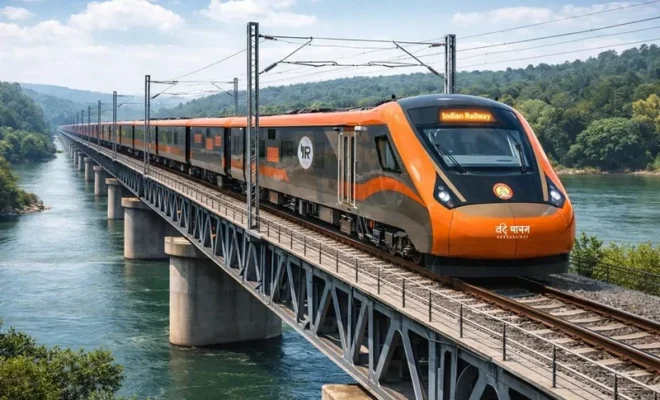
With the trial run of India’s first Vande Bharat freight EMU at 130 kmph from Ahmedabad to Mumbai Central, India has achieved an important milestone in terms of achieving faster transport of freight by rail. This trial run has been carried out as a part of Indian Railways’ initiative towards achieving faster and better freight services for those goods that cannot afford delays.
This is especially important since the Vande Bharat platform has so far been known primarily for passenger trains and not for any freight trains. However, the Vande Bharat freight EMU that has been used for the trials has been exclusively designed to transport freight, such as parcels, among others.
What Happened During the Ahmedabad-Mumbai Trial?
The last test was done by the Research Designs and Standards Organisation (RDSO) on the Ahmedabad-Vadodara-Mumbai Central of Western Railway line. The train ran from Ahmedabad to Mumbai Central under specific operational conditions, which were closely monitored by railway personnel.
This test did not consist only in checking the train’s speed. There were instruments that measured the stability and behaviour of the train when running at the speed of 130 kmph. The test was conducted under specific loads, such as 50 per cent power load, and railway personnel also checked prescribed permanent and temporary speed restrictions on the route.
This is crucial as a cargo train with heavy loads must first prove stability and safe running before being allowed to run at high speeds.
What Is the Vande Bharat Freight EMU?
The Vande Bharat Freight EMU is a 16-coach self-propelled freight train developed by Integral Coach Factory (ICF), Chennai. Unlike the conventional freight train, which is pulled by a locomotive, the Vande Bharat based trainset has distributed propulsion.
It has been designed for a completely different market segment of freight transport. Instead of being a replacement for the conventional freight trains which transport massive quantities of bulk cargoes, it has been designed for cargo that needs speed, reliability, and control during transport.
Its likely customers will include e-commerce/courier firms, electronic manufacturers, pharmaceutical companies, and those businesses that rely on cold chain logistics.
Why Does 130 Kmph Matter for Freight?
Conventional freight movement tends to be oriented towards efficient bulk cargo carriage, but not towards reaching the same speeds as passenger trains. The Vande Bharat Freight EMU follows a divergent strategy by concentrating on timely movement of cargo.
In case of pharmaceuticals, electronics, valuable shipments, and other such perishables, cutting down the travel time itself may serve a business advantage. High-speed rail movement would also provide companies with an option for avoiding road transport on congested routes.
The 130 kmph trials thus are indicative of something beyond just speed. They indicate the fact that Indian Railways is experimenting with ways in which the high-speed train technology can be modified to cater to freight purposes too.
What Can This Freight Train Carry?
Unlike the old-fashioned bulk cargo trains, the freight EMU is based on the modern logistical needs. Sources have revealed that this train is equipped with certain features meant for the carriage of time sensitive or palletized cargo, like roller flooring and large automatic doors. This train will also be able to transport refrigerated or temperature sensitive cargo, which means that the train could be used to transport pharmaceuticals or other cold chain goods.
Also included in this train are security features such as CCTVs, fire alarms, advanced rail security features and even Kavach.
All of these features mean that this train can better be referred to as an ultra fast logistical system.
Is 130 Kmph Its Maximum Speed?
No. This speed of 130 kmph attained during the test run on the Ahmedabad-Mumbai route must not be seen as the train’s maximum design capability.
It may be recalled that in previous testing of the Vande Bharat Freight EMU train, higher speeds had been attained in different scenarios. It is said that the train’s design capability is about 160 kmph, whereas in one such test done earlier in empty condition, the train had been able to attain a speed of 145 kmph.
Why Ahmedabad-Mumbai Is an Important Route
This is due to the fact that the Ahmedabad-Mumbai Corridor links the two most important economic regions in Western India.
There is the possibility that companies may stand to gain from this faster freight train especially those involved in transporting value-for-money commodities within Gujarat and Maharashtra.
Additionally, this railway can serve as a good testing ground as the performance of the train will be tested under operating conditions and not just on a test track.
Will It Replace Conventional Freight Trains?
The Vande Bharat Freight EMU does not mean that heavy freight trains and Dedicated Freight Corridor should be discontinued. They are meant to complement each other.
Conventional freight trains continue to play a critical role in carrying bulky goods such as coal and other minerals. The need for high speed for a train can arise when there are valuable cargo items to be carried.
It could help Indian Railways to offer customized services to various types of customers with respect to freight items being carried.
What Happens After the Trial?
The present exercise of Ahmedabad-Mumbai is still a part of the testing process. The technical information obtained from the trials will be used by RDSO for assessing the stability and the operational speed of the rake.
The official commercial run will only come when there is a technical assessment of the train, which includes the operational decision and safety clearance. Till date, the Indian Railways has not set any date for the commercial run of Vande Bharat Freight.
Why This Could Change Indian Logistics
However, speed and reliable logistics have now become very crucial in the e-commerce, pharmaceuticals, and fast delivery industries in India. Road logistics continue to be the dominant means of transport in some of these cases. However, factors like congestion, cost of fuel, and long distances may pose a challenge in this regard.
It would be quite interesting to observe how the introduction of a faster railway logistics system may offer an alternative in such a case. This is because the Vande Bharat Freight EMU signifies that the Vande Bharat technology is no longer confined to fast passenger transportation in India.
Explore India’s Next Big Transformations
Could India’s Bullet Trains Change Rail Travel?
Check out India’s first 280 kmph bullet train plans and its expected 2027 debut.
Can Arctic Routes Transform India’s Trade?
Find out how India’s Northern Sea Route voyage could diversify future supply lines.
What Is Shakti Ki Sapt Dhara?
Uncover PM Modi’s roadmap for building a Viksit Bharat by 2047.
Why Is Vande Mataram Making History?
See why the full six-stanza national song will be performed at the Red Fort.
Could Night Trains Redefine Indian Railways?
Dive into India’s emerging rail revolution focused on speed, technology, and sleeper comfort.
Conclusion
The 130 kmph trial run of India’s first Vande Bharat Freight EMU between Ahmedabad and Mumbai has been a landmark move in the development of modernizing freight transport. The 16-coach train is specially built for fast transportation of parcels and cargo, especially of value goods that need fast transit.
However, it is only a trial and not the first move towards making it commercially operational. The train’s performance would have to be further evaluated before its launch into service.
This indicates that the Vande Bharat story of India isn’t limited to passenger trains alone. The 130 kmph trial run of the country’s first Vande Bharat freight EMU between Ahmedabad and Mumbai shows the Indian Railways’ willingness to test out the fast train technology for time sensitive cargo movement.