
Assam Seeks Bengal Aid to Restore Historic Madhupur Satra: Cross-State Cultural Diplomacy Push
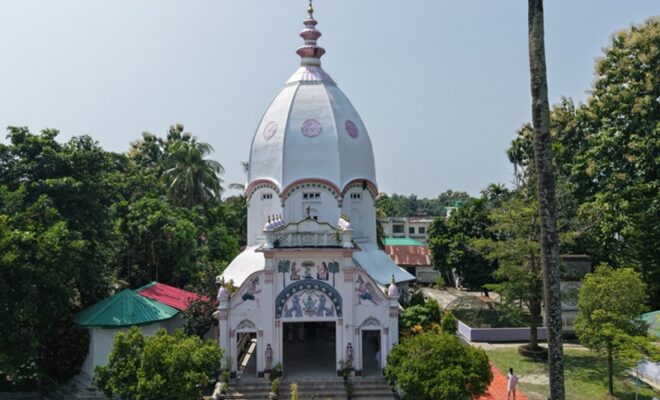
A historic cultural connection between Assam and West Bengal is taking centre stage as the two states move towards jointly developing Madhupur Satra in Cooch Behar into a major religious, cultural and heritage tourism destination.
The development gained momentum after Assam Chief Minister Himanta Biswa Sarma visited the historic Vaishnavite site on September 19 and held discussions with West Bengal ministers, officials and representatives of the Satra. Assam has already allocated ₹35 crore for the project, while discussions have also centred on West Bengal’s participation and the need for a joint development plan.
The initiative is significant because Madhupur Satra is located in West Bengal but has a deep connection with Assam’s Vaishnavite tradition and the legacy of Srimanta Sankardeva. The proposed collaboration could therefore turn heritage preservation into a form of cross-state cultural cooperation.
Why Madhupur Satra Is Historically Important
Not only is Madhupur Satra a religious complex in Cooch Behar; it has also played a prominent role in the life of Mahapurush Srimanta Sankardeva, the Assamese saint, social reformer and a major personality responsible for the growth of the Vaishnavite tradition in Assam in the 15th century.
From the reports that were obtained during the recent trip, it can be understood that Sankardeva passed the last part of his life at Madhupur. Hence, Madhupur has a special significance in terms of its spiritual and cultural importance in Assam even though the Satra is situated in West Bengal.
Consequently, there is special cultural significance of the place both for the people of Assam as well as for the Vaishnavite community as a whole.
What Assam Is Asking West Bengal to Do
This current attempt has been described as a collaborative effort rather than the redevelopment program for Assam alone.
During his visit, Mr Himanta Biswa Sarma requested collaboration between the state governments of Assam and West Bengal for protecting and developing the Satra. Mr Sarma also suggested the need for a delegation from West Bengal to visit Batadrava Than in Nagaon, which is the birthplace of Srimanta Sankardeva, to know about the development model being followed there.
The proposed visit is significant because it relates two very prominent places associated with the Sankardeva – Batadrava in Assam where he was born and Madhupur in Cooch Behar where he spent the latter part of his life.
It is therefore not merely about construction but a cultural bond between both the places.
₹35 Crore Assam Investment and Bengal’s Role
It has been reported that the Assam state government has set aside ₹35 crore for the development of Madhupur Satra.
It is also reported that the West Bengal state government has talked about making a contribution of about ₹30 crore. However, the structure of the joint funding and implementation process is not yet clear. According to West Bengal minister Nishith Pramanik, the two governments will work out a detailed plan before deciding on the joint implementation process.
This is particularly significant since this project becomes a cross-state heritage project wherein both states will be involved in the preservation and development of an area outside Assam but with rich Assamese cultural history.
The Land and Encroachment Challenge
The most significant practical question that is involved with the redevelopment project is the availability of land.
Sarma stated that the scale of the project would depend on whether or not more land can be obtained for expansion. In case expansion was not possible, then the redevelopment plan would have to be implemented using the existing land space which was estimated to be 16 bighas or about five acres.
The Minister of West Bengal, Nishith Pramanik, was also aware of the question of encroachments at the religious site. He added that there were talks regarding how to deal with the problem of encroachment without affecting those who are affected.
This shows that the redevelopment of the heritage site involves not just construction and tourism planning but also land management.
From Religious Site to Heritage Tourism Destination
This proposal for redevelopment of the site is also being considered from the perspective of tourism.
The government of Assam would like to see the redevelopment of Madhupur Satra to an extent that is commensurate with other Sankardeva sites in Assam, especially the Batadrava Than site. With the acquisition of additional land, Sarma has indicated that Madhupur could become a significant tourism attraction in North Bengal.
It could help in creating a tourist circuit of religious sites which include significant Vaishnavite sites of Assam and West Bengal.
This could draw in pilgrims, scholars, cultural heritage tourists, etc.
A Cultural Bridge Between Assam and West Bengal
The project has a significance beyond infrastructure because Madhupur represents a historical connection that crosses today’s state boundaries.
The cultural traditions associated with Sankardeva developed across a region whose historical networks were not defined by modern administrative borders. Today, the Madhupur project provides an opportunity for Assam and West Bengal to use that shared history as a basis for cooperation.
The proposed visit of West Bengal representatives to Batadrava is particularly relevant in this context. It could create greater coordination between institutions responsible for preserving different sites associated with the same cultural figure.
Preserving Manuscripts and Living Heritage
Discussion regarding restoration is also taking place amidst growing efforts to conserve the tangible cultural heritage of Madhupur.
In August 2026, there started a project for digitization of the rare manuscripts of Sanchi-pat, which were stored in Madhupur Dham Satra. The conservation project has been considered to be significant with regard to preservation of manuscripts having connection with the Vaishnavite culture of the region.
This becomes another aspect of the discussion on development of the area. Restoration of Madhupur is not only about buildings, roads and tourism infrastructure; it is also about protecting the manuscripts and other aspects of the cultural heritage of the region.
Why the Project Matters Today
The Madhupur Satra initiative comes as governments increasingly use heritage and religious tourism to strengthen regional tourism economies.
For Assam, the project provides an opportunity to preserve an important part of its cultural history even though the site lies in neighbouring West Bengal. For West Bengal, redevelopment could strengthen Cooch Behar’s position on the religious and heritage tourism map.
The project could also encourage better connectivity, accommodation, visitor facilities and preservation infrastructure around the Satra, although the exact development plan is yet to be finalized.
What Happens Next
The immediate next step is the preparation of a detailed development blueprint involving the two states and the Satra authorities.
Questions around land availability, encroachment, funding, infrastructure and heritage preservation will have to be resolved before the full project can take shape. The governments are also expected to determine how responsibilities will be divided between Assam and West Bengal.
The proposed visit by a West Bengal delegation to Batadrava could be an early step towards establishing a more structured cultural partnership.
Conclusion
The proposed redevelopment of Madhupur Satra is emerging as more than a temple infrastructure project. It represents an attempt by Assam and West Bengal to jointly preserve a site that carries deep significance for Assamese Vaishnavite heritage.
With Assam committing ₹35 crore and West Bengal discussing its own financial and administrative role, the project could eventually transform Madhupur into a major pilgrimage and heritage destination.
At its heart, however, the initiative is about reconnecting two states through the legacy of Srimanta Sankardeva and using shared cultural history as a bridge for cooperation.
Madhupur Satra’s future is now being shaped through a cross-state effort: Assam wants to preserve its connection to Sankardeva’s legacy, while West Bengal’s participation could turn the historic Cooch Behar site into a major religious and cultural tourism destination.
India’s Changing Role in Global Trade
Why Does India Need Global Lithium?
Explore why Argentina, Australia and Chile matter for India’s mineral security.
What Does India’s BRICS Chairship Mean?
Find out why India is focusing on pragmatism through BRICS.
Can Quick-Commerce Change India’s Social Contract?
Uncover how rapid delivery growth is reshaping India’s digital economy.
How Will India-US Minerals Cooperation Help?
Check out how critical minerals could strengthen semiconductor supply chains.
Why Is India Sourcing Commodities Directly?
Dive into India’s growing advantage in global commodity sourcing.