
India-Vietnam Defence Pact: Joint Equipment Production Agreed at 19th Commission Meeting
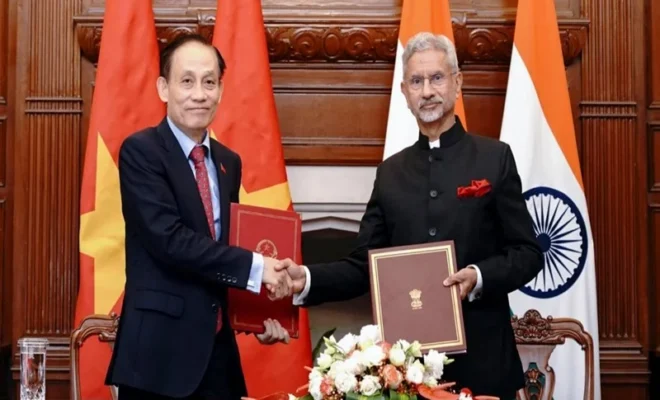
The two countries have reached an agreement on increasing cooperation in areas of defence and security, including joint development of Indian defence products at the 19th India-Vietnam Joint Commission meeting, which was held in New Delhi on September 14, 2026. The meeting involved discussions on various issues such as defence, trade, technology, energy, connectivity, and regional security, and was co-chaired by External Affairs Minister S. Jaishankar and Vietnamese Foreign Minister Le Hoai Trung.
This comes as the two nations continue to look for ways of expanding their Enhanced Comprehensive Strategic Partnership and boosting cooperation in the Indo-Pacific region. It is important to note that according to the official Indian statement, the defence cooperation agreement aims to increase cooperation “including through co-production of Indian defence items.”
What Was Agreed at the 19th Joint Commission Meeting?
This Joint Commission was not confined only to military cooperation, however. The two nations discussed the whole spectrum of their bilateral relationship and came up with several sectors in which greater cooperation could be achieved.
As far as the field of defence and security was concerned, it was decided to consolidate all existing cooperation, including the joint production of defence equipment made in India. In addition to this, the two nations also explored the possibility of expanding economic ties between the two nations, creating beneficial economic linkages and providing better market access to Indian marine, agriculture and pharmaceutical products in Vietnam.
Air and port connectivity, nuclear energy, space cooperation, heritage conservation, standards of seafarers, capacity building and people-to-people connections were other subjects discussed by the two nations. It was further agreed by both the nations that 2027 would be celebrated as the Year of India-Vietnam friendship.
What Does Joint Production of Defence Equipment Mean?
The concept of “joint production” is crucial as it involves more than just the acquisition of defence hardware from the other nation.
In terms of co-production, there is the potential for collaboration between India and Vietnam regarding the production and technologies that may be involved in the manufacturing of the defence products. There was no mention of which equipment or production agreement was reached in the joint commission’s press release, and therefore it will be too early to characterize this move as a definite agreement to jointly produce any missile, plane or naval system.
Nonetheless, this is a new trend in their military-industrial relationship.
Why Vietnam Is Important to India’s Defence Strategy
Vietnam is now an indispensable partner in India’s policy of Act East and also in India’s Indo-Pacific approach as articulated by Foreign Minister Jaishankar, who referred to Vietnam as an important partner of India under its Act East Policy and Indo-Pacific approach.
Moreover, India-Vietnam relations have been moving away from conventional diplomatic engagements to practical cooperation in defence technology, maritime security, military cooperation and defence manufacturing.
Furthermore, the timing is also important since India and Vietnam share a keen interest in having a peaceful and rules-based Indo-Pacific region. In their recent meetings, they have discussed issues of maritime security and regional developments in relation to the South China Sea.
How This Builds on Existing Defence Cooperation
However, the recent development is not the start of the defense relationship between India and Vietnam. It should be noted that both countries have established military exchanges, training programs, joint exercises and defense industrial cooperation.
Only one day prior to the meeting of the Joint Commission, India’s Defense Secretary Rajesh Kumar Singh had a meeting with Senior Lieutenant General Nguyen Truong Thang, Deputy Minister of National Defense of Vietnam in New Delhi. The discussion was concentrated on speeding up joint efforts in technology transfer and defense industry cooperation.
Moreover, India and Vietnam decided to conduct the next Defense Policy Dialogue in India during Aero India 2027.
Why “Made in India” Defence Equipment Matters
The Joint Commission declaration makes specific mention of the co-production of Indian defense equipment, although India has pointed out that the supply of Made-in-India defense equipment to Vietnam needs to be increased.
Deeper defense-industrial cooperation between India and Vietnam would help India further widen the international presence of its defense manufacturing industry. For Vietnam, it would help improve its own defense capabilities through access to Indian defense technology and equipment.
An industrial connection has become necessary in the context of India’s overall drive towards indigenous manufacture and export of defense equipment.
Maritime Security Dimension
Maritime cooperation is a significant component of the India-Vietnam relationship in light of the maritime importance of the Indo-Pacific region and the maritime routes surrounding it for both countries.
Recent India-Vietnam defense talks have focused on maritime cooperation, technology transfer and regional security. The Defense Ministry of India has mentioned that both the countries wish to enhance practical cooperation through the ASEAN-led mechanisms such as the ASEAN Defence Ministers’ Meeting Plus.
Thus, the defense relationship between India and Vietnam is not confined to weapon systems and defense equipment alone.
Defence Is Only One Part of a Bigger Partnership
This latest engagement has shown that there is an attempt being made by India and Vietnam to further enhance the relationship between the two nations in various economic and technological sectors.
The topics which were discussed included better supply chains, greater market access, air connectivity, nuclear energy cooperation and cooperation in space. Also, discussions took place on possibilities to increase the trade and investments between the two countries.
As part of their economic strategy, India and Vietnam aim at reaching a goal of having annual bilateral trade worth $25 billion by 2030.
What Next?
The next step would be the implementation of the general pledges made during the Joint Commission meeting into concrete projects and agreements.
The official statement makes no mention of any particular defence system for joint production as well as there is no timeline and financial cost associated with the deal. Hence, further consultations between the defence and industry experts would be required in order to decide on the future course of action under this agreement.
The scheduled Defence Policy Dialogue during Aero India 2027 would be one such occasion.
Conclusion
This new India-Vietnam defence agreement made at the 19th Joint Commission Meeting reflects a step towards greater industrial and security cooperation, whereby co-production of India’s defence equipment emerges as one such area of collaboration.
This particular agreement forms only one aspect of a far larger engagement which includes trade, technology, maritime security, connectivity, energy, and space cooperation. Although there have been no specifics from either government regarding the type of weapons or projects in this regard, the agreement to co-produce comes as yet another development in the growth of India-Vietnam Enhanced Comprehensive Strategic Partnership.
Stay Updated on India’s Biggest Financial Developments
Will Bank Unions Resume Their Strike?
Check out why the nationwide strike call was suspended and what happens next.
What Changes Are Coming From SEBI?
Find out how CAS and derivatives rules could affect retail investors.
How Is FBI Tackling Financial Fraud?
Uncover the latest developments in the global hunt for cross-border fraud.
What Are UPI’s New Transaction Limits?
Browse NPCI’s latest daily limits and security features for safer payments.
What Does “Humanity First” Mean?
Dive into India’s BRICS chairship and its significance amid global sanctions.