
India’s BRICS Chairship and the Meaning of “Humanity First” in a Sanctions-Hit World
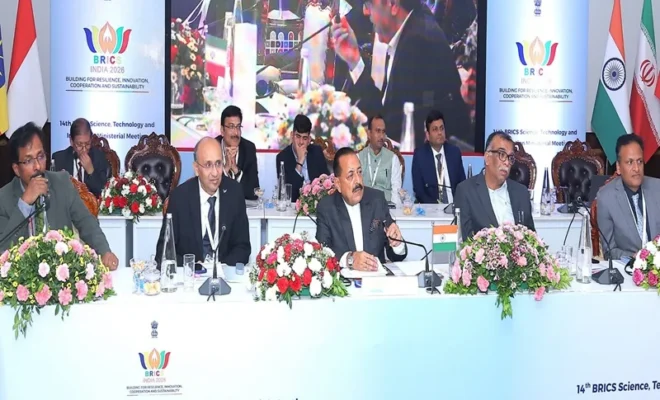
The BRICS chairmanship of India in 2026 comes at a time when the international order is facing multiple tests from geopolitical conflicts, economic uncertainties, disruptions in supply chains, environmental challenges, technology changes and widening development differentials. In this context, India has adopted a people-centric approach to the leadership of BRICS, which it terms “Humanity First.”
In adopting this “Building for Resilience, Innovation, Cooperation and Sustainability” as the theme of its chairmanship, India hopes to use the platform of BRICS to be more practical, development-focused and responsive to the issues of common citizens. While launching the Indian logo, theme and website for BRICS 2026 in January, the Minister of External Affairs S. Jaishankar emphasized that BRICS was a major platform of dialogue, cooperation and response to the challenges faced together.
As late as August, the Ministry of External Affairs had highlighted that there were hundreds of events held in India on the three foundational pillars of BRICS: political and security cooperation; economic and financial cooperation; cultural and people-to-people exchanges. MEA Secretary and BRICS Sherpa Sudhakar Dalela has repeatedly stressed that the Indian chairmanship of BRICS would follow a people-centric approach based on the “Humanity First” principle.
This approach takes on its full meaning only if one sees BRICS not just as a grouping of emerging nations, but as a platform that is increasingly getting engaged in discussions on how the international order should be reconfigured or reshaped.
“Humanity First” Is About Development, Not Just Diplomacy
First, the core principle behind India’s position is that international cooperation should ultimately be assessed based on its impact on individuals. This implies that discussions regarding trade, finance, technology, health, food security, and energy cannot be left in the exclusive domain of official state-to-state negotiations.
In terms of implementation, India’s BRICS agenda highlights such areas of cooperation as resilience, innovation, cooperation and sustainability. In essence, the first area involves building up resistance against shocks; the second – applying technology for the purposes of development; the third one refers to bridging the growing divergence between BRICS members; and the last one stresses economic and environmental sustainability as an essential part of policymaking.
This particular emphasis on individuals is especially apparent in regard to the health and labor tracks. In the context of health, India’s BRICS agenda encompasses such areas as digital health infrastructure, pandemic preparedness, cost-effective healthcare, mental well-being, healthy lifestyles, and cooperation among public health agencies.
As for the labor track, the BRICS Labor and Employment Ministers’ Meeting held in Hyderabad involved such priorities as social protection, labor market formalization, female participation in labor market, skills, and digital technologies. It is noteworthy that the Indian delegation called this work as part of people-centric chairmanship, which is based on the principle of “Humanity First.”
Overall, it is quite clear what India wants to say: BRICS should not become just another forum of declarations, which are out of touch with the real economic life of people.
The Sanctions Question Changes the Conversation
“Humanity First” formula also gains importance in an international context where sanctions and other economic measures have become increasingly important tools of statesmanship.
BRICS members have consistently been worried about unilateral economic coercion and its impact on development, health, and food security. The Rio de Janeiro declaration, endorsed during the Brazilian chairship in 2025, said unilateral and secondary sanctions could have far-reaching implications for the population, especially for vulnerable sections, and reiterated the stance of the grouping vis-a-vis sanctions which were not endorsed by the UN Security Council.
The current chairmanship of India cannot overcome the differences existing in the political realm among BRICS members. “Humanity First” concept does not mean BRICS has now become politically homogenous. There are many countries in BRICS with different foreign policy and economic priorities.
That diversity is precisely why India’s approach matters.
Rather than attempting to manufacture complete political agreement, New Delhi appears to be emphasising areas where cooperation remains possible despite disagreement. Health, food security, disaster preparedness, supply chains, digital infrastructure, trade and development offer practical avenues for countries to work together without requiring identical positions on every geopolitical question.
From Rhetoric to Resilience
Indeed, the idea of resilience becomes even more significant in the modern globalised environment, in which disruption can be transnational.
Any conflict can have an impact on fuel prices several thousand miles away; any interruption in key shipping routes can increase the cost of transport across continents; any disease outbreak can put stress on the health sector and interrupt economic activity. Any climate catastrophe can have an adverse effect on food production and infrastructure.
India’s BRICS agenda acknowledges these linkages.
As a consequence, during its tenure India has promoted cooperation in diverse fields such as agriculture, disaster risk reduction, energy and resilience of supply chains. In addition to that, the Foreign Ministers’ statement included climate, biodiversity, artificial intelligence, energy security, food security and supply chain resilience.
In this context, “Humanity First” takes on a more practical meaning.
Innovation With a Human Purpose
Technology is yet another important challenge for the humanity first approach.
Artificial Intelligence, digital public infrastructure, and other emerging technologies can greatly enhance productivity and service access. However, their impact can be negative, should the benefits stay limited to the most technologically advanced countries and population groups.
India’s BRICS strategy aims at making innovation part of the development agenda. Thus, BRICS Foreign Ministers‘ discussion covered cooperation in the field of artificial intelligence, as well as a human-centric approach to emerging technologies. Digital public infrastructure and cooperation of startups and SMEs have also been covered in the BRICS chairship agenda.
India’s own experience with digital public infrastructure makes such discussion especially relevant. The general issue for BRICS is whether technological innovation can be made sufficiently accessible to become an instrument of development and not another factor of global inequality.
This issue will become more and more relevant with the development of AI’s impact on employment, healthcare, education, finance and public administration.
Trade as a Tool for Inclusion
Another domain where India seeks to make the BRICS agenda pragmatic is economic cooperation.
During the BRICS Trade Ministers’ Meeting held in Jaipur in August, the countries have made progress towards finalizing the Strategy for BRICS Economic Partnership 2030 and agreed upon principles that will ensure better access to financing by small businesses. The other focus was placed on increased service trade and resilient and diversified global value chains.
The importance of this initiative is reflected in who will reap its benefits.
The trade policy can be talked about using the vocabulary of tariffs, market access, and macroeconomic data. Increasingly, India’s diplomatic approach is linking these matters with MSMEs, women-owned businesses, youth entrepreneurship, and employment opportunities.
This is an important change of focus. The resiliency of the global economy does not equate with the resiliency of corporations or stock markets. It should also include resilient livelihoods.
BRICS as a Voice for the Global South
It should also be noted that India’s chairmanship of the organization takes place against the backdrop of the considerable expansion of BRICS itself. The organization now includes Brazil, Russia, India, China, South Africa, Egypt, Ethiopia, UAE and Indonesia, forming a larger platform of representatives from various regions of the Global South. The official position of India regarding BRICS sees the potential of the organization in increasing inclusiveness in global governance, but not in being an alternative to the existing system of global governance.
It should be noted that such an approach is essential.
India is not presenting BRICS as an alternative bloc. India’s chairmanship of the organization emphasized the need for reform of global governance systems and the role of international financial institutions and the UN Security Council in this process, but at the same time continuing to use the multilateralism framework.
Explore the key BRICS developments shaping India’s global diplomacy.
Why Is Doval in Beijing Now?
Check out what the 25th India-China border talks could mean for bilateral ties.
What Matters at BRICS Sports Meet?
Find the key agenda, participating nations, and significance of India’s 2026 meeting.
Why Reform Global Finance Now?
Uncover Jaishankar’s call for changes to the global financial architecture.
Can India and Bangladesh Reset Ties?
Browse the latest signals pointing toward renewed India-Bangladesh cooperation.
What Does Putin’s BRICS Banknote Signal?
See why the BRICS banknote reveal could carry wider economic significance.
The Real Test Will Be Delivery
The Indian chairmanship of BRICS has already yielded a comprehensive program that includes hundreds of meetings in various Indian cities, in addition to more than 20 ministerial themes to prepare the leaders’ meeting at the end of this year.
However, “Humanity First” will be tested ultimately not by the sheer number of meetings conducted or declarations made.
“Humanity First” will be measured by tangible achievements in areas such as health care, food and energy security, job creation, access to technology, disaster management, and opportunities for development economies, among others.
This is significant since there are contradictions within BRICS itself. Its member states have divergent strategic interests, varying political systems, and even sometimes differing stances on global issues. The Indian chairmanship will not be able to overcome these contradictions.
What it can achieve is pragmatic cooperation based on shared interests.
A More Practical BRICS
In light of India’s 2026 chairship of BRICS, there will be an opportunity to make the organization more of an international cooperation body and less of an abstract geopolitical positioning body.
The “Humanity First” philosophy gives a great guideline for judging any action: Does it increase resilience of people, does it create more opportunities for people, does it make technology accessible for people, does it increase healthcare, does it preserve livelihoods, or economic stability?
And if the answer to any of the aforementioned questions is yes, then BRICS is no longer just a platform where rising powers are supposed to come together and discuss their issues. Rather, BRICS becomes an instrument by which countries with a significant part of the world population can try to solve global issues that are hard to solve individually.
Conclusion
It is quite evident that India’s BRICS chairship comes at a time when the world is facing very complicated challenges such as sanctions, wars, fragmentation of the international community, technological disruptions, and uneven development.
Instead of trying to ignore all those divisions, India tries to make some pragmatic cooperation spaces among countries despite all those problems.
Therefore, “Humanity First” can be regarded as a wider proposal stating that legitimacy of international cooperation lies in its capacity to serve people.
The current task of India is to turn the aforementioned philosophy into tangible results such as better health care systems, resilient supply chains, responsible technology, energy and food security, and increased representation of developing economies.