
Indian Space Startup TakeMe2Space Prepares Edge-AI Satellite Launch on SpaceX
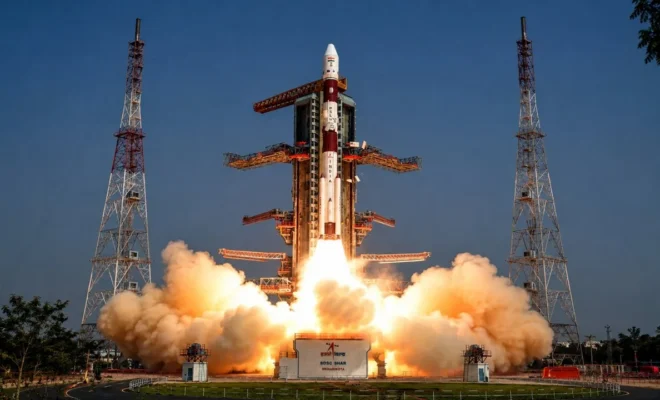
Indian private space industry is set to achieve another landmark accomplishment soon as Hyderabad-based company TakeMe2Space is gearing up to send its satellite MOI-1A on board a SpaceX vehicle. The mission is expected to take place on October 1, 2026 and will be one of the payloads for SpaceX’s Transporter-18 rideshare mission.
The most distinctive feature of MOI-1A is that it was not designed solely to take pictures and transfer a massive amount of raw data back to Earth. The satellite has been designed with the capability of processing data in orbit using artificial intelligence computing hardware and delivering useful information to the users.
TakeMe2Space says that this satellite is the first Indian orbital computing satellite.
What Is TakeMe2Space?
TakeMe2Space is a space start-up based out of Hyderabad in India, whose focus is on orbital computing as well as the infrastructure of space-based data centres.
The company works to develop satellites that are able to carry out computing functions when in space instead of depending on computing when data is transferred from space to Earth.
This start-up aims to develop data centers in space where the processing of Earth observation data takes place near the source of origin.
Ronak Kumar Samantray, who is the founder as well as the CEO of the company, has stated that the technology aims to make data processing from satellites fast and efficient because of less transfer of raw data to Earth.
What is MOI-1A?
The MOI-1A is an under 50 kg satellite that was made specially for computing in orbit. This satellite will be equipped with NVIDIA Orin NX processors that will allow the running of AI models onboard the satellite itself.
At the same time, this satellite has a multispectral imaging device that allows it to collect Earth observation data and compute this data while in space orbit.
It means that a new paradigm of satellite data collection has been created where a satellite collects and computes some data rather than just collecting a lot of data and transferring it for further computation.
How Does Edge AI in Space Work?
The idea is fairly straightforward but has significant technological implications.
Typically, an earth observation satellite gathers data and sends it back to a ground station. This might take quite a lot of bandwidth, especially in the case of satellites that capture very high-resolution images over vast regions.
In the case of edge computing, some of the processing would take place on board the satellite.
Using MOI-1A, data may be gathered from a certain region and analyzed using an AI model created by a user to provide results on Earth rather than sending all the gathered data.
Reuters noted that customers would be able to upload containerized AI models on the satellite.
Why Processing Data in Orbit Matters
The greatest benefit is the possibility of reduced data transmission needs.
Consider a scenario where the satellite collects thousands of images over a farming area. The traditional method will involve sending all these images to earth and then the software analyses the images to determine the presence of crop stress, any change in land use, etc.
However, with Orbital AI, the satellite would be able to analyze the images and only transmit useful data.
TakeMe2Space claims that their OrbitLab allows users to upload their AI models and run them in the satellite, stating that it reduces the cost of data transmission significantly.
This concept is more pertinent now because of the rising amount of data generated by earth observation satellites.
Who Could Use the Technology?
According to Reuters, 23 customers have been secured for the MOI-1A mission by TakeMe2Space already. The customers include institutions related to geographic information systems and education, while applications related to businesses include agriculture, mining, logistics, and insurance.
For agriculture, the application of orbital AI can be used to recognize patterns in extensive farmlands. The mining companies can use processed images from satellites to monitor sites, while insurers may find it helpful in analyzing geographic or environmental information.
The crucial aspect here is that the satellite is not just taking pictures. It is designed to transform satellite data into useful information before transmitting it to Earth.
What Happened to TakeMe2Space’s Earlier Satellite?
The coming mission comes with its own interesting back story.
TakeMe2Space had earlier proven its capability of orbital computing towards the end of 2024. They had been able to demonstrate how software could be loaded, computation carried out in orbit and results downloaded.
Unfortunately, their later MOI-1 satellite ended up being lost following a failure of the third stage during the ISRO PSLV-C62 mission of January 2026. The coming MOI-1A is, in essence, an effort to put the idea of orbital computing into practical use.
The choice of flying the replacement satellite under SpaceX’s Transporter-18 mission comes with great significance for the company.
Why SpaceX’s Transporter-18 Mission Matters
MOI-1A will be launched via SpaceX’s Transporter-18 rideshare program, providing TakeMe2Space with orbital access without the need for a dedicated launch vehicle for their smaller satellite.
The increasing significance of rideshare programs for space startups lies in the fact that this makes it possible for space startups to launch satellites into space along with other satellites.
India’s emerging private space industry is shown to be more integrated within the international space industry by the fact that Indian startups now have access to global launch facilities.
Is MOI-1A Actually a Data Centre in Space?
Not really. That is why the difference is crucial.
MOI-1A is actually an orbiting computer satellite, and not a big orbiting data center similar to those that are currently being developed by some bigger technology corporations.
According to Reuters, the space vessel has around 150 watts of electricity, and its on-board computer is meant for edge computing.
The ultimate aim of TakeMe2Space is to develop larger satellites in the future, and the corporation has also announced some plans related to large orbital data centers.
What Comes Next for TakeMe2Space?
Beyond the current stage of building a single satellite, the plans of the startup are more long-term.
According to TakeMe2Space, it aims at further expansion of its orbital-computing constellation, with bigger satellites expected after 2027. It has also mentioned potential usage of orbital cold storage for important information, possibly including examples from financial services and defence areas.
According to the roadmap of the company itself, the plan is to build a six-satellite constellation for extended coverage and orbital computing.
Thus, MOI-1A can potentially be a bridge towards much bigger space computer infrastructure.
Why This Mission Matters for India
The Indian space industry had traditionally been focused on government initiatives, especially through ISRO. The rise of Indian ventures such as TakeMe2Space is indicative of the growing role of private companies in the development of space-related technologies.
The importance of the MOI-1A initiative thus transcends one satellite.
This is an effort made by an Indian venture to create a new kind of infrastructure where space observation and artificial intelligence computing go hand-in-hand.
In case of success, the technology can show that Indian ventures can create commercially relevant technologies around satellite data and not just participate in launching satellites or building satellites.
Conclusion
MOI-1A Mission of TakeMe2Space is a fascinating case in the new paradigm of satellite data management.
While in the past massive amounts of data would be transmitted to the ground to be processed there later, now the satellite would try to analyze it in orbit through edge computing powered by NVIDIA.
October 1st SpaceX Transporter-18 launch, therefore, goes beyond being just one more rideshare flight. It is the trial for the potential of space-based AI computation as an industry-relevant service.
India’s Space Race Is Entering a New Era
How Is Skyroot Expanding India’s Space-Tech?
Check out Skyroot’s latest ₹403 crore funding and growth plans.
What Makes GalaxEye’s Patent Significant?
Find out how its new US patent advances satellite imaging.
What Happened During Vikram-1 Integration?
Uncover the latest Vikram-1 developments and India’s private space race.
When Will Skyroot’s Vikram-1 Launch?
Explore its mission goals, launch timeline, and rocket technology.
Why Are Indian Space Scientists Leaving?
Look into the reasons behind voluntary retirements and ISRO’s tightened exit rules.