
Weaponising Water or Protecting Rights? Decoding India’s Firm Stand on the Indus Waters Treaty
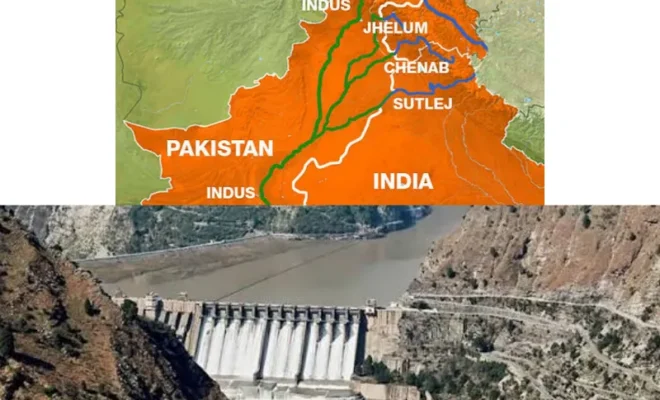
Water does not only serve as a resource for South Asia; it has to ensure food security for agriculture for millions of people and also serves to stabilize economies. The river system of the Indus holds special significance for both India and Pakistan as a strategic resource. Even through many wars, conflicts, diplomatic crisis, and decades of political tensions, the Indus Water Treaty (IWT), signed way back in 1960, has stood the test of time. But now, India’s decision to suspend the treaty following the terrorist attack of April 2025 in Pahalgam has changed everything. It has created a new paradigm of water sharing and national security.
The stance taken by India raises a question that has become very relevant: Is it possible to maintain water agreements while the neighbouring country engages in terrorist activities? The answer of the Government of New Delhi to the above question has been quite clear-cut.
Understanding the Indus Waters Treaty and Its Strategic Importance
Indus Waters Treaty was signed between India and Pakistan on 19 September 1960 and involved World Bank in mediation process. This treaty envisaged a plan for utilizing waters of six rivers – Indus, Jhelum, Chenab, Ravi, Beas and Sutlej.
As per the agreement, India held the primary right over eastern rivers that include Ravi, Beas and Sutlej, while Pakistan held primary rights over western rivers comprising of Indus, Jhelum and Chenab. However, India did have certain allowed uses of western rivers’ water including for irrigation and power generation purposes.
This is one of the best examples of making a deal of natural resources when the two countries possess hostile political relations.
However, changing security issues, growing need of water and development priorities of India have raised questions about the treaty.
Why India Placed the Indus Waters Treaty in Abeyance
It should be noted that the direct reason for such changes was the terrorist attack in Pahalgam, Jammu & Kashmir, on April 22, 2025, which claimed 26 lives. In this regard, India decided to suspend the Indus Water Treaty unless Pakistan gives up terrorism once and for all.
This step is the indicator of the general change in the approach of the Indian foreign policy towards Pakistan. The primary cause of this step is that cooperation in usual terms is impossible without taking into account terrorism.
Certainly, in the opinion of India, cooperation in water resources cannot be isolated from security. In such a case, the implementation of the treaty without addressing the security issues would be irrational.
However, one needs to note that the suspension of the treaty does not mean cutting off of water flow physically. Pakistan continues to receive water from the Indus rivers.
International Arbitration and India’s Legal Position
This action of India has raised many legal disputes in the international arena. In a decision on 31 August 2026, the Permanent Court of Arbitration in The Hague has determined that the Indus Waters Treaty is wholly in operation and that India’s action does not constitute sufficient grounds for suspending or abrogating its commitments under the treaty.
The tribunal has provided temporary guidelines concerning the project of India’s Ratle hydroelectric power plant on river Chenab.
However, India has rejected this decision saying that it has been rendered by a “court” illegally constituted and that it has not recognized its jurisdiction. India has argued that this process violates the dispute resolution mechanism under the treaty.
PCA-CPA+2
This case reveals one of the major problems, namely there is no common legal understanding of the treaty and dispute resolution mechanisms between India and Pakistan.
iIs Water Becoming a Geopolitical Instrument?
It has been stated that the abrogation of the Indus Water Treaty may lead to turning the common natural resource into political instrument. Indeed, it is worth noting that the agricultural industry, drinking water, and energy sector of Pakistan are greatly dependent on the water of the Indus Basin. There might be some economic and humanitarian concerns in case of any doubts related to the water supply.
However, it would not be correct to consider the Indian standpoint without taking into account its needs in regard to water security. The region of Jammu and Kashmir has great hydropower potential but there are many obstacles related to implementation of some projects because of technical and treaty issues.
Thus, the usage of water resources, which India can use according to the treaty, is a legitimate interest of this country. However, it should be clear what a proper usage of water resources and an artificial shortage of water are.
Why India Needs a Long-Term Water Security Strategy
As such, the Indian policy concerning the Indus will have to go beyond mere diplomacy and work on its internal water infrastructure including hydroelectric power generation, dam building, irrigation, and flood management.
Moreover, there is the challenge of climate change which is an additional complication for this problem since there is a changing pattern of rainfall, melting of glaciers, and unpredictable floods. Scientific management of water resources is needed in both countries.
Lastly, any development activities carried out by India have to be sustainable in terms of environmental concerns and engineering.
Beyond the Treaty: Protecting National Interests and Water Rights
The question of Indus Waters Treaty dispute raises a general question concerning the relationship between international cooperation and national security, taking into account the firm stance of India in this dispute.
However, water is one of natural resources which can never be considered out of the context of the general issues of security.
It is necessary for India to defend its own national interests, to have an opportunity to develop the use of water resources and to ensure its own security, but not to exploit them in excessive quantities.
Indian-Pakistani relations in the field of water will depend on the ability of the parties to change their attitude to confrontation and adopt a sustainable policy approach, considering security, water rights and climate change issues.
In any case, it is important to ensure that the security, development and proper river management remain the priorities of India.
Gaming, Global Diplomacy, OTT Awards, Luxury Cars & Space Exploration
What Makes GTA 6’s India Launch a Major Gaming Event?
Explore the reported launch details, check PS5 and Xbox pricing, discover the 212GB storage requirement, and understand the midnight rollout highlights.
What Will India and Japan Discuss at the 2+2 Ministerial Dialogue?
Discover the key defence and strategic cooperation priorities, explore the bilateral agenda, and understand how the dialogue could shape India-Japan relations.
Which Indian Web Series Are Nominated for IFFI 2026 OTT Awards?
Explore the five nominated web series, discover their recognition ahead of the Goa Film Festival, and find out what to expect from the November 20–28 event.
What Makes the Range Rover SV Sawai Collection Special?
Discover the bespoke luxury SUV’s first-look details, explore its exclusive design elements, and understand what sets this special collection apart.
How Far Has Voyager 1 Travelled from Earth?
Explore NASA’s historic light-day milestone, understand what the distance means in space exploration, and discover how the legendary spacecraft continues its journey beyond the Solar System.