
ISRO Vikram-1 Rocket Integration: What Happened at Sriharikota and What Comes Next for India’s Private Space Race?
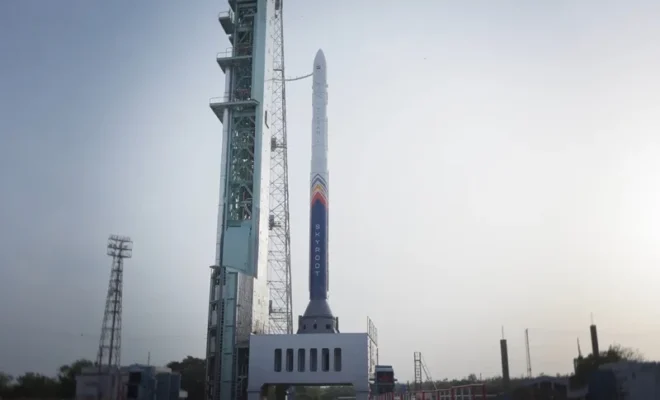
The private space industry of India has achieved a landmark success through the successful orbital insertion of Vikram-1 rocket built by Skyroot Aerospace. The rocket was launched from the Satish Dhawan Space Centre at Sriharikota on July 18, 2026, at 12:05:30 PM IST. This marks the first-ever private Indian rocket launch to orbit from Indian soil.
This success marks the completion of many months of rigorous efforts involved in the construction, assembly, testing, and finally launching of the rocket from Sriharikota. What was referred to as the rocket being in its “final integration phase” before is now an accomplishment. It is now time to examine the importance of the journey taken by Vikram-1.
What Is Vikram-1?
Vikram-1 is a four-stage rocket that has been built by Skyroot Aerospace based out of Hyderabad. This rocket has three solid fuel stages and an upper liquid fuel stage meant for precise orbital insertion.
This rocket belongs to the Vikram rocket series of the launch vehicles from Skyroot, named after Vikram Sarabhai, who was one of the pioneers of the Indian Space Program. Vikram-S had already been successfully launched by Skyroot as the first Indian rocket in a privately led venture in space in 2022.
What Happened During Final Integration?
Before being launched, Vikram-1 had to be assembled piece by piece at Sriharikota and be put through rigorous testing. One of the critical events before this took place in June when Skyroot successfully integrated the rocket’s second stage called Kalam-250.
The stage is powered by a solid-fueled engine that can generate up to 235 kilonewtons of vacuum thrust for about 85 seconds. It has a flexible nozzle that enables the guidance system to adjust the trajectory of the rocket while in flight.
After that, all the other stages were integrated as the vehicle was assembled for launch. By July, the seven-story rocket was already fully assembled in the launch pad with a crew prepared to launch the mission.
Why Was Sriharikota So Important?
This mission was carried out from the Satish Dhawan Space Center, the main launch site in India used for the orbital missions of ISRO.
It is the use of private development together with publicly owned infrastructure that sets this mission apart. ISRO and IN-SPACe have facilitated the work of Skyroot with respect to providing access to facilities, testing infrastructure, technical consultations, and launch services.
ISRO claims that the facilities were used for solid motor casting and testing, whereas the liquid upper stage engine was tested at the Liquid Propulsion Systems Center. Finally, the vehicle was assembled at the First Launch Pad at Sriharikota.
What Did Vikram-1 Deliver?
As part of the Aagaman mission, several payloads were launched into Low Earth Orbit, including Skyroot’s SCOPE satellite and Grahaa Space’s SOLARAS S3 satellite. ISRO stated that two satellites were successfully placed into orbit, while other payloads located on the upper stage would be used for in-orbit experiments.
In total, the mission was planned for the orbit at about 450 km. In fact, the choice of payload shows what kind of dedicated market of launches Skyroot intends to develop.
Why Is the Launch a Big Deal for India?
The significance of Vikram-1 is not limited to one rocket alone or just one company.
For years, India’s orbital launch capability was known in the context of government-led space missions. With the emergence of private launch rockets, the scenario takes a different shape altogether as a new dimension gets added to India’s space domain.
ISRO highlighted that the mission launched on July 18 was the first time that an Indian private company conducted an orbital launch from the country’s territory. According to ISRO, the success story may pave way for such projects and opportunities in the future.
This is a result of the reform package introduced in the space sector in 2020 when India made the space sector open to private investment.
What Happens After Vikram-1?
The successful test flight is not the final chapter in the story of Vikram-1. It is just the beginning of a new phase.
Skyroot had indicated that Aagaman was the first of three planned development flights for Vikram-1 prior to the company moving to commercial missions. As mentioned above, Skyroot has also stated its plans to increase its launch pace to about one orbital rocket a month once its manufacturing operations reach scale.
The data collected during the maiden orbital flight would be very crucial. Data collected from the mission would help engineers to study the performance of the rocket during the ascent phase, stage separation, guidance, upper-stage operations and payload release.
The Future of Skyroot
Skyroot has already begun looking ahead from Vikram-1.
The company had talked about its future plans for the development of bigger rockets with higher payload capacity as well as reusable rocket technology which can lead to reducing costs.
The ultimate aim of Skyroot is the creation of a commercial launch business offering customized access to orbit for satellite companies all around the world.
What Does This Mean for ISRO?
The Vikram-1 launch is not meant to take away ISRO’s position. It proves that both India’s public and private space sectors can function under the same umbrella.
ISRO will be able to concentrate on the national projects, scientific research, manned space flight and rocket launches, while private companies will focus on developing the commercial space launch services and technology.
Thus, the successful Vikram-1 mission indicates a larger trend towards change of India’s space policy, where the government continues to be a driving technological and infrastructural power, while the private companies become launch-service providers.
The Big Picture
The Vikram-1 journey started with the dreams of the young private space company and ended with the first orbital launch from Sriharikota.
The fact that the rocket launch was successful shows that Indian private space sector has left the stage of prototypes and demonstrations to enter the sphere of real operation. This is confirmed by ISRO’s evaluation of the mission as opening the door for similar projects and commercial opportunities.
The next step would be proving consistency. One successful orbital launch establishes the company’s credibility; several successful launches will determine its competitiveness.
Don’t miss these trending space and innovation stories shaping India’s future.
What makes Vikram-1 launch significant?
Check out the mission goals, launch schedule, and breakthrough technology behind Skyroot Aerospace’s Vikram-1 rocket.
How did students build satellite?
Find the inspiring story of 750 school girls contributing to a satellite set to launch aboard ISRO’s smallest rocket.
Why are ISRO scientists resigning?
Uncover the reasons behind stricter ISRO exit rules and the wave of voluntary retirements among Indian space scientists.
What comes after ISRO hiatus?
See how ISRO is preparing for three major rocket launches as India’s space program regains momentum after the pandemic pause.
Can India become global tech hub?
Dive into the factors driving India’s booming startup ecosystem and its potential to emerge as the world’s next major technology powerhouse.
Conclusion
The last integration process of Vikram-1 rocket was an important process but now that is history for us. The rocket successfully took off on 18th July 2026 and orbited, making Skyroot the first private company of India to launch rockets from the Indian soil.
The true story lies ahead where analyzing the flight data, verification of vehicle, planning further development missions and establishing commercial launch service will be the agenda.
The success of Vikram-1 launch is not only the success of the launch but it was a test of India’s new space ecosystem to establish the capability from private sector.
Vikram-1 has already crossed the milestone of launching from the launchpad. The next milestone will be whether Skyroot will be able to convert this first flight of theirs into a commercial success.