
Taiwan Approves Record Defense Budget With Drone Allocation Amid Rising Cross-Strait Tension
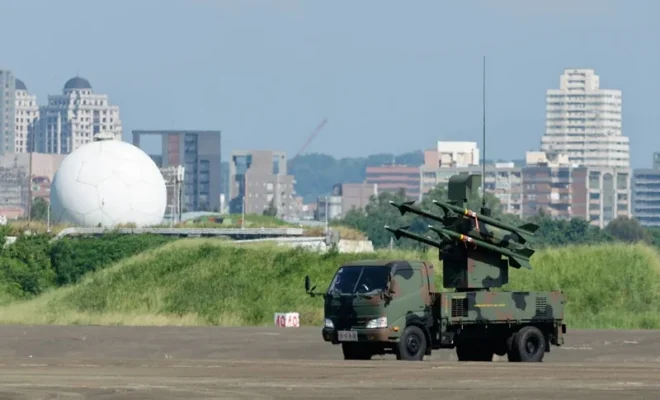
Finally, after an unprecedented long wait, the Taiwanese government budget for 2026 has been ratified. This development marks the end of the months-long deadlock between the ruling Democratic Progressive Party and the opposition-held parliament. The timing of this news is especially significant since Taiwan continues to improve its defensive capabilities in response to Chinese pressure.
The most anticipated item in the new budget concerns funding for the purchase of drones. Despite the cutback of NT$48 billion out of the government’s initial NT$3.034 trillion request, the budget allocated NT$63.4 billion for the development and purchase of drones remains unchanged.
Why Taiwan’s 2026 Budget Was Delayed
Taiwan’s budget was expected to be passed by the end of 2025; however, disagreements between President Lai Ching-te’s government and the majority of the opposition in parliament continually undermined efforts towards reaching a final decision on the issue.
As a result of losing the parliamentary majority during the 2024 election, the KMT and Taiwan People’s Party gained leverage over Taiwan’s government budget. Several aspects of the proposed budget raised concern from the opposition, with the opponents claiming that some expenditures were too high or too poorly justified.
Defence budget is one of the items where the opposition has made significant demands. Although the administration of President Lai claims that there is a need for the country to speed up its military modernisation due to growing military capabilities of China, there is significant opposition to some elements of the government proposals.
Despite the long-running debate, government functions continued since last year’s budget was in effect. Consequently, the passing of the budget eliminates one of the domestic obstacles of Taiwan’s defence planning.
The NT$63.4 Billion Drone Allocation
The key thing to note in relation to the new budget passed is the survival of Taiwan’s drone program in face of parliament cuts.
As the new budget, it will allocate NT$63.4 billion to drone industry development and acquisition. In this regard, the KMT, which opposed the budget in the past, had been set on making major cuts on it due to possible overlapping and wastage. However, it eventually did not cut down on it after determining that there was no overlapping between the drone industry development and acquisition programs which warrant the need to reduce it.
This is a huge step forward for Taiwan, given how drones have become a cost-effective method of enhancing surveillance, reconnaissance, and defense capabilities.
In relation to its defense plans, Taiwan itself has classified military drones as an asymmetric capability which it needs. It has even announced that its Ministry of National Defense intends to acquire more than 5,000 drones across more than 13 types before 2028.
Why Drones Matter in a Taiwan-China Conflict
The geography of Taiwan provides grounds for using the drones for the purposes of defending this state. The state needs to control a significant area of sea and air approaches and prepare for a range of scenarios from protracted pressure to a potential blockade and invasion.
Drone technology may allow performing constant monitoring while providing the possibility of deploying significantly more platforms compared to expensive alternatives. Also, the use of drones creates additional complications for the enemy since it allows raising several threats that will need to be detected and neutralized.
This path is clearly indicated by recent military exercises. In the 2026 Han Kuang exercises, conducted by Taiwan, the Taiwanese military showed medium-sized strike drones developed in Taiwan for the first time. This drill was aimed at testing the possibilities of Taiwan’s reaction on the scenarios of attack through the Taiwan Strait.
The experience of the war in Ukraine has also affected the approach towards cheap drones, their mass deployment and asymmetrical warfare. Overall, for Taiwan, it means that cheap unmanned systems may perform an important role along with missiles, aircraft, ships and other military systems.
Cross-Strait Tensions Are Driving the Defence Push
This budget approval comes at a time when Taiwan is under continuous pressure by Beijing from a military and political perspective.
China has been claiming Taiwan as its territorial possession, and in recent years, it has been carrying out aggressive military activities close to the island of Taiwan. The government of Taiwan has rejected Beijing’s claims on sovereignty and, in recent times, has been concentrating on developing their capabilities for deterrence and defense purposes.
This was evident during the 2026 Han Kuang Exercises, wherein Taiwan has included civilian resilience plans, infrastructure disruption scenarios, and other scenarios of how things would be during a war scenario. They have gone to the extent of reducing the speed of internet communication in a number of places to test their capability to communicate during a war period.
The clear indication is that Taiwan is now taking defense preparations beyond the ambit of military.
The Budget Is Large, But Taiwan Is Planning an Even Bigger Increase
The passing of the budget for 2026 is not the end of the discussion on Taiwanese defence spending.
Taiwanese government is preparing the budget for 2027, which will set the record by taking Taiwan’s defence spending over NT$1 trillion. Reuters quoted sources saying that the defence budget proposal will see a 16% increase from the previous year and will exceed 3% of Taiwan’s GDP.
This will mean a significant increase in the country’s defence spending, which shows how seriously Taiwan views the current security situation.
The increase in the budget comes along with the investments in modernisation of its military, especially air and sea defence, weapons production, and asymmetric warfare including drones.
Why the US Is Watching Taiwan’s Defence Spending
The budget of defence expenditures of Taiwan is also of significant interest in Washington.
The US government has always urged Taiwan to enhance its self-defence capability and has provided it with several packages of armaments. Special attention has been paid to integrated air and missile defences and unmanned aerial systems.
Enhancing the defences of Taiwan by the US government is aimed at enhancing deterrence and complicating any military actions against Taiwan.
The growing interest of Taiwan in the development of domestic drones is a part of this overall approach because it diminishes the dependence on expensive imported platforms and allows manufacturing a large quantity of equipment domestically.
What the Budget Means for Taiwan’s Defence Strategy
The deployment of drones provides an indication that the philosophy behind the defence policy of Taiwan is shifting in nature.
Instead of focusing purely on costly military aircraft, ships, and traditional weapon platforms, Taiwan is now embracing the concept of a layered defence strategy using traditional weaponry along with numerous cheap drones.
This approach is all the more pertinent to an island surrounded by a much larger country. The aim here isn’t to counter China’s military platform by platform, but rather to ensure that Taiwan’s defence strategy can never be overpowered.
The newfound protection for the drone budget can thus be said to extend beyond just technological advances. It is one of the many steps being taken by Taiwan to ensure a resilient defence mechanism.
What Happens Next?
The next step will be implementing the plans. The fact that the funding has been approved does not mean that Taiwan is able to operate the drones.
Taiwan will have to transform the budget allocation into operational capabilities, manufacturing facilities within the country, personnel trained for operating the drones, communication networks and coordination between the drones and other military assets.
Furthermore, there will not be an end to the political discussion on the issue. There is a difference of opinion between the government and the opposition regarding defence expenditure, and the 2027 budget allocation will cause yet another big discussion in parliament.
However, at present, the budget allocation for 2026 makes sure that the barrier has been overcome.
Explore more stories shaping India’s future
Can India Win The Chip Race?
Check out how India aims to compete with global semiconductor powers.
Can India Host The 2036 Olympics?
Find out how India is preparing its nationwide talent hunt for the Olympic bid.
Why Is Meta Under Scrutiny?
Uncover what the summons could mean for social media regulation and internet freedom.
Can India Reach 100 GW?
Browse India’s ambitious nuclear expansion plan featuring five next-generation reactors.
Why Were Dark Stores Suspended?
See why Maharashtra FDA took action against Blinkit, Zepto and Instamart stores.
Conclusion
The passing of the budget by Taiwan for the long-awaited year 2026 marks a very important point for the island’s security doctrine. Despite a general decrease of NT$48 billion compared to the originally proposed budget, the NT$63.4 billion drone budget remained untouched, which means the Taiwanese government gets one step closer to funding the program.
This development marks not only a breakthrough in terms of finance but also in terms of military doctrines. In the future, drones will become a key element of asymmetric defence strategy and not a marginal weapon anymore.
Taking into consideration the increasing military pressure from China and preparation of Taipei to a new defence expenditure rise in 2027, one can assume that drones, local production, and civilian resilience will gain even greater importance in the near future.
Thus, Taiwan’s unprecedented defence drive goes beyond just buying powerful weaponry. The survival of its NT$63.4 billion drone budget is the proof of the island’s readiness to focus on technology and asymmetric defence strategy in the face of an increasingly uncertain cross-Strait future.